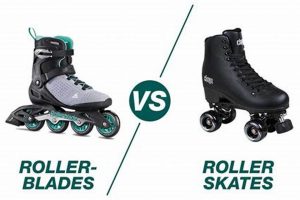
The sport involves two teams of five members skating counter-clockwise around a track. Participants, equipped with specialized footwear, strategically maneuver to facilitate scoring opportunities for their designated point scorer, known as the jammer, while simultaneously hindering the opposing team’s jammer. Effective blocking and tactical skating are crucial for success in this full-contact team activity.
Its emergence in the 1930s evolved from banked-track marathon races to a more theatrical and combative spectacle. Today, it emphasizes athleticism, strategic gameplay, and inclusivity. The modern revival has fostered strong communities and empowers individuals through teamwork, physical fitness, and self-expression. The game also presents opportunities for skill development, fostering camaraderie and promoting a physically active lifestyle.
Subsequent sections will delve into equipment specifics, gameplay rules and regulations, training regimens for athletes, and the global landscape of leagues and organizations that govern and promote this dynamic athletic pursuit. Furthermore, the article will examine the community aspects and the empowering experiences it provides for its participants.
Performance Enhancement Strategies
The following recommendations are designed to optimize skill and safety in the context of competitive team skating activities. These strategies emphasize both individual development and team coordination.
Tip 1: Focus on Fundamental Skating Proficiency: Mastering basic skating techniques, such as balance, agility, and speed, is essential. Consistent practice of these skills will improve overall performance and reduce the risk of injuries.
Tip 2: Develop Strategic Blocking Techniques: Effective blocking is crucial for team success. Learn to anticipate opponent movements, maintain a stable stance, and utilize legal blocking zones to create pathways for the jammer and impede the opposing team.
Tip 3: Enhance Jamming Agility and Speed: Jammers should prioritize speed and evasiveness. Drills that focus on quick starts, directional changes, and navigating through tight spaces are invaluable.
Tip 4: Prioritize Communication and Teamwork: Success relies on seamless coordination. Clear and concise communication between team members is essential for executing strategic plays and adapting to changing game conditions.
Tip 5: Strength and Conditioning: A dedicated strength and conditioning program can significantly improve skating power and endurance. Exercises targeting leg strength, core stability, and cardiovascular fitness are highly recommended.
Tip 6: Protective Gear Maintenance: Regularly inspect and maintain all protective gear, including helmets, mouthguards, wrist guards, elbow pads, and knee pads, to ensure optimal safety and prevent injuries.
Tip 7: Review Rules and Regulations: A thorough understanding of the official rules and regulations of the governing body is vital. This ensures fair play and avoids penalties that could disadvantage the team.
Adherence to these guidelines can lead to substantial improvements in individual performance and overall team effectiveness. Consistent practice and a dedication to these principles are key to achieving success.
The subsequent section will explore advanced strategies for competitive play and tactics for maximizing team potential.
1. Equipment Standardization

Equipment standardization within the context of roller derby is fundamental to ensuring participant safety and maintaining a level playing field. Standardized equipment, including helmets, mouthguards, wrist guards, elbow pads, knee pads, and roller skates themselves, are subject to rigorous testing and certification processes. For example, the Women’s Flat Track Derby Association (WFTDA), a prominent governing body, stipulates specific requirements for protective gear to mitigate the risk of injuries resulting from collisions and falls.
The absence of such standardization could lead to significant disparities in player safety, with some participants using inferior or inadequate protective gear. This could result in a higher incidence of injuries, potentially leading to legal liabilities for leagues and event organizers. Furthermore, non-standardized equipment could create an unfair competitive environment, where certain skaters have an undue advantage due to equipment enhancements that exceed accepted limits.
Therefore, equipment standardization is not merely a procedural formality, but rather a critical component of the sport. It is important for safeguarding player well-being, promoting equitable competition, and ensuring the long-term sustainability of roller derby as a recognized and respected athletic endeavor. Ongoing adherence to and enforcement of these standards are essential for maintaining the integrity of the sport.
2. Gameplay Regulations

Gameplay regulations in roller derby establish the boundaries within which athletic competition occurs. These rules govern legal blocking zones, scoring procedures, and penalties for infractions. A direct cause-and-effect relationship exists: adherence to these regulations promotes fair play, reduces injuries, and upholds the integrity of the sport. Conversely, disregard for these rules results in penalties that can negatively impact a team’s performance. A practical example is the prohibition of blocking with the head or below the mid-thigh, a rule designed to prevent serious injury. Without consistent enforcement of this regulation, participants face increased risk of harm, potentially deterring participation and undermining the sport’s reputation.
Moreover, gameplay regulations dictate the specific actions players can take to score points, defend against opponents, and navigate the track. These rules are not arbitrary; they are crafted to balance physical contact with strategic gameplay, ensuring the activity remains athletic rather than merely chaotic. For instance, the jammer’s ability to score a point for each opposing blocker they pass legally in a single lap incentivizes speed, agility, and strategic maneuvering while simultaneously requiring blockers to employ defensive tactics within clearly defined legal boundaries. The interplay between offensive and defensive strategies, governed by explicit rules, defines the core dynamic of the competition.
In summary, gameplay regulations are indispensable. Their precise definition and rigorous enforcement constitute a critical component that directly impacts participant safety, competitive balance, and the overall viability and reputation of the activity. Challenges persist in consistently interpreting and applying these rules across different leagues and levels of play, requiring ongoing efforts to refine and clarify the rulebook to maintain its effectiveness. This detailed understanding is essential for participation and for those interested in the sport’s nature.
3. Strategic Maneuvering

Strategic maneuvering is an indispensable component of roller derby, directly influencing team success and overall competitive outcome. The dynamic nature of the sport requires participants to execute pre-planned tactics and adapt to rapidly changing on-track conditions. Teams orchestrate sophisticated blocking formations to clear pathways for their jammer, while simultaneously impeding the opposing jammer’s progress. For example, a well-executed “wall” formation can effectively prevent an opposing jammer from passing, thereby minimizing the opponent’s scoring opportunities. These maneuvers necessitate anticipating opponents’ movements and reacting swiftly to exploit vulnerabilities. A team’s ability to coordinate and execute these strategic plays often dictates its success in a bout.
Beyond blocking tactics, strategic maneuvering also extends to jammer positioning and point-scoring strategies. Jammers must possess the agility and awareness to navigate through densely populated areas of the track, identifying gaps in the opposing team’s defense and capitalizing on scoring opportunities. Real-world examples of successful jamming strategies include using “apex jumps” to legally pass multiple blockers simultaneously or employing “whip” maneuvers to gain momentum and evade opposing skaters. Furthermore, teams strategically deploy their blockers to assist the jammer, creating screens and providing support to maximize point-scoring potential. The strategic deployment of “power jams” which are jams initiated with the team’s jammer starting in the penalty box, showcases a team’s ability to take advantage of a power play situation. These tactical decisions highlight the importance of strategic thinking in achieving competitive advantage.
In summary, strategic maneuvering is not merely an ancillary aspect; it is the bedrock upon which roller derby competitions are built. A thorough understanding of strategic principles and the ability to execute them effectively are essential for both individual skaters and entire teams. Challenges arise in developing and adapting strategic game plans to counter evolving opponent tactics. This continuing challenge underscores the need for constant evaluation and adjustment in the roller derby.
4. Physical Conditioning
Physical conditioning is a non-negotiable component of roller derby, directly impacting a skater’s ability to perform effectively and safely. The sport demands a unique blend of cardiovascular endurance, muscular strength, agility, and balance. Insufficient physical conditioning directly correlates with increased risk of injury, decreased skating proficiency, and reduced overall team performance. An example of this cause-and-effect relationship can be seen in skaters who neglect cardiovascular training; they typically experience fatigue more quickly, leading to decreased speed and impaired decision-making during gameplay. Proper conditioning, conversely, allows skaters to maintain high-intensity performance throughout an entire bout, maximizing their contribution to the team’s success.
Furthermore, targeted strength training is crucial for executing essential roller derby maneuvers such as blocking, bracing, and rapid directional changes. Lower body strength is particularly important, as it provides the power and stability required for effective skating and forceful impacts. Core strength contributes to balance and agility, enabling skaters to maintain control and avoid falls. Upper body strength, while perhaps less emphasized, is still vital for defensive maneuvers and maintaining stability during contact. Without adequate strength conditioning, skaters are more susceptible to injuries such as sprains, strains, and fractures. A dedicated conditioning program should, therefore, incorporate a comprehensive range of exercises designed to address these specific physical demands, including squats, lunges, plyometrics, and core stabilization exercises. A professional example of the importance is the rigorous training regimens imposed by professional roller derby leagues for the health and safety of participants.
In summary, physical conditioning is not merely a beneficial supplement to roller derby participation; it is an intrinsic and essential element. The specific demands of the sport require a comprehensive conditioning program that addresses cardiovascular fitness, muscular strength, agility, and balance. Addressing challenges such as time constraints and access to specialized training facilities can lead to sustainable physical conditioning protocols. This understanding is crucial for any individual seeking to participate in roller derby safely and effectively, and it underscores the importance of prioritizing physical preparation within the sport.
5. Community Development
Community development is intrinsically linked to the growth and sustainability of roller derby. The sport’s grassroots nature fosters a sense of belonging and shared purpose among participants, extending beyond mere athletic competition. The structure relies heavily on volunteerism for officiating, coaching, and event management, generating a network of individuals invested in the sport’s success. A direct consequence of this community involvement is the creation of supportive environments, where individuals from diverse backgrounds coalesce around shared goals, fostering social inclusion and personal development. Real-world examples include the establishment of non-profit roller derby leagues that actively engage in community outreach programs, supporting local charities and promoting positive social change. The comprehension of community development is vital for understanding the holistic impact of the activity, transcending athletic achievement and emphasizing positive contributions.
The development of community further manifests through mentorship programs and skill-sharing initiatives within leagues. Experienced skaters mentor new recruits, providing guidance on skating techniques, gameplay strategies, and team dynamics. This knowledge transfer contributes to the continuous improvement of individual skaters and the overall strength of the league. Furthermore, the collaborative nature of team training sessions and bout production facilitates the development of interpersonal skills, leadership abilities, and conflict-resolution techniques. These skills are transferable to other areas of life, empowering individuals to become active and engaged citizens within their broader communities. The success of this is seen in the increase in involvement with organizations within leagues.
In summary, community development is not an external add-on to roller derby but an essential component that sustains and enriches the sport. Understanding this interconnectedness is crucial for ensuring the long-term viability of roller derby. Challenges exist in maintaining community engagement, managing diverse opinions, and ensuring inclusivity for all participants. Addressing these challenges requires ongoing commitment to open communication, transparent decision-making, and a shared dedication to fostering a welcoming and supportive community environment. Therefore, community development should be the forefront of discussion in the promotion of the sport.
Frequently Asked Questions
The following questions address common inquiries and misconceptions surrounding this dynamic team sport. These are intended to provide a clear and concise understanding of its core aspects.
Question 1: What distinguishes this contact sport from other forms of recreational skating?
This sport is a highly structured athletic competition involving two teams, strategic gameplay, and specific rules governing physical contact. Recreational skating, in contrast, is generally less structured and focused on individual enjoyment.
Question 2: Is protective gear optional for participants?
Protective gear, including helmets, mouthguards, wrist guards, elbow pads, and knee pads, is mandatory for all participants. This requirement is in place to minimize the risk of injuries associated with falls and collisions.
Question 3: Are specific skill sets required before participating?
While advanced skating skills are not always required initially, a foundational understanding of basic skating techniques is recommended. Most leagues offer training programs to develop the necessary skills and knowledge.
Question 4: How are points scored during a bout?
Points are scored by the designated “jammer” skater, who earns one point for each opposing blocker legally passed during a scoring lap. Strategic blocking by teammates is essential for creating scoring opportunities.
Question 5: What are common penalties, and how do they affect gameplay?
Common penalties include illegal blocking, tripping, and insubordination. Penalties result in a skater being sent to the penalty box, temporarily reducing the team’s on-track presence and potentially impacting strategic gameplay.
Question 6: How are roller derby leagues structured and organized?
Many roller derby leagues are democratically run organizations. They feature local, regional, and international competitions. These structured systems facilitate organized gameplay and development of athlete skill.
In summary, this Q\&A provides a foundational understanding of roller derby’s key elements. Participation requires adherence to safety protocols and a commitment to strategic teamwork.
The next section explores advanced strategies and training methodologies employed by competitive teams.
Roller Skates Roller Derby
This discourse has illuminated various facets of roller skates roller derby, from its foundational equipment standards and gameplay regulations to the strategic maneuvers, physical conditioning, and community development that define its character. Each element contributes to its unique composition. Standardization ensures safety, regulations enforce fairness, strategy dictates outcome, conditioning sustains performance, and community fosters growth.
The continued evolution and sustainability of roller skates roller derby demand ongoing commitment to safety, equitable competition, and community engagement. Leagues and participants alike must prioritize these tenets to ensure the sport’s integrity and long-term viability. Future research and development should focus on enhancing safety protocols, refining strategic approaches, and promoting inclusive community practices. This dedication will solidify the sport’s position as a legitimate athletic pursuit.
![Find Cheap Skate Roller Center Photos: [Location] Fun! | Learn to Surf & Skate: A Beginner's Step-by-Step Guide](https://universitysurfandskate.com/wp-content/uploads/2026/05/th-141-300x200.jpg "Find Cheap Skate Roller Center Photos: [Location] Fun! Learn to Surf & Skate: A Beginner's Step-by-Step Guide")