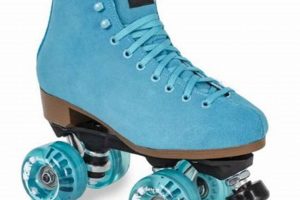
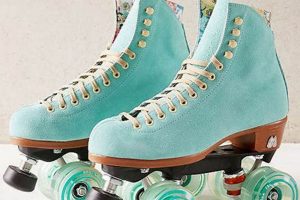
The comparison between inline skates and traditional quad skates is a fundamental consideration for individuals seeking recreational or competitive skating options. This choice dictates the equipment’s maneuverability, stability, and suitability for various skating styles. The equipment each represents different design philosophies and skating experiences.
The significance of this distinction lies in its impact on skill development, performance, and the overall skating experience. Historically, quad skates were the predominant choice, evolving from early roller skating inventions. Inline skates gained prominence later, offering enhanced speed and agility for specific disciplines like roller hockey and aggressive skating. Understanding their historical context enriches the user’s appreciation for their respective strengths.
Therefore, this article will delve into the specific attributes of each type, examining wheel configuration, boot design, and intended use cases to provide a comprehensive understanding of their differences.
Essential Considerations
Selecting appropriate skating equipment requires careful evaluation of individual needs and preferences. A thoughtful approach will ensure an enjoyable and safe skating experience.
Tip 1: Assess Intended Use: Determine the primary skating activity. For recreational use on smooth surfaces, either style may suffice. For roller hockey or speed skating, inline skates are typically preferred. Artistic or rhythm skating often utilizes quad skates.
Tip 2: Evaluate Ankle Support: Inline skates generally offer more rigid ankle support, which can be beneficial for beginners or those seeking stability. Quad skates provide greater ankle freedom, favored by experienced skaters requiring agility.
Tip 3: Consider Wheel Configuration: Inline skates feature wheels in a single line, promoting speed and maneuverability. Quad skates have wheels arranged in pairs, offering increased stability, especially at lower speeds.
Tip 4: Examine Braking Systems: Inline skates typically have a heel brake, while quad skates use a toe stop. Familiarize oneself with the braking mechanism and practice its use before engaging in regular skating.
Tip 5: Prioritize Comfort and Fit: Ill-fitting skates can lead to discomfort, blisters, and impaired performance. Ensure a snug but not overly tight fit. Consider trying on skates with appropriate socks before purchase.
Tip 6: Maintenance is Key: Regularly inspect and maintain skating equipment. Clean wheels, lubricate bearings, and tighten any loose components. Proper maintenance extends the lifespan of the skates and enhances safety.
Tip 7: Seek Expert Advice: Consult with experienced skaters or knowledgeable staff at a reputable skate shop. Their insights can provide valuable guidance in selecting the most suitable equipment.
By carefully considering these aspects, individuals can make informed decisions that align with their specific requirements and enhance their skating experience. Prioritizing safety and comfort is paramount.
The subsequent sections will delve into comparative analyses of specific performance characteristics associated with each type of skating equipment.
1. Maneuverability

Maneuverability, referring to the ease with which a skater can change direction and navigate obstacles, is a critical factor when comparing roller blades and quad skates. The design of each impacts this attribute significantly, influencing the types of skating activities for which each is best suited.
- Wheel Configuration and Turning Radius
Inline skates, with their single line of wheels, generally allow for tighter turning radii and quicker directional changes. This configuration enables skaters to execute complex maneuvers such as slalom skating and rapid pivots. Quad skates, due to the wider wheel base, offer a wider turning radius, prioritizing stability over agility in tight spaces.
- Frame Length and Pivot Points
The length of the skate frame directly affects maneuverability. Shorter frames enhance agility, allowing for quicker turns, while longer frames provide greater stability at higher speeds. Inline skates often have shorter frame options for aggressive skating, emphasizing maneuverability in skate parks. Quad skates typically feature a fixed frame length, providing a consistent balance of stability and turning ability.
- Wheel Hardness and Grip
Wheel hardness, measured on the durometer scale, influences the grip and slide characteristics of the skates. Softer wheels provide greater grip, enhancing control during turns, while harder wheels facilitate sliding and speed. Inline skates commonly utilize harder wheels for speed, while quad skates often employ softer wheels for improved grip on various surfaces.
- Boot Design and Ankle Support
The boot design and ankle support significantly impact the skater’s ability to control the skates. Inline skates, with their taller, more rigid boots, provide greater ankle support, enabling precise movements and power transfer. Quad skates, with lower-cut boots, offer greater ankle flexibility, allowing for more nuanced movements and artistic expression.
Ultimately, the choice between roller blades and quad skates depends on the skater’s priorities. For individuals seeking maximum agility and responsiveness, inline skates may be preferred. Those prioritizing stability and control, particularly at lower speeds, may find quad skates more suitable. Understanding these maneuverability differences is key for selecting equipment that aligns with intended use and skill level.
2. Stability
Stability, a primary concern for skaters of all skill levels, distinguishes inline skates from quad skates. Wheel configuration, boot design, and center of gravity each contribute to the overall stability offered. Quad skates, with their two-by-two wheel arrangement, provide a wider base of support, increasing stability, particularly at lower speeds. This enhanced stability is advantageous for beginners and those seeking recreational skating experiences, reducing the likelihood of imbalance and falls. Conversely, inline skates, with wheels aligned in a single line, possess a narrower base, which challenges balance but offers increased potential for speed and maneuverability.
The impact of stability extends beyond simple balance. It influences confidence, control, and the ability to execute complex maneuvers safely. For example, a skater performing spins or jumps on quad skates benefits from the inherently stable platform, allowing for controlled landings. Conversely, an inline skater engaged in speed skating relies on precise balance and controlled movements to maintain stability at high velocities. Boot design and ankle support further contribute to stability. Higher, more rigid boots, commonly found in inline skates, provide increased ankle support, minimizing ankle roll and enhancing stability during quick movements. Quad skates typically feature lower boots, offering greater ankle flexibility at the cost of some stability.
In summary, the relationship between stability and equipment selection is crucial. Quad skates prioritize stability, making them suitable for beginners and recreational use, while inline skates trade some stability for increased speed and maneuverability. Understanding these trade-offs is essential for choosing equipment that aligns with individual skill level and skating goals. The pursuit of stability, regardless of skate type, remains paramount for a safe and enjoyable skating experience.
3. Speed
The attribute of speed differentiates inline skates from quad skates. The single-line wheel configuration of inline skates minimizes rolling resistance, enabling greater velocity. This design facilitates longer strides and more efficient energy transfer, resulting in higher top speeds. Quad skates, with their wider wheel base, encounter greater rolling resistance, limiting maximum speed. This inherent difference makes inline skates the preferred choice for speed skating and competitive racing events. The design promotes rapid acceleration and sustained high-speed performance.
Wheel size and bearing quality further influence speed capabilities. Inline skates typically utilize larger wheels and precision bearings, reducing friction and enhancing speed potential. Quad skates commonly employ smaller wheels, prioritizing maneuverability over outright speed. Real-world examples highlight this disparity. Speed skaters consistently utilize inline skates, achieving velocities far exceeding those attainable on quad skates. Roller derby, while traditionally employing quad skates, sees advancements in skate technology, including larger wheels, to enhance speed and agility within the constraints of the sport.
In summary, inline skates inherently possess a speed advantage due to their design and wheel configuration. While quad skates offer benefits in stability and maneuverability, their speed potential is limited by their wider wheelbase and smaller wheel size. Understanding this distinction is crucial for individuals selecting skating equipment based on desired performance characteristics. The selection of inline skates or quad skates involves a trade-off between speed and other attributes such as stability and agility, requiring careful consideration of individual needs and preferences.
4. Support
Support, in the context of skating equipment, directly influences user safety, performance, and comfort. When comparing roller blades (inline skates) and quad skates, support characteristics diverge significantly due to fundamental design differences. Inline skates typically feature a higher, more rigid boot that extends further up the ankle. This construction provides substantial lateral and medial support, reducing the risk of ankle roll and offering greater stability, particularly for beginners or individuals with weaker ankles. The increased support is beneficial for maintaining proper alignment during high-impact activities or when navigating uneven surfaces. A practical example is observed in speed skating, where the rigid boot of inline skates facilitates efficient power transfer and prevents ankle strain during sustained high-speed movements.
Quad skates, conversely, generally offer less inherent ankle support. The lower-cut boot design allows for greater ankle flexibility, which some skaters prefer for artistic expression and maneuverability. However, this reduced support necessitates stronger ankle musculature and a higher degree of balance. Skaters using quad skates often rely on specialized lacing techniques or additional ankle supports to compensate for the boot’s lower profile. A real-world example is seen in roller derby, where skaters may reinforce their quad skate boots with additional padding or bracing to withstand the lateral forces and impacts encountered during gameplay. The choice between greater support versus greater flexibility is a critical consideration, dependent on skating style, skill level, and individual physical characteristics.
Ultimately, the appropriate level of support depends on the skater’s needs and priorities. While increased support, as offered by inline skates, enhances stability and reduces the risk of injury, it may limit freedom of movement. Quad skates, with their greater flexibility, allow for more nuanced movements but require greater lower leg strength and balance. Understanding the trade-offs between support and maneuverability is crucial for selecting the appropriate skating equipment. Choosing equipment that does not provide adequate support can lead to discomfort, fatigue, and potential injury, highlighting the importance of considering support as a primary factor in the selection process. Further analysis into other features could allow individuals to get maximum performance depending on skills and desired skating style.
5. Agility
Agility, defined as the ability to change direction quickly and efficiently, represents a key differentiator between inline skates and quad skates. The fundamental design of each type influences a skaters capacity for rapid maneuvers and directional changes. Inline skates, with their single-line wheel configuration, facilitate quicker pivots and tighter turns, lending themselves to enhanced agility on smooth surfaces. The ability to execute sharp turns and rapid changes in direction is crucial in disciplines such as roller hockey and slalom skating, where inline skates are the prevalent choice. This agility advantage stems from the reduced rolling resistance and narrower profile of the inline configuration, enabling more immediate responses to directional impulses. Quad skates, by contrast, provide a stable platform but inherently limit the speed and ease with which directional changes can be executed.
The practical significance of this agility differential manifests in various skating contexts. In competitive roller derby, for example, skaters using quad skates often compensate for their reduced agility with strategic positioning and blocking techniques. However, the rising prevalence of hybrid skating styles, incorporating elements of both inline and quad skating, highlights the adaptability and evolving nature of the sport. Furthermore, the specific wheel arrangement impacts the degree of control a skater maintains during agile movements. Inline skates require precise weight distribution and ankle control to prevent instability during rapid turns, whereas quad skates provide a more forgiving platform for less experienced skaters. Therefore, the choice between inline skates and quad skates depends not only on the desired level of agility but also on the skater’s skill level and physical capabilities.
In summary, agility is a defining characteristic when evaluating inline skates versus quad skates. The inherent design differences impact a skater’s capacity for rapid directional changes, influencing equipment selection based on intended use and skill level. While inline skates generally offer superior agility due to their wheel configuration, quad skates provide a more stable base that may be preferable for beginners or those prioritizing stability over rapid maneuverability. The challenge lies in selecting equipment that optimizes agility without compromising safety and control, underscoring the importance of understanding the distinct performance characteristics of each skate type.
6. Braking
Braking mechanisms are crucial for safety and control in skating, representing a significant point of divergence between roller blades and quad skates. The design and implementation of braking systems influence a skater’s ability to stop effectively, affecting performance and confidence across various skill levels and skating disciplines. Understanding the nuances of braking systems is essential for informed equipment selection.
- Heel Brakes on Inline Skates
Inline skates typically employ a heel brake located on the rear of one skate, usually the right. This braking system requires the skater to shift weight backward and lift the toe, engaging the brake pad with the ground. The heel brake offers a relatively intuitive stopping method for beginners, allowing for controlled deceleration. However, advanced skaters may find the heel brake less responsive than other techniques, potentially hindering agility in certain situations. Its effectiveness depends on the skater’s ability to maintain balance during weight transfer.
- Toe Stops on Quad Skates
Quad skates utilize toe stops positioned at the front of each skate. To engage the brakes, the skater presses the toe stops against the ground, creating friction and slowing momentum. Toe stops offer precise control and are favored by skaters in disciplines like roller derby and artistic skating, where quick stops and agile maneuvers are essential. However, mastering toe stop braking requires practice and coordination, as improper technique can lead to instability or falls. The adjustability of toe stops allows skaters to customize the braking force and angle.
- Braking Techniques and Skill Level
Beyond the hardware, the effectiveness of braking depends on the skater’s skill level and technique. Regardless of the skate type, proficiency in techniques such as the T-stop, plow stop, and power slide enhances control and stopping power. These techniques require practice and adaptability, allowing skaters to respond effectively to various conditions and obstacles. Advanced skaters often combine multiple techniques to optimize braking performance, demonstrating the importance of skill development alongside equipment selection.
- Maintenance and Safety Considerations
Regular maintenance of braking systems is paramount for safety. Worn brake pads or toe stops reduce braking efficiency and increase the risk of accidents. Inspection and replacement of these components are essential for maintaining optimal braking performance. Additionally, skaters should regularly practice braking techniques to ensure preparedness in emergency situations. The integration of protective gear, such as wrist guards and helmets, further enhances safety and minimizes the potential for injury during falls or sudden stops.
The comparison of braking systems between roller blades and quad skates reveals fundamental differences in design, implementation, and technique. While heel brakes offer an accessible stopping method for beginners, toe stops provide enhanced control and agility for experienced skaters. Regardless of the chosen system, consistent practice and proper maintenance are crucial for ensuring safe and effective braking. These attributes ultimately contribute to a skater’s overall enjoyment and confidence.
Frequently Asked Questions
The following questions address common concerns and misconceptions surrounding the selection and use of roller blades (inline skates) and quad skates. These responses aim to provide clear, concise information to aid informed decision-making.
Question 1: Is one type inherently safer than the other?
Safety depends more on skill level, protective gear, and adherence to safe skating practices than on the type of skate. Both types present risks if used improperly. Inline skates may offer more ankle support, potentially reducing ankle injuries, but quad skates often provide greater stability at low speeds. Proper training and protective equipment are paramount regardless of skate type.
Question 2: Which type is easier for beginners to learn?
Quad skates are often perceived as easier for beginners due to their wider base of support, which promotes stability. However, learning to balance on either type requires practice and patience. Some individuals may find inline skates more intuitive due to their forward-facing orientation. Beginner lessons are advisable regardless of the chosen equipment.
Question 3: Are roller blades faster than quad skates?
Generally, inline skates achieve higher speeds due to their wheel configuration, which minimizes rolling resistance. This makes them suitable for speed skating and long-distance skating. Quad skates, while capable of reasonable speeds, are typically not as efficient for sustained high-speed skating.
Question 4: Can I use roller blades at a roller rink designed for quad skates?
Most roller rinks accommodate both inline and quad skates. However, it is prudent to verify specific rink policies beforehand. Some rinks may have designated sessions for different skate types or restrict certain maneuvers for safety reasons.
Question 5: Which type is better for roller derby?
Roller derby traditionally utilizes quad skates, which offer maneuverability and stability advantageous for blocking and agile movements. However, some skaters are now experimenting with inline skates in roller derby, leveraging their speed and agility in specific roles.
Question 6: What are the maintenance requirements for each type?
Both inline and quad skates require regular maintenance, including wheel cleaning, bearing lubrication, and hardware inspection. Inline skates may require more frequent wheel replacements due to wear. Toe stops on quad skates also require periodic replacement. Neglecting maintenance can compromise performance and safety.
In summary, selecting the appropriate type involves considering skill level, intended use, and personal preferences. Safety, maintenance, and adherence to established guidelines are critical, regardless of the chosen equipment.
The subsequent section will provide a conclusive summary.
Conclusion
The preceding analysis has presented a comprehensive comparison, dissecting the core attributes that distinguish roller blades and skates. From maneuverability and stability to speed, support, agility, and braking mechanisms, the nuanced differences reveal distinct performance characteristics. Informed selection necessitates careful consideration of intended use, skill level, and individual preferences. Both options present viable avenues for recreation and sport, contingent on the user’s specific needs and the demands of the chosen skating discipline.
Ultimately, the choice is not a matter of superiority but of suitability. Individuals are encouraged to thoroughly evaluate their requirements and seek guidance from experienced skaters or reputable retailers before making a decision. Understanding the intricacies of each option ensures a safe and rewarding skating experience.
![Find Cheap Skate Roller Center Photos: [Location] Fun! | Learn to Surf & Skate: A Beginner's Step-by-Step Guide](https://universitysurfandskate.com/wp-content/uploads/2026/05/th-141-300x200.jpg "Find Cheap Skate Roller Center Photos: [Location] Fun! Learn to Surf & Skate: A Beginner's Step-by-Step Guide")