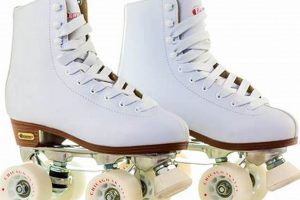
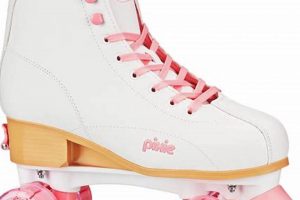
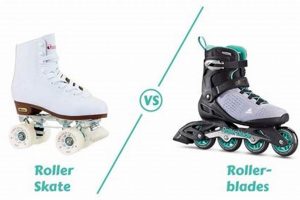
The comparison of quad skates and inline skates involves understanding distinct wheeled footwear options. Quad skates feature two wheels in the front and two in the back, offering stability. Inline skates, conversely, have wheels arranged in a single line, prioritizing speed and maneuverability. These differing designs dictate their respective performance characteristics and suitability for various activities.
The significance of understanding these differences lies in choosing the appropriate equipment for individual needs and preferences. Historically, quad skates gained initial popularity, later followed by the rise of inline skates. Each type provides specific advantages, influencing user experience in recreation, fitness, and competitive sports.
This article will further explore the detailed characteristics, advantages, disadvantages, and best use cases associated with each skate type, providing a comprehensive overview to inform equipment selection.
Essential Considerations for Selecting Wheeled Footwear
Proper selection requires careful assessment of individual needs, skill level, and intended application. Neglecting these factors can lead to suboptimal performance or increased risk of injury.
Tip 1: Evaluate Stability Requirements: Quad skates, with their wider base, offer enhanced stability, particularly beneficial for beginners or individuals prioritizing balance over speed. For example, recreational skaters often find quad skates more comfortable for leisurely outdoor use.
Tip 2: Assess Maneuverability Needs: Inline skates facilitate greater maneuverability and speed due to their single-line wheel configuration. Hockey players, for instance, frequently utilize inline skates to replicate on-ice movement.
Tip 3: Consider Intended Usage: The primary activity influences the optimal choice. Artistic skating often favors quad skates, while speed skating necessitates inline skates designed for maximum velocity.
Tip 4: Prioritize Comfort and Fit: Proper fit minimizes the risk of blisters and maximizes control. It’s important to try on different brands and sizes to find the best match for individual foot shape.
Tip 5: Account for Maintenance Requirements: Both types require regular maintenance, including wheel rotation and bearing cleaning. Inline skates typically require more frequent maintenance due to the complexity of their wheel assemblies.
Tip 6: Factor in Terrain: Smooth surfaces favor inline skates, whereas quad skates can handle uneven terrain with greater ease. Consider the typical skating environment when making a decision.
Tip 7: Research Protective Gear: Regardless of the chosen skate type, adequate protective gear, including helmets, knee pads, elbow pads, and wrist guards, is essential for minimizing the risk of injury.
Selecting the right type involves weighing the tradeoffs between stability, maneuverability, intended use, and personal preferences. A well-informed decision contributes to a safer and more enjoyable skating experience.
The subsequent sections will delve into a detailed comparison of specific models and features, allowing for a more nuanced understanding of the available options.
1. Stability vs. Speed

The dynamic between stability and speed is a fundamental consideration when differentiating quad skates and inline skates. This trade-off shapes the overall skating experience, influencing user choice based on intended activity and skill level.
- Wheelbase and Balance
Quad skates, due to their wider wheelbase created by the four-wheel configuration, inherently offer enhanced stability. This broadened contact surface area provides a more balanced platform, reducing the likelihood of instability, especially for novice skaters. Conversely, inline skates, with their single line of wheels, require greater core strength and balance to maintain equilibrium, prioritizing speed over initial stability.
- Turning and Maneuverability Trade-offs
The stability offered by quad skates impacts turning radius and maneuverability. While stable, the wider base can limit the agility and quick directional changes achievable with inline skates. Inline skates, allowing for tighter turns and more responsive movements, excel in scenarios requiring rapid changes in direction but necessitate greater balance control.
- Impact on Learning Curve
The inherent stability of quad skates typically results in a shallower learning curve for beginners. New skaters often find it easier to maintain balance and control on quad skates, fostering a sense of confidence and reducing the risk of falls during the initial stages of learning. Inline skates, demanding more refined balance skills, often present a steeper learning curve but ultimately allow for greater speed and agility as proficiency increases.
These interplaying facets of stability and speed highlight the core differences between quad and inline skates. The choice hinges on individual priorities: those seeking ease of learning and enhanced stability often prefer quad skates, while those prioritizing speed and maneuverability tend toward inline skates. This core distinction permeates all aspects of the skating experience.
2. Maneuverability Control

Maneuverability control distinguishes quad skates from inline skates, dictating the skater’s ability to execute turns, navigate obstacles, and perform complex movements. The design differences inherent in each type directly affect the precision and responsiveness of these actions, influencing their suitability for specific skating disciplines.
- Wheelbase and Turning Radius
Quad skates, with their wider wheelbase and fixed axles, necessitate a leaning action to initiate turns. This creates a wider turning radius, suited for sweeping arcs and controlled movements. Inline skates, conversely, allow for sharper turns due to the in-line wheel configuration, enabling quicker direction changes and tighter maneuvers. This difference affects agility in environments requiring rapid adjustments.
- Frame Design and Responsiveness
The frame design of each skate type contributes significantly to responsiveness. Quad skates often feature a plate connecting the boot to the wheels, providing a stable platform but potentially limiting responsiveness in intricate maneuvers. Inline skate frames, typically made of aluminum or composite materials, offer varying degrees of flex and stiffness, allowing skaters to fine-tune responsiveness based on their preferences and intended use. A stiffer frame translates to more direct power transfer and quicker reaction times.
- Boot Height and Ankle Support
Boot height and ankle support play a crucial role in maneuverability. Quad skates generally feature lower-cut boots, offering greater ankle freedom and facilitating artistic movements that require flexibility. Inline skates, particularly those designed for aggressive skating or hockey, often have higher cuffs that provide increased ankle support, enhancing stability and control during high-impact maneuvers. The level of ankle support directly influences the skater’s ability to execute precise turns and maintain balance during complex movements.
- Wheel Durometer and Grip
Wheel durometer, or hardness, and grip properties significantly impact maneuverability control. Softer wheels (lower durometer) provide greater grip, enhancing control on slick surfaces but reducing speed. Harder wheels (higher durometer) offer less grip but increased speed, suitable for smooth surfaces and experienced skaters. Quad skates and inline skates offer a range of wheel durometers to cater to various skating styles and surface conditions, enabling skaters to optimize their maneuverability control accordingly.
The interplay between wheelbase, frame design, boot support, and wheel characteristics determines the maneuverability control achievable with each skate type. Understanding these nuances allows skaters to select the equipment best suited for their desired skating style and environmental conditions, ultimately influencing their ability to navigate, perform tricks, and maintain control.
3. Wheel Configuration
Wheel configuration stands as a primary differentiating factor between quad skates and inline skates. This arrangement directly influences stability, maneuverability, and speed, shaping the overall skating experience and determining suitability for specific disciplines.
- Quad Skates: Parallel Arrangement
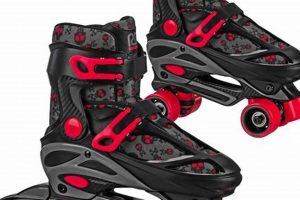
Quad skates feature two wheels positioned in the front and two in the back, forming a parallel configuration. This design creates a wider base of support, contributing to enhanced stability, particularly advantageous for beginners and recreational skaters. The parallel arrangement inherently limits top-end speed compared to inline skates due to increased rolling resistance.
- Inline Skates: Linear Arrangement
Inline skates utilize a linear arrangement, with wheels aligned in a single row along the center of the boot. This configuration reduces rolling resistance, enabling higher speeds and greater efficiency. The linear setup demands more refined balance skills and core strength, making inline skates suitable for experienced skaters seeking performance-oriented activities such as speed skating and hockey.
- Wheel Size and Spacing
Wheel size and spacing vary within each skate type, further influencing performance characteristics. Larger wheels, common in inline speed skates, facilitate higher speeds and smoother rolling over uneven surfaces. Smaller wheels, often found in quad skates and recreational inline skates, prioritize maneuverability and responsiveness. Wheel spacing affects stability and agility, with wider spacing enhancing stability and narrower spacing promoting agility.
- Frame Material and Wheel Mounting
The frame material and wheel mounting system influence power transfer and vibration dampening. Inline skate frames are typically constructed from aluminum or composite materials, offering varying degrees of stiffness and responsiveness. Quad skate plates, traditionally made of metal or nylon, provide a stable platform for wheel mounting. The rigidity of the frame or plate directly affects the skater’s ability to transfer energy efficiently and maintain control, particularly during high-intensity maneuvers.
The divergence in wheel configuration between quad skates and inline skates fundamentally alters their performance profiles. The choice between parallel and linear arrangements hinges on individual priorities related to stability, speed, and intended application, ultimately defining the overall skating experience.
4. Application Specificity
The selection between quad skates and inline skates frequently depends on the intended application. Each type offers advantages tailored to distinct skating disciplines, influencing performance and user experience.
- Artistic Skating vs. Speed Skating
Artistic skating, encompassing routines with jumps, spins, and dance elements, typically favors quad skates. The wider wheelbase and greater maneuverability at slower speeds offered by quad skates allow for precise control and execution of intricate figures. Speed skating, conversely, necessitates inline skates for maximizing velocity and efficiency. The linear wheel arrangement minimizes rolling resistance, facilitating higher speeds essential for competitive racing.
- Roller Derby vs. Inline Hockey
Roller derby, a contact sport involving strategic blocking and racing, commonly utilizes quad skates. The stability afforded by the quad design enables skaters to withstand impacts and maintain balance during physical interactions. Inline hockey, replicating ice hockey on wheels, mandates inline skates for mimicking the on-ice skating experience. The maneuverability and speed of inline skates allow for quick transitions, precise puck control, and rapid changes in direction characteristic of the sport.
- Recreational Skating vs. Aggressive Skating
Recreational skating, encompassing leisurely outdoor skating and fitness activities, can accommodate both quad and inline skates depending on individual preference and terrain. Quad skates offer stability and control for casual skating on varied surfaces, while inline skates provide efficiency and speed for longer distances on smooth pavements. Aggressive skating, involving stunts, grinds, and jumps, typically utilizes specialized inline skates designed for durability and impact resistance. These skates feature reinforced frames and wheels to withstand the stresses of performing tricks in skate parks and urban environments.
- Dance and Rhythmic Skating vs Urban Skating
Dance and rhythmic skating often utilizes roller skates for better control and artistic ability for movements such as grooves. Urban skating often employs rollerblades for better speed.
The specific requirements of each skating discipline drive the selection between quad skates and inline skates. Application specificity underscores the importance of aligning equipment choice with intended use, optimizing performance and enjoyment.
5. Skill Level
Skill level exerts a considerable influence on the appropriate selection between quad skates and inline skates. Beginner skaters often benefit from the inherent stability of quad skates, which facilitates balance and control during initial learning stages. The wider base of support inherent in the quad design reduces the likelihood of falls, allowing novices to develop fundamental skating skills with greater confidence. For instance, a child learning to skate for the first time might find quad skates easier to manage, progressing to inline skates as balance and coordination improve. The causal relationship here is clear: lower skill levels find quad skates more accommodating, leading to a more positive initial skating experience.
As skill level advances, skaters may transition to inline skates to capitalize on their speed and maneuverability. Intermediate and advanced skaters often require the responsiveness and agility offered by inline skates for activities such as hockey, speed skating, or aggressive skating. The ability to perform quick turns, execute complex maneuvers, and achieve higher speeds becomes paramount, rendering the stability of quad skates less critical. Consider a hockey player who needs the agility and speed of inline skates to effectively navigate the rink and control the puck. The progression reflects a shift in priorities, where speed and agility outweigh the initial stability advantages.
Ultimately, the choice between quad skates and inline skates should align with the skater’s proficiency and intended use. While quad skates provide a stable platform for beginners, inline skates unlock advanced performance capabilities for experienced skaters. Recognizing the impact of skill level on skate selection promotes safer and more enjoyable skating experiences, preventing frustration and potential injuries associated with using equipment beyond one’s current abilities. The optimal decision considers not just the desired activity, but also the skater’s current skill set and progression goals, ensuring the equipment facilitates rather than hinders development.
6. Terrain Adaptability
Terrain adaptability represents a critical factor in differentiating quad skates and inline skates. The wheeled footwear’s capacity to navigate diverse surfaces impacts user experience, safety, and performance. Quad skates, due to their wheel configuration and typically softer wheel durometer, generally exhibit superior terrain adaptability compared to inline skates. This stems from their greater capacity to absorb vibrations and maintain grip on uneven surfaces, such as cracked pavement or gravel paths. Conversely, inline skates, optimized for smooth surfaces, encounter significant performance degradation and heightened risk of instability on rough terrain. The underlying cause is the smaller contact area and often harder wheels, which transmit vibrations more directly to the skater and reduce traction.
The practical significance of understanding terrain adaptability becomes evident in real-world scenarios. For instance, recreational skaters traversing mixed urban environments often find quad skates more suitable due to their capacity to handle transitions between smooth sidewalks and rougher street surfaces. Conversely, inline speed skaters require meticulously maintained, smooth tracks to achieve optimal velocity and minimize the risk of wheel slippage. Ignoring terrain considerations can lead to compromised skating experiences, increased physical strain, and potentially dangerous situations, particularly when encountering unexpected surface irregularities at higher speeds. The choice in wheel material also contribute for the terrain adaptation of both skates.
In conclusion, terrain adaptability profoundly influences the comparative utility of quad skates and inline skates. While inline skates excel on smooth, predictable surfaces, quad skates offer greater versatility and safety across varied terrains. Skaters must carefully assess their intended environment and prioritize terrain adaptability when selecting wheeled footwear to maximize performance, minimize risk, and ensure a comfortable and enjoyable skating experience. The trade-offs between speed and terrain versatility should be carefully considered.
Frequently Asked Questions
This section addresses common inquiries and clarifies misconceptions surrounding the distinctions between quad skates and inline skates. It provides concise answers to facilitate informed decision-making.
Question 1: Are roller skates inherently more stable than rollerblades?
Roller skates, featuring a wider wheelbase due to their quad wheel configuration, generally offer enhanced initial stability compared to inline skates. This characteristic proves beneficial for beginners or individuals prioritizing balance over speed.
Question 2: Which type of skate is better for outdoor use on uneven surfaces?
Roller skates typically handle uneven surfaces more effectively than inline skates. Their wider wheels and softer durometer contribute to greater vibration absorption and improved grip on rough terrain.
Question 3: Do rollerblades allow for higher speeds compared to roller skates?
Yes, inline skates, or rollerblades, generally achieve higher speeds due to their linear wheel arrangement, which reduces rolling resistance. This configuration facilitates greater efficiency and velocity, particularly on smooth surfaces.
Question 4: Which type of skate is more suitable for artistic skating or roller derby?
Roller skates are generally favored for artistic skating and roller derby. Their maneuverability and stability at lower speeds allow for precise execution of intricate maneuvers and physical interactions within these disciplines.
Question 5: Is one type of skate easier to learn than the other?
Roller skates often present a shallower learning curve for beginners due to their inherent stability. This characteristic enables novices to develop fundamental skating skills more easily before transitioning to more challenging skate types.
Question 6: Do rollerblades require more maintenance than roller skates?
Inline skates often necessitate more frequent maintenance due to the complexity of their wheel assemblies and bearing systems. Regular cleaning and lubrication are essential for optimal performance and longevity.
In summary, the ideal choice between roller skates and rollerblades depends on individual needs, preferences, and intended use. Consider factors such as stability requirements, skill level, and terrain conditions to make an informed decision.
The subsequent section will delve into a comparison of specific skate models and their unique features.
Concluding Remarks
This exploration of roller skates vs rollerblades has illuminated fundamental differences in design, performance, and application. Stability, maneuverability, speed, and terrain adaptability serve as key differentiators, influencing user experience and suitability for specific skating disciplines. Informed selection necessitates a thorough assessment of individual needs, skill level, and intended environment.
The decision between quad skates and inline skates represents a considered choice, impacting safety and enjoyment. Further research into specific models and evolving technologies remains prudent for optimizing performance and maximizing the benefits of wheeled locomotion. The continued development of both skate types ensures a diverse range of options catering to a spectrum of skating preferences.
![Get Rolling! Brand New Pair of Roller Skates Song [Audio] | Learn to Surf & Skate: A Beginner's Step-by-Step Guide](https://universitysurfandskate.com/wp-content/uploads/2026/05/th-191-300x200.jpg "Get Rolling! Brand New Pair of Roller Skates Song [Audio] Learn to Surf & Skate: A Beginner's Step-by-Step Guide")