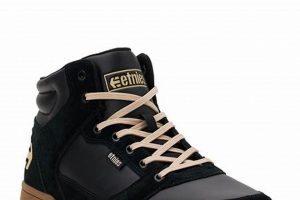
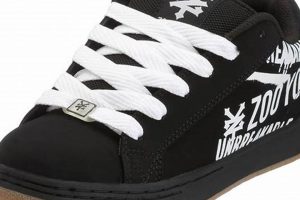
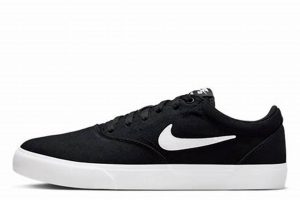
Footwear designed for skateboarding frequently lacks inherent structural features that accommodate the foot’s natural curvature. Specific models, however, integrate a contoured insole or midsole component intended to mitigate the impact of high-impact activities on the foot. An example is a skate shoe that incorporates a raised support within the shoe’s internal structure to align with the longitudinal arch.
The inclusion of this feature can be particularly beneficial, addressing potential discomfort and reducing the risk of certain foot-related conditions. Historically, standard skate shoes prioritized board feel and durability over ergonomic considerations. Modern designs increasingly recognize the importance of foot health and biomechanical alignment for prolonged comfort and performance. The adoption of supportive features can enable skaters to engage in their activity for longer durations with decreased risk of strain.
The following sections will explore different types of available models, the implications of selecting appropriate footwear, and considerations for individuals with pre-existing foot conditions. Further discussion will cover the materials used in the construction of supportive skate shoes, and provide advice for selecting the best option based on individual needs and skating style.
Selecting Supportive Skate Footwear
Choosing appropriate skateboarding footwear is crucial for comfort, performance, and injury prevention. The following tips offer guidance in selecting options that incorporate arch support.
Tip 1: Assess Arch Type: Determine the arch height through wet foot testing or professional assessment. This identification will dictate the level of support required for optimal biomechanical alignment. A low arch necessitates a different support structure than a high arch.
Tip 2: Evaluate Insole Construction: Inspect the insole material and design. Look for molded insoles with defined arch contours, rather than flat, unsupportive inserts. Insoles should ideally be removable for customization.
Tip 3: Consider Midsole Material: The midsole plays a crucial role in shock absorption and support. EVA (Ethylene-vinyl acetate) or polyurethane midsoles offer varying degrees of cushioning and stability. Higher density materials generally provide more robust support.
Tip 4: Examine Internal Support Structures: Some footwear integrates internal arch supports directly into the shoe’s chassis. These structures provide consistent support that is independent of the insole. Examine the shoe’s internal construction for evidence of such features.
Tip 5: Prioritize Fit and Stability: A secure, snug fit is essential for proper support. The heel should be firmly seated, and the midfoot should be adequately supported. Evaluate the shoe’s stability by performing balance tests on a flat surface.
Tip 6: Explore Orthotic Options: If standard footwear does not provide sufficient support, consider using custom or over-the-counter orthotics. Consult with a podiatrist or qualified professional for personalized recommendations.
Tip 7: Break-In Period: New footwear may require a break-in period for optimal comfort and performance. Wear the shoes for short periods initially, gradually increasing the duration to allow the materials to conform to the foot’s shape.
Adhering to these guidelines can significantly improve foot comfort and reduce the risk of injuries associated with skateboarding. Proper selection contributes to enhanced performance and prolonged enjoyment of the activity.
The subsequent section will delve into the long-term implications of utilizing supportive skate footwear and highlight preventative measures for common foot ailments.
1. Optimal Foot Alignment

Optimal foot alignment, achievable through appropriately designed skateboarding footwear, constitutes a critical factor in musculoskeletal health and performance. Footwear incorporating arch support aims to maintain the foot in a neutral position, preventing excessive pronation (inward rolling) or supination (outward rolling). When a skater’s foot excessively pronates, the tibia and femur rotate internally, potentially leading to imbalances in the kinetic chain affecting the knees, hips, and lower back. Conversely, excessive supination can increase the risk of ankle sprains and stress fractures due to insufficient shock absorption.
Skateboarding, characterized by high-impact landings and repetitive movements, places considerable stress on the lower extremities. Footwear lacking sufficient arch support exacerbates these stresses, potentially leading to chronic pain and dysfunction. For example, a skater with flat feet using shoes without adequate support may experience plantar fasciitis (inflammation of the plantar fascia) or Achilles tendinitis due to the increased strain on these structures. The correct alignment promotes efficient force transfer, allowing the muscles and joints to function optimally and reduce the risk of injury.
In summary, optimal foot alignment contributes significantly to injury prevention and enhanced performance in skateboarding. Understanding the interplay between foot biomechanics and footwear design is essential for selecting supportive shoes that promote long-term musculoskeletal health. Prioritizing appropriate arch support can mitigate the adverse effects of repetitive high-impact activities and ensure that skaters maintain proper form and stability.
2. Reduced Impact Force

Skateboarding involves repetitive, high-impact activities, and the capacity of skate shoes to attenuate these forces is paramount. Footwear incorporating arch support contributes significantly to impact reduction. The arch of the foot acts as a natural shock absorber, and when properly supported, its biomechanical function is optimized. This leads to a more efficient distribution of force across the foot and up the kinetic chain, mitigating stress on the ankles, knees, and hips. For example, when a skater lands a trick, the supported arch cushions the impact, lessening the load on the joints. Without this support, a greater proportion of the impact force is transmitted directly to the skeletal structure, elevating the risk of injury.
The integration of supportive elements within skate shoe design directly influences the magnitude and distribution of impact forces. A well-designed arch support system not only cushions the heel strike but also guides the foot through its natural range of motion, reducing the likelihood of over-pronation or supination. This controlled movement minimizes the potential for joint stress and soft tissue damage. Furthermore, supportive footwear often incorporates specialized cushioning materials in the midsole and outsole, further enhancing impact absorption. Consider a skater performing a series of ollies; the cumulative effect of repeated landings can be detrimental without adequate force reduction, but the proper support can mitigate this.
In conclusion, the relationship between arch support in skate shoes and reduced impact force is crucial for long-term musculoskeletal health. By optimizing foot biomechanics and incorporating advanced cushioning materials, supportive footwear can significantly minimize the risk of injury associated with skateboarding. Understanding the importance of impact force reduction empowers skaters to make informed choices about their footwear, ultimately contributing to enhanced performance and longevity in the sport.
3. Enhanced Stability

The design and construction of skateboarding footwear directly affect a skater’s stability, influencing both performance and safety. Footwear incorporating arch support plays a vital role in enhancing stability, particularly during high-impact maneuvers and intricate board control.
- Improved Foot and Ankle Alignment
Arch support promotes neutral foot alignment, reducing the likelihood of overpronation or supination. Proper alignment stabilizes the ankle joint, providing a more secure platform for balance and board control. For example, during a grind, a skater relies on subtle foot adjustments to maintain balance; footwear with arch support minimizes unwanted foot movement, thereby improving stability.
- Enhanced Proprioception
Proprioception, the body’s awareness of its position in space, is crucial for maintaining balance. Arch support increases sensory feedback from the foot, enabling quicker and more accurate adjustments. A skater attempting a complex flip trick benefits from enhanced proprioception, allowing for precise corrections in mid-air and a more stable landing.
- Optimized Force Distribution
Arch support helps distribute force evenly across the foot, preventing concentrated pressure points that can compromise stability. This even distribution enhances the skater’s ability to maintain balance and control, especially during transitions and sharp turns. Uneven force distribution can lead to instability and an increased risk of ankle rolling or other injuries.
- Increased Ground Contact
Footwear that conforms to the foots natural arch structure can promote greater contact with the shoe’s insole and subsequently the skateboard. This larger contact area increases friction, enhancing grip and overall stability. During slides or power moves, a skater needs maximum contact to maintain control; arch support contributes to this contact, reducing the risk of slippage.
Collectively, these facets demonstrate the substantial contribution of arch support in skateboarding footwear to enhanced stability. The improved alignment, enhanced proprioception, optimized force distribution, and increased ground contact afforded by such footwear translate to increased board control, reduced risk of injury, and ultimately, improved skating performance.
4. Injury Prevention

The impact of skateboarding footwear on injury prevention is significant, particularly in relation to the presence and design of arch support. Skateboarding inherently involves repetitive high-impact maneuvers that place substantial stress on the lower extremities. Footwear lacking adequate arch support can exacerbate this stress, leading to various injuries, including plantar fasciitis, ankle sprains, and knee pain. The incorporation of appropriate arch support mitigates these risks by optimizing foot biomechanics and enhancing shock absorption. For example, a skater repeatedly landing jumps may develop plantar fasciitis due to the strain on the plantar fascia, a ligament on the sole of the foot. Footwear incorporating well-designed arch support redistributes the impact force, reducing the load on the plantar fascia and minimizing the risk of inflammation.
Furthermore, arch support contributes to ankle stability, a critical factor in preventing ankle sprains. By maintaining the foot in a neutral position, arch support reduces the likelihood of excessive pronation or supination, which can compromise ankle stability and increase susceptibility to sprains. Skateboarding often requires quick lateral movements and sudden changes in direction, placing considerable demand on the ankle joint. Footwear with arch support provides the necessary support to withstand these forces and maintain stability. Custom orthotics or insoles further enhance injury prevention by addressing individual biomechanical needs. For instance, a skater with overpronation may benefit from orthotics that correct their foot alignment, reducing stress on their ankles and knees.
In summary, the integration of arch support in skateboarding footwear constitutes a vital component of injury prevention. Through enhanced shock absorption, improved foot alignment, and increased ankle stability, supportive footwear mitigates the risks associated with the high-impact nature of skateboarding. A proactive approach to footwear selection, considering individual biomechanical needs and the features of supportive skate shoes, significantly contributes to the long-term health and well-being of skaters. The understanding and application of these principles are paramount for reducing the incidence of injuries and promoting sustained participation in the sport.
5. Performance Improvement

Performance enhancement in skateboarding is directly influenced by the symbiotic relationship between foot biomechanics and footwear design. Skate shoes incorporating arch support can contribute to notable improvements in a skater’s capabilities by addressing fundamental aspects of stability, force transmission, and energy efficiency.
- Enhanced Board Feel and Control
Arch support optimizes foot alignment, promoting a more stable and connected interface between the skater’s foot and the board. Improved foot stability translates to greater board feel and enhanced control during complex maneuvers, transitions, and landings. A skater performing intricate technical tricks, such as flip variations or grinds, benefits from the increased precision afforded by optimized foot alignment, allowing for more consistent execution and refined control.
- Optimized Energy Transfer
Efficient energy transfer is crucial for generating power and maintaining momentum in skateboarding. Arch support facilitates a more natural and efficient transfer of force from the skater’s lower extremities to the board. For example, during an ollie, the skater’s foot acts as a lever, transferring force to propel the board into the air; optimized foot alignment ensures that this force is transmitted effectively, maximizing height and distance. Skate shoes with proper arch support therefore minimize energy loss and enhance propulsion efficiency.
- Reduced Fatigue and Improved Endurance
Prolonged skateboarding sessions can lead to fatigue and reduced performance due to muscular strain and inefficient biomechanics. Arch support alleviates foot fatigue by distributing pressure evenly and reducing stress on specific muscle groups. Minimized fatigue translates to improved endurance, enabling skaters to maintain peak performance for extended periods. Skate shoes engineered with support features assist in mitigating the common discomforts of prolonged practice.
- Increased Landing Stability and Control
Landing stability is essential for executing tricks safely and consistently. Footwear incorporating arch support enhances stability upon landing by promoting neutral foot alignment and optimizing shock absorption. The structured support allows the skater to maintain balance and control, reducing the risk of injury and improving overall confidence. In high-impact situations, the optimized support structure improves the likelihood of a smooth and controlled landing.
The above facets illustrate the direct impact of supportive footwear on performance improvement in skateboarding. By addressing fundamental aspects of stability, energy transfer, fatigue reduction, and landing control, skate shoes integrating arch support enable skaters to enhance their capabilities and push the boundaries of their performance. Ultimately, appropriate footwear selection contributes not only to enhanced performance but also to increased longevity and enjoyment of the sport.
6. Longitudinal Arch Protection
Longitudinal arch protection, a primary function of skate shoes engineered with internal support structures, serves to maintain the structural integrity of the foot during high-impact activities. Without adequate protection, the longitudinal arch, a key weight-bearing structure, may experience excessive strain, potentially leading to conditions such as plantar fasciitis, arch collapse, or posterior tibial tendon dysfunction. Skateboarding, with its characteristic jumps, landings, and repetitive movements, places considerable stress on the foot. Footwear specifically designed to incorporate arch support acts as a preventative measure, mitigating the risk of these stress-related injuries. As an example, consider a skater performing a series of kickflips. The impact force generated during each landing is absorbed and distributed more effectively when the longitudinal arch is properly supported, reducing the strain on the plantar fascia.
The inclusion of longitudinal arch protection extends beyond simple comfort; it directly affects the skater’s biomechanics and performance. A stable and well-supported arch facilitates more efficient force transfer from the lower extremities to the skateboard, leading to improved board feel and control. Furthermore, proper arch support reduces fatigue, allowing skaters to maintain their performance for longer durations. Conversely, footwear lacking adequate support can lead to muscle imbalances, improper gait mechanics, and increased risk of ankle sprains and knee injuries. A practical application of this understanding involves selecting skate shoes with firm, contoured insoles that closely match the individual’s arch profile, ensuring optimal support and alignment.
In summary, longitudinal arch protection is a crucial component of skate shoes designed for high-performance and injury prevention. Footwear engineered with appropriate support structures contributes to foot health, enhanced biomechanics, and improved skating performance. The challenges lie in ensuring that the support is customized to the individual’s specific arch type and skating style. Recognizing the practical significance of longitudinal arch protection is paramount for skaters seeking to optimize their performance and minimize the risk of lower extremity injuries, aligning with the broader theme of promoting long-term athletic health and well-being.
Frequently Asked Questions
The following addresses common inquiries regarding skateboarding footwear designed to provide support for the foot’s arch. These questions are answered with the intent to provide clarity and informed decision-making.
Question 1: What constitutes “arch support” in a skate shoe?
Arch support in skate shoes refers to a structural element within the shoe, typically incorporated into the insole or midsole, that conforms to and supports the longitudinal arch of the foot. This support aims to maintain proper foot alignment and reduce stress on the plantar fascia.
Question 2: Why is arch support important for skateboarding?
Skateboarding involves high-impact activities that place considerable stress on the feet. Arch support helps to distribute this stress evenly, reducing the risk of plantar fasciitis, ankle sprains, and other foot-related injuries. Additionally, proper arch support can improve stability and enhance board control.
Question 3: How does one determine the appropriate level of arch support needed?
The appropriate level of arch support depends on individual foot type and biomechanics. Individuals with low arches (flat feet) generally require more support than those with high arches. A podiatrist or qualified professional can assess foot type and recommend suitable levels of support.
Question 4: Can skate shoes with arch support accommodate custom orthotics?
Some skate shoes are designed with removable insoles, allowing for the use of custom orthotics. However, not all models offer this feature. It is advisable to check the product specifications or consult with a retailer to determine compatibility with custom orthotics.
Question 5: Are skate shoes with arch support less durable than traditional skate shoes?
The inclusion of arch support does not necessarily compromise durability. High-quality skate shoes with arch support are constructed using durable materials and reinforced stitching to withstand the rigors of skateboarding. Durability largely depends on the overall construction and materials used, rather than the presence of arch support.
Question 6: Do skate shoes with arch support affect board feel?
Some skaters may initially perceive a difference in board feel when transitioning to skate shoes with arch support. However, this is often a matter of adjustment. Properly designed skate shoes with arch support should enhance stability and control without significantly impairing board feel. The optimal support structure improves efficient power transfer between foot and board.
Selecting footwear with the appropriate arch support is a critical factor in promoting foot health and optimizing performance in skateboarding. Consulting with professionals and understanding individual needs can help in making informed decisions.
The subsequent section will explore specific models of skate shoes with arch support, examining their features and benefits in greater detail.
Conclusion
This exploration has detailed the critical role of skate shoes with arch support in mitigating injury risk and enhancing performance. By optimizing foot biomechanics, reducing impact forces, and promoting stability, such footwear addresses the specific demands of skateboarding. The selection of appropriate support structures, tailored to individual foot type and skating style, represents a crucial investment in long-term musculoskeletal health.
The informed consideration of design features, construction materials, and individual biomechanical needs is paramount when selecting skateboarding footwear. Prioritizing models engineered to deliver support offers a practical means of promoting athletic longevity and continued participation in the sport. It remains the individual’s responsibility to evaluate and select footwear that promotes both safety and the ability to reach their highest potential.