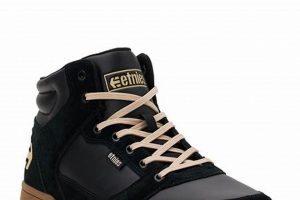
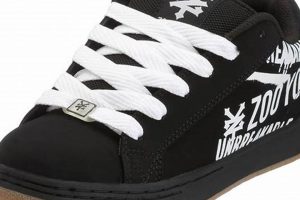
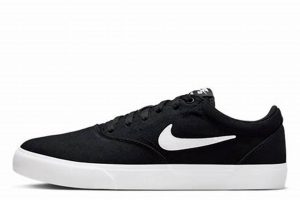
Footwear designed for skateboarding must withstand considerable abrasion and provide adequate support. These specialized products typically feature durable construction, reinforced stitching, and a flat, grippy outsole to maximize board feel and control. A suitable pair protects the wearer from impact and enhances performance during various skateboarding maneuvers.
The selection of appropriate skateboarding footwear significantly impacts both safety and skill development. Durable materials prolong the lifespan of the shoe, mitigating the costs associated with frequent replacements. Enhanced grip promotes stability and precision, enabling the execution of complex tricks. Historically, modifications were made to existing athletic shoes to better suit the demands of skateboarding, leading to the development of purpose-built designs.
The subsequent discussion will address the crucial elements to consider when choosing appropriate skateboarding footwear, including material composition, sole construction, impact absorption capabilities, and specific features that cater to different skateboarding styles and preferences.
Essential Considerations for Skateboarding Footwear
Selecting appropriate footwear is paramount for both performance and safety in skateboarding. Prioritizing durability, support, and grip will significantly enhance the skateboarding experience.
Tip 1: Prioritize Durable Materials: Canvas and suede are commonly employed due to their abrasion resistance. Leather provides enhanced protection and longevity but may compromise board feel. Consider reinforced stitching in high-wear areas such as the toe and ollie patch.
Tip 2: Examine Sole Construction: A flat, vulcanized rubber sole offers optimal grip and board feel. Cupsole construction provides greater impact protection, especially for skaters engaging in larger jumps and drops. The sole pattern should offer sufficient traction across various surfaces.
Tip 3: Assess Impact Absorption: Insoles with cushioning technologies, such as polyurethane or gel inserts, can mitigate the impact forces experienced during landings. Footwear with enhanced heel support and cushioning can further reduce the risk of injury.
Tip 4: Evaluate Ankle Support: High-top footwear provides additional ankle support and stability, particularly beneficial for beginners or those prone to ankle injuries. Low-top shoes offer greater flexibility and freedom of movement but less ankle protection.
Tip 5: Ensure a Snug and Comfortable Fit: Footwear should fit snugly without being restrictive. Adequate toe room is essential to prevent discomfort and blisters. Consider the shoe’s width to accommodate individual foot shapes.
Tip 6: Consider the Shoe’s Weight: Lightweight footwear can enhance board feel and reduce fatigue during extended skateboarding sessions. However, lighter materials may compromise durability.
Tip 7: Inspect Lacing Systems: Recessed or reinforced lacing systems minimize the risk of lace breakage during tricks. Consider using lace protectors or alternative lacing techniques to further extend lace lifespan.
By carefully considering these aspects, skateboarders can select footwear that provides the necessary protection, support, and performance characteristics to maximize their enjoyment and minimize the risk of injury.
The following sections will delve into specific footwear recommendations based on individual skateboarding styles and preferences, further refining the selection process.
1. Durable Material

The selection of durable materials is paramount in the context of skateboarding footwear. Footwear used in this activity is subjected to significant abrasion from contact with the skateboard deck, pavement, and other surfaces. The material’s capacity to resist wear and tear directly impacts the lifespan of the footwear. Inadequate material durability results in premature failure, necessitating frequent replacements and increased expenditure. For instance, skateboarding shoes constructed from low-grade canvas exhibit accelerated wear compared to shoes utilizing reinforced suede or leather.
The connection between material durability and the overall quality of skateboarding footwear extends beyond mere longevity. Durable materials contribute to consistent performance. Compromised structural integrity due to material degradation can negatively affect board feel, impact absorption, and ankle support. Consider the ollie patch, a critical area subject to intense friction. A reinforced ollie patch constructed from durable material safeguards against rapid wear, ensuring sustained performance during ollies and other flip tricks.
In summary, the relationship between durable materials and skateboarding footwear is one of direct causality and significant practical consequence. The utilization of abrasion-resistant materials directly translates to increased product longevity, enhanced performance consistency, and ultimately, reduced long-term costs for the skater. Understanding the material properties and their impact on footwear performance is essential for informed purchasing decisions. The choice of a material that’s up to task provides a solid foundation for optimal skating experience.
2. Sole Construction

Sole construction critically influences the performance and durability of skateboarding footwear. The manner in which the sole is attached to the upper shoe directly affects board feel, impact absorption, and overall shoe longevity. Two primary methods of sole construction, vulcanization and cupsole design, each offer distinct advantages and disadvantages within the context of skateboarding.
Vulcanized soles, characterized by their flexibility and heightened board feel, are created by bonding the rubber sole to the upper shoe through heat and pressure. This process yields a strong, flexible bond that allows the skater to feel the contours of the skateboard, facilitating precise board control. Conversely, cupsole construction involves stitching or cementing a pre-molded sole to the upper shoe. This approach offers greater impact protection due to the increased thickness of the sole unit and the inclusion of cushioning materials. For instance, skaters who primarily engage in street skating, characterized by flat ground tricks and technical maneuvers, often prefer the enhanced board feel of vulcanized soles. In contrast, skaters who frequently tackle larger obstacles, such as ramps and gaps, may benefit from the superior impact protection offered by cupsole construction. The sole pattern, or tread, is also a significant factor; deeper treads provide enhanced grip, particularly on rough or uneven surfaces, while smoother soles may offer slightly improved board feel.
The understanding of sole construction is thus crucial for selecting appropriate skateboarding footwear. The choice between vulcanized and cupsole designs, as well as the consideration of tread patterns, should align with the skater’s individual style, skill level, and the specific terrain they typically encounter. Prioritizing informed decision-making in relation to sole construction contributes directly to enhanced performance, increased safety, and prolonged footwear lifespan. Ultimately, a well-considered sole construction is a fundamental element of high-quality skateboarding footwear, directly influencing the skater’s ability to effectively engage with the sport.
3. Impact Absorption

Impact absorption is a critical attribute of skateboarding footwear due to the repetitive and often forceful landings inherent in the activity. The human body, particularly the feet, ankles, and knees, experiences significant stress from these impacts. Inadequate absorption of these forces can lead to acute injuries, such as sprains and fractures, as well as chronic conditions, including osteoarthritis and plantar fasciitis. Therefore, skateboarding footwear incorporating effective impact absorption technologies is essential for mitigating these risks and promoting long-term musculoskeletal health. For instance, skaters performing a simple ollie can generate forces several times their body weight upon landing. Without adequate cushioning, these forces are directly transmitted to the joints, increasing the likelihood of injury.
The effectiveness of impact absorption is typically achieved through the integration of specialized materials and design features within the shoe’s midsole and insole. Polyurethane (PU) and ethylene-vinyl acetate (EVA) foams are commonly employed for their cushioning properties, distributing impact forces across a larger area. Gel inserts and air pockets are also utilized to provide localized shock absorption and enhance comfort. Furthermore, the thickness and density of the midsole play a significant role in determining the level of impact protection. Footwear designed for vert skating or aggressive street skating often features thicker midsoles with higher densities to withstand the more substantial impacts associated with these disciplines. The practical application of this understanding is evident in the design of high-performance skateboarding shoes, which often incorporate multiple layers of cushioning materials and reinforced heel counters to maximize impact absorption and stability.
In conclusion, impact absorption is not merely a desirable feature, but a necessity in skateboarding footwear. The appropriate selection of shoes with effective impact absorption capabilities can significantly reduce the risk of injury, enhance comfort, and improve overall performance. Skaters must carefully consider the materials, construction, and design features of footwear to ensure adequate protection against the repetitive and forceful impacts inherent in the sport. Prioritizing impact absorption ultimately contributes to a safer and more sustainable skateboarding experience.
4. Ankle Support

Ankle support constitutes a significant element in the design and functionality of skateboarding footwear. The activity inherently involves a high risk of ankle injuries, including sprains and strains, due to the dynamic movements, sudden impacts, and potential for missteps. Footwear that adequately supports the ankle can mitigate these risks, enhancing both safety and performance. The level of support required is often dependent on the skater’s skill level, skateboarding style, and individual susceptibility to injury. For instance, novice skaters, who are still developing their balance and coordination, often benefit from footwear with increased ankle support. Similarly, skaters who engage in more aggressive forms of skateboarding, such as vert or street skating involving large drops, require enhanced ankle stability to withstand the forces generated upon landing.
The provision of ankle support in skateboarding footwear typically involves several design features. High-top designs, which extend above the ankle joint, offer a greater degree of stability and protection compared to low-top alternatives. Internal or external supports, such as reinforced heel counters or padded collars, further enhance ankle stability by limiting excessive movement. The rigidity and construction of the shoe’s upper also contribute to overall support; stiffer materials provide greater resistance to ankle inversion or eversion. Footwear lacking adequate ankle support may increase the likelihood of ankle injuries, leading to decreased performance and potential long-term complications. In contrast, well-designed skateboarding shoes with appropriate ankle support can enable skaters to execute complex maneuvers with greater confidence and reduce the risk of injury.
In conclusion, the connection between ankle support and skateboarding footwear is fundamentally linked to safety and performance. Footwear offering sufficient ankle support helps minimize the risk of injuries, particularly sprains and strains, while simultaneously enabling skaters to push their boundaries with greater assurance. The specific design features contributing to ankle support, such as high-top designs and reinforced structures, should be carefully considered based on individual needs and skateboarding styles. Understanding the crucial role of ankle support in footwear selection is a critical aspect of promoting a safe and sustainable skateboarding practice.
5. Snug Fit
A secure, conforming fit significantly influences skateboarding footwear performance. Ill-fitting shoes can cause instability, reduce board feel, and increase the risk of blisters and other foot-related injuries. A snug fit, conversely, ensures optimal contact between the foot and the shoe’s interior, translating to enhanced board control and responsiveness. Consider the scenario of attempting a kickflip: a shoe that allows the foot to slide internally compromises the skater’s ability to precisely manipulate the board’s rotation. A secure fit, in this instance, provides the necessary support and responsiveness for successful execution.
Achieving an appropriate fit requires considering several factors. Lacing systems play a crucial role in adjusting the shoe’s tightness. Recessed or reinforced lacing designs can prevent lace breakage during tricks, maintaining a consistent fit throughout a skateboarding session. Sock thickness also impacts the fit; thicker socks may necessitate a larger shoe size to prevent constriction. Furthermore, the shoe’s internal construction, including padding and arch support, contributes to the overall fit and comfort. A shoe with inadequate arch support, for example, can lead to foot fatigue and discomfort, even if the length and width are appropriate. A snug fit also means the toes should have adequate room to prevent jamming into the front of the shoe.
In summary, the relationship between a snug fit and effective skateboarding footwear is a causal one. A secure fit facilitates optimal board control, reduces the risk of injury, and enhances overall comfort. Achieving this fit necessitates careful consideration of lacing systems, sock thickness, and internal shoe construction. The practical significance of understanding this connection lies in its direct impact on skateboarding performance and safety. Selecting shoes that provide a snug, supportive fit is a fundamental aspect of optimizing the skateboarding experience.
Frequently Asked Questions
This section addresses common inquiries regarding footwear selection for skateboarding, providing objective information to inform purchasing decisions.
Question 1: What distinguishes skateboarding shoes from regular athletic shoes?
Skateboarding shoes are engineered for enhanced durability, grip, and board feel. These products typically feature reinforced construction, durable materials like suede or canvas, and flat, vulcanized rubber soles optimized for board control.
Question 2: How often should skateboarding shoes be replaced?
The lifespan of skateboarding shoes varies based on usage frequency, skateboarding style, and shoe quality. Visible signs of wear, such as sole separation or material tears, indicate the need for replacement. Regular inspection and preventative maintenance can prolong shoe life.
Question 3: Are high-top or low-top skateboarding shoes preferable?
The choice between high-top and low-top skateboarding shoes depends on individual preference and ankle support requirements. High-tops offer increased ankle stability, while low-tops provide greater freedom of movement. Consider skateboarding style and prior ankle injuries when making a decision.
Question 4: What materials are most durable for skateboarding shoes?
Suede and canvas are commonly employed due to their abrasion resistance. Leather provides enhanced protection and longevity, but may compromise board feel. Reinforced stitching in high-wear areas is crucial regardless of the primary material.
Question 5: How important is sole construction in skateboarding shoes?
Sole construction significantly affects board feel and impact protection. Vulcanized soles offer enhanced board feel and flexibility, while cupsole construction provides superior impact absorption. Select sole construction based on skateboarding style and terrain.
Question 6: Can skateboarding shoes be used for other activities?
While skateboarding shoes can be worn for casual purposes, their specialized design prioritizes skateboarding performance and durability. Using them for other high-impact activities may accelerate wear and tear.
Prioritizing informed decision-making based on these factors will contribute to the selection of appropriate skateboarding footwear.
The subsequent section will explore advanced considerations in skateboarding footwear, including specific technologies and customization options.
Essential Footwear for Skateboarding Performance
The preceding analysis has examined the multifaceted characteristics of “good shoes to skate in,” focusing on the critical factors of material durability, sole construction, impact absorption, ankle support, and fit. Each of these elements contributes significantly to the performance and safety of the skater. The selection of appropriate footwear represents a crucial investment in both athletic capability and injury prevention.
The information presented should empower skateboarders to make informed decisions when purchasing footwear. Recognizing the interplay between shoe design and skating demands allows for optimized performance and a reduced risk of physical harm. Further research and consultation with experienced skaters or retail professionals are encouraged to refine footwear selection based on individual needs and preferences.