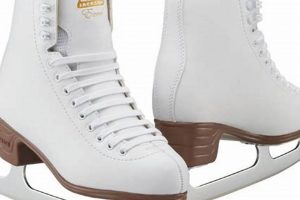
These specialized ice skates are designed for the execution of jumps, spins, and intricate footwork. A defining characteristic is the presence of toe picks on the front of the blade, which are crucial for launching into jumps and providing stability during certain maneuvers. The blade itself is typically longer and more curved than those found on hockey skates, facilitating smoother gliding and edge control. For example, competitive athletes rely on properly fitted and maintained equipment to perform required elements in their programs.
Their importance stems from their direct impact on an athlete’s ability to perform and progress in the sport. The design allows for the necessary precision and control needed to master challenging skills. Historically, evolving designs have played a significant role in advancing the technical capabilities of skaters, allowing for more complex and athletic performances. Choosing the appropriate equipment, alongside skilled coaching, can directly contribute to improved performance, decreased risk of injury, and enhanced enjoyment of the discipline.
The following sections will delve into the specific components, fitting considerations, and maintenance practices associated with these skates, providing a more comprehensive understanding of their role in the world of ice skating. Understanding these aspects is essential for both aspiring and experienced skaters to optimize performance and longevity in the sport.
Figure Skates
This section provides crucial advice regarding the selection, fitting, and maintenance of specialized ice skates. Proper care and informed choices are paramount for performance and safety.
Tip 1: Blade Selection: Consider skill level and skating style. Beginner blades are generally less expensive and forgiving, while advanced blades offer greater precision and edge control. For example, a novice skater might begin with a blade featuring a larger radius of rocker, facilitating easier turns.
Tip 2: Boot Stiffness: Choose boot stiffness appropriate for skating level. Stiffer boots provide more ankle support, crucial for executing advanced jumps. Overly stiff boots can hinder beginner’s progress by restricting ankle movement.
Tip 3: Professional Fitting: Seek a qualified fitter. Ill-fitting equipment can lead to discomfort, blisters, and potential injuries. A professional fitter will assess foot shape, size, and skating needs to recommend the optimal boot and blade combination.
Tip 4: Proper Lacing: Lace the skates firmly, but not excessively tight. Tight lacing restricts circulation and can cause numbness. Focus on achieving a snug fit around the ankle for optimal support.
Tip 5: Blade Sharpening: Maintain blade sharpness. Dull blades reduce edge control and make it difficult to perform maneuvers. The frequency of sharpening depends on skating frequency and ice conditions, generally every 10-20 hours of skating time.
Tip 6: Blade Protection: Always use hard guards when walking off the ice. This prevents nicks and damage to the blades. Soft guards should be used for storage to absorb moisture and prevent rusting.
Tip 7: Drying After Use: Thoroughly dry blades and boots after each skating session. Use a clean cloth to wipe down the blades and allow the boots to air dry. This prevents rust and mildew, extending the lifespan of the equipment.
Adhering to these guidelines is essential for maximizing the performance and lifespan. Neglecting proper care can lead to diminished performance, increased risk of injury, and costly repairs.
The subsequent sections will explore the specific types and advanced customization techniques, further enhancing your understanding of their intricate role in the sport.
1. Blade Composition

The composition of a figure skate blade is a primary determinant of performance characteristics. The materials used and their manufacturing processes directly influence the blade’s edge quality, durability, and overall responsiveness on the ice. Selecting the appropriate composition is crucial for skaters seeking to optimize their technical execution and artistic expression.
- Steel Type and Hardness
The type of steel used significantly affects edge retention and resistance to wear. High-carbon steel alloys, for example, offer superior hardness, leading to longer-lasting sharp edges. However, increased hardness can sometimes result in brittleness, making the blade more susceptible to chipping or cracking under extreme stress. The Rockwell hardness scale is a common metric used to quantify the steel’s resistance to indentation, providing a benchmark for skaters to compare different blades.
- Manufacturing Process
The method of manufacturing, such as forging versus casting, impacts the blade’s structural integrity and consistency. Forged blades, created through hammering and shaping heated metal, tend to be denser and more resistant to bending or warping than cast blades. Controlled heat treatment processes are also critical in optimizing the steel’s hardness and toughness, ensuring a balance between edge retention and resistance to fracture. Precise manufacturing techniques contribute to uniform blade geometry and consistent performance.
- Coating and Plating
Surface coatings or plating, such as chrome or titanium, can enhance a blade’s resistance to corrosion and improve its gliding properties. Chrome plating, for example, provides a protective layer against rust and can reduce friction between the blade and the ice, resulting in smoother glides. However, the thickness and quality of the plating are crucial; poorly applied coatings can chip or flake off, diminishing their protective benefits. Some advanced blades utilize specialized coatings to further reduce friction and improve ice feel.
- Blade Flexibility
The composition indirectly affects flexibility. The type of metal that is used, as well as its density or thickness, will play a part in the give and take that is experienced when skating. Blades with higher carbon or steel, can increase the hardness, but can also reduce the ability to twist and turn the skate. Therefore, you need to take into consideration the material and your personal needs or preferences.
Understanding the intricate relationship between blade composition and performance is essential for both skaters and coaches. By carefully considering the steel type, manufacturing process, and any applied coatings, skaters can select blades that best suit their skill level, skating style, and the specific demands of their routines. These choices, informed by technical knowledge and experience, can significantly impact a skater’s ability to execute complex maneuvers and achieve their competitive goals.
2. Boot Stiffness

Boot stiffness is a critical parameter in the design and selection of figure skates, directly impacting an athlete’s performance, control, and risk of injury. The boot’s resistance to flexion and torsion dictates the level of support provided to the ankle and lower leg, influencing the skater’s ability to execute jumps, spins, and footwork with precision and stability. Selecting the appropriate boot stiffness is a nuanced process, contingent on the skater’s skill level, body weight, and the specific demands of their training regimen.
- Ankle Support and Injury Prevention
Stiffer boots provide increased ankle support, minimizing the risk of sprains and other lower extremity injuries, particularly during high-impact landings. The rigid structure limits excessive ankle movement, preventing the joint from exceeding its natural range of motion. This is especially important for skaters performing complex multiple-revolution jumps. However, excessively stiff boots can restrict ankle mobility, hindering the development of proper skating technique, especially in beginners.
- Energy Transfer and Jump Execution
The stiffness of the boot influences the efficiency of energy transfer from the skater’s body to the blade. Stiffer boots minimize energy loss during the jump take-off, allowing the skater to generate more power and achieve greater height and distance. This is crucial for executing demanding jump elements. Softer boots, while providing more flexibility, may result in decreased power output and less controlled landings.
- Control and Edge Work Precision
Boot stiffness affects a skater’s ability to maintain precise control over edges. Stiffer boots transmit subtle movements of the ankle and foot directly to the blade, enabling skaters to execute intricate edge work and maintain stability during complex turns and spins. Softer boots may provide less responsiveness, making it more challenging to achieve the necessary precision for advanced skating maneuvers.
- Progression and Skill Development
The appropriate boot stiffness should align with a skater’s current skill level and their progression goals. Beginner skaters typically benefit from boots with moderate stiffness, allowing them to develop fundamental skating skills without excessive restriction. As skaters advance and begin to attempt more challenging elements, stiffer boots become necessary to provide the required support and control. Over time, the level of support is increased as needed.
The selection of figure skates should involve careful consideration of boot stiffness, taking into account the skater’s individual needs and skill level. Professional fitting and guidance from experienced coaches are essential to ensure that the chosen boots provide the optimal balance of support, control, and flexibility, maximizing performance and minimizing the risk of injury. As skaters progress, their boot stiffness should be periodically reevaluated to accommodate their evolving technical abilities and physical development, ensuring they have the appropriate equipment for optimum improvement.
3. Ankle Support
Ankle support within figure skates is a foundational element, crucial for both performance and injury prevention. It determines a skater’s ability to maintain balance, execute intricate maneuvers, and withstand the repetitive stresses inherent in the sport. The level of support required varies based on skill level, skating frequency, and the specific demands of the skater’s programs.
- Boot Stiffness and Stability
Boot stiffness directly translates to the degree of ankle support. Stiffer boots provide greater stability, preventing excessive ankle pronation or supination, particularly during landings from jumps. For instance, a skater attempting triple jumps requires significantly stiffer boots than a novice learning basic edges. However, overly stiff boots can impede ankle flexibility, potentially hindering the development of proper technique and muscle strength. The correct balance is essential.
- Lacing Systems and Customization
Lacing systems play a critical role in achieving optimal ankle support. Proper lacing techniques, such as strategic tightening in specific areas, allow skaters to customize the fit and support according to their individual needs. For example, tightening the laces around the ankle can enhance stability for skaters prone to ankle instability, while loosening the laces in the lower foot area can improve comfort and range of motion. The proper use of lacing techniques can significantly improve comfort, support, and ankle health.
- Boot Height and Cuff Design
The height of the boot and the design of the cuff contribute to overall ankle support. Higher boots offer more extensive support to the lower leg, while specifically designed cuffs can provide additional reinforcement around the ankle joint. Innovations in cuff design, such as articulated cuffs that allow for a greater range of motion while still providing support, are constantly evolving. This can be especially helpful for jumps.
- Material Construction and Padding
The materials used in the construction of the boot, as well as the type and placement of padding, influence the level of ankle support. High-quality materials, such as reinforced leather or synthetic composites, provide a rigid yet comfortable structure. Strategic placement of padding around the ankle bone can further enhance comfort and prevent rubbing or pressure points. Over time, the fit and padding can shift and need to be replaced to continue giving the support needed.
The multifaceted nature of ankle support in figure skates necessitates careful consideration of boot stiffness, lacing systems, boot height, and material construction. Skaters must work with qualified professionals to select equipment that provides the optimal balance of support, comfort, and flexibility, ensuring both performance enhancement and injury prevention. Neglecting these factors can compromise skating performance and increase the risk of long-term musculoskeletal problems.
4. Toe Pick Design
The toe pick, a series of serrated teeth located at the front of the blade, is a defining feature of figure skates. Its design directly dictates the execution of pivotal maneuvers, most notably jumps and spins. The size, shape, and arrangement of the teeth impact the skater’s ability to gain purchase on the ice for takeoffs and landings. For example, a larger, more aggressively shaped toe pick provides greater grip, facilitating powerful jumps such as the Lutz and Flip. Conversely, a smaller, less pronounced toe pick offers greater control during spins and intricate footwork.
Variations in toe pick design cater to different skating styles and skill levels. Beginners often benefit from smaller toe picks, which reduce the risk of accidental catches and promote the development of proper edge control. Advanced skaters, however, require more substantial toe picks to execute complex jumps involving multiple rotations. The placement of the toe pick relative to the blade’s rocker also influences performance, affecting the skater’s balance and the ease with which they can initiate spins. Incorrect toe pick design can hinder a skater’s progress and increase the risk of falls. A prominent example of the impact of design on technique can be seen in the evolution of the toe loop jump, where subtle adjustments to the toe pick shape have allowed for more consistent and controlled execution.
In essence, the toe pick’s design is integral to the functionality of figure skates. Its precise geometry and placement impact the skater’s ability to perform fundamental and advanced skills. Understanding these connections is crucial for skaters, coaches, and equipment manufacturers alike. Optimization of toe pick design remains a key area of development in figure skating equipment, with ongoing research aimed at enhancing performance and safety. The nuanced relationship between toe pick design and skating technique underscores its enduring importance in the sport.
5. Blade Curvature
Blade curvature, a critical parameter in figure skate design, fundamentally influences a skater’s maneuverability, glide, and stability on the ice. This curvature, often referred to as the rocker, determines the contact point between the blade and the ice surface, directly impacting edge control and the ease with which a skater can perform turns, spins, and jumps.
- Radius of Rocker and Glide Efficiency
The radius of rocker describes the curvature along the length of the blade. A smaller radius of rocker (i.e., a more curved blade) allows for quicker turns and increased maneuverability but can reduce glide efficiency due to the smaller contact area. Conversely, a larger radius of rocker (i.e., a flatter blade) provides greater glide efficiency and stability on straight lines, but may make turns more challenging. Competitive skaters often select blades with specific rocker profiles optimized for their individual skating style and program requirements. For example, a skater specializing in intricate footwork may favor a blade with a smaller radius of rocker, while a skater prioritizing speed and glide may prefer a blade with a larger radius.
- Sweet Spot and Balance Point
The sweet spot refers to the optimal contact point on the blade where the skater can maintain balance and control. Blade curvature directly influences the location and size of the sweet spot. A well-designed blade will have a sweet spot positioned to allow for effortless balance and smooth transitions between edges. Factors such as blade length, rocker profile, and blade placement on the boot affect the position of the sweet spot, requiring skaters to adapt their technique accordingly. A skater struggling with balance may benefit from adjusting the blade’s position or selecting a blade with a more forgiving sweet spot.
- Blade Curvature and Edge Control
Blade curvature is intrinsically linked to edge control, which is paramount for executing all skating maneuvers. The curvature facilitates the skater’s ability to engage and maintain consistent pressure on the inside and outside edges of the blade. Proper edge control allows for precise turns, stable landings, and controlled spins. Variations in blade curvature can influence the ease with which a skater can achieve the desired edge angle, necessitating adjustments in technique to compensate for the blade’s characteristics. Skaters performing advanced edge jumps, such as the loop or axel, require exceptional edge control facilitated by a properly designed and maintained blade curvature.
- Transitional Curvature and Flow
The smoothness of the transition between different curvatures along the blade affects a skater’s flow and the seamlessness of their movements. Abrupt changes in curvature can create instability and hinder the skater’s ability to maintain a continuous flow of motion. Well-designed blades feature gradual transitions in curvature, allowing for smooth and effortless changes in direction and edge engagement. Skaters often describe a “smooth” blade as one that allows them to effortlessly transition between edges and maintain a consistent flow of movement across the ice.
In summary, blade curvature is a fundamental design element impacting the performance of figure skates. By understanding the interplay between rocker, sweet spot, edge control, and transitional curvature, skaters can make informed decisions about blade selection and maintenance, ultimately optimizing their performance and enhancing their connection to the ice. The evolution of blade curvature continues to drive innovation in figure skating, enabling athletes to push the boundaries of technical and artistic expression.
Frequently Asked Questions About figure skates
This section addresses common inquiries concerning specialized footwear designed for ice skating. The information provided aims to clarify uncertainties and offer guidance.
Question 1: How does figure skate blade sharpening affect performance?
Blade sharpening creates edges that grip the ice, allowing for controlled movements. Dull blades diminish edge control, compromising jumps, spins, and turns. Regular sharpening, performed by a qualified technician, is essential for optimal performance.
Question 2: What is the significance of boot stiffness in figure skates?
Boot stiffness provides ankle support and facilitates energy transfer during jumps and spins. The appropriate stiffness level depends on the skater’s skill level and body weight. Insufficient stiffness increases the risk of injury, while excessive stiffness restricts mobility.
Question 3: How often should figure skates be replaced?
The lifespan of figure skates depends on usage frequency and maintenance. Signs of wear, such as breakdown of the boot’s support or significant blade damage, indicate the need for replacement. Professional assessment is recommended.
Question 4: What constitutes a proper fit for figure skates?
A proper fit ensures a snug but comfortable fit, allowing for minimal movement within the boot. The heel should be securely locked in place, and the toes should have adequate room. Professional fitting is crucial to avoid discomfort and potential injuries.
Question 5: How should figure skate blades be protected when not in use?
Hard guards should be used when walking off the ice to prevent damage to the blades. Soft guards should be used for storage to absorb moisture and prevent rusting. Regular cleaning and drying of the blades after each use are also essential.
Question 6: What is the purpose of toe picks on figure skate blades?
Toe picks are used to initiate jumps, spins, and certain footwork maneuvers. The size and shape of the toe pick influence the skater’s ability to execute these elements effectively. Different toe pick designs cater to varying skill levels and skating styles.
The information above is aimed to enhance understanding of this specific equipment, promoting safe practices and improving athletic achievements.
The following section will offer guidance for maximizing the potential of these skates, leading to enhanced performance.
Conclusion
This discussion has explored critical aspects of figure skates, underscoring their significance in enabling athletic performance and ensuring skater safety. From the intricacies of blade composition and boot stiffness to the nuanced impact of toe pick design and blade curvature, each element contributes to the equipment’s overall functionality and effectiveness. Understanding these features is paramount for skaters, coaches, and equipment professionals alike.
The ongoing pursuit of innovation in figure skating equipment reflects a dedication to advancing athletic capabilities and minimizing the risk of injury. Continued research, informed selection, and meticulous maintenance remain essential for optimizing performance and promoting longevity within the sport. Investing in knowledge and expertise surrounding figure skates represents a commitment to excellence on the ice, fostering both technical mastery and artistic expression.