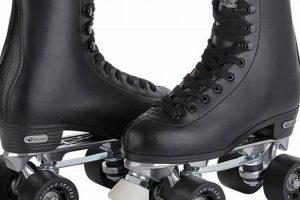
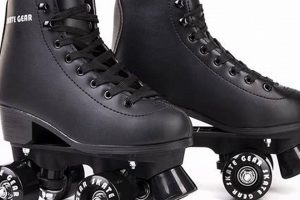
The act of propelling oneself forward on specialized footwear equipped with wheelscommonly arranged in two sets of two constitutes a recreational and athletic pursuit. This activity requires balance, coordination, and controlled movements to navigate various surfaces. Proficiency comes with practice and understanding of fundamental techniques.
Engaging in this wheeled activity provides numerous physical and mental advantages. It promotes cardiovascular health, strengthens leg muscles, and improves balance and coordination. Historically, it has served as a popular form of exercise, entertainment, and even transportation, evolving from rudimentary designs to sophisticated equipment used in diverse disciplines like roller derby, artistic skating, and speed skating.
The subsequent sections will detail the essential steps involved in learning the basic techniques, from initial stance and balance to forward motion, turning, and stopping. Guidance on safety measures and equipment selection will also be provided to ensure a secure and enjoyable experience.
Essential Techniques and Safety Measures
The following recommendations aim to provide guidance for a successful and safe introduction to this activity. Focus on foundational skills and prioritizing personal safety.
Tip 1: Gear Acquisition. Prioritize appropriate safety gear. A helmet, wrist guards, elbow pads, and knee pads are essential to mitigate potential injuries, especially during the initial learning phase. Ensure a snug and secure fit for all protective equipment.
Tip 2: Initial Stance. Begin by establishing a stable stance. Maintain a slight bend in the knees and a balanced distribution of weight between both feet. This posture lowers the center of gravity, promoting stability and control.
Tip 3: Controlled Movement. Initiate forward motion with small, controlled steps. Avoid large, sudden movements that can compromise balance. Gradually increase stride length and speed as confidence and stability improve.
Tip 4: Mastering the “Duck Walk”. Practice the “duck walk” technique, where the heels are together and toes are pointed outward. This helps build muscle memory and develop a feel for gliding and controlling direction.
Tip 5: Safe Stopping. Learn to stop using the toe stop, if equipped. Apply gradual pressure while keeping the non-stopping foot slightly behind. Alternative methods, such as the T-stop, require more advanced skill and should be practiced under controlled conditions.
Tip 6: Practice Area. Choose a smooth, flat surface free of obstacles and traffic. This minimizes the risk of falls and allows for focus on fundamental techniques. Designated skating areas or empty parking lots are suitable options.
Tip 7: Gradual Progression. Advance skills incrementally. Do not attempt complex maneuvers before mastering the basics. Rushing the learning process increases the likelihood of accidents and discouragement.
By consistently adhering to these recommendations, individuals can effectively build a solid foundation, increasing safety and overall enjoyment.
With a focus on building a strong foundation in these skills, one can look forward to enjoying a safe and fun experience.
1. Balance

Balance is the cornerstone of competent roller skating. The physics of maintaining equilibrium while on wheels necessitates constant adjustments to counteract the forces of gravity and momentum. Instability results in falls and hinders the ability to execute even the simplest maneuvers. For example, a skater unable to maintain an upright posture over the wheels will struggle to propel themselves forward efficiently or safely, and is more likely to experience loss of control.
The relationship between balance and roller skating extends beyond merely staying upright. Controlled balance allows for nuanced weight shifting, enabling turns, transitions, and more complex skating techniques. A skater with good balance can lean into turns, using their body weight to control their trajectory. Conversely, poor balance limits maneuverability and increases the risk of collisions with obstacles or other skaters. Figure skating maneuvers, for example, rely heavily on achieving and maintaining balance on a single wheel.
In summary, balance is not merely a prerequisite for roller skating; it is an integral, dynamic component that directly impacts the skater’s ability to move effectively, safely, and with control. Without a solid foundation in balance, attempts to learn more advanced skills are likely to be unproductive and potentially dangerous. Consistent practice of foundational balance exercises is essential for all skill levels, highlighting the ongoing relevance of this principle.
2. Posture
Posture, in the context of roller skating, constitutes more than mere uprightness. It is a dynamic alignment of the body’s center of gravity relative to the supporting wheels, fundamentally influencing balance, control, and overall skating efficiency. Incorrect posture acts as a direct impediment to proper technique, creating unnecessary strain and increasing the likelihood of falls. For instance, a skater with rounded shoulders and a forward-leaning head displaces their center of gravity, making it difficult to maintain balance during turns or when encountering uneven surfaces. This misalignment forces compensatory adjustments in other muscle groups, leading to fatigue and potential injury.
The practical implications of correct posture are significant across all skill levels. A slight bend at the knees, a straight back, and engaged core muscles create a stable and responsive platform for executing various skating maneuvers. This posture allows for effective weight transfer, essential for initiating turns and controlling speed. In disciplines such as roller derby, where rapid changes in direction and physical contact are common, a strong, balanced posture is crucial for maintaining stability and avoiding collisions. Conversely, improper posture leads to wasted energy and diminished control, hindering performance and increasing the risk of accidents. Furthermore, a neutral spine minimizes the risk of lower back pain, a common complaint among skaters with poor postural habits.
In conclusion, appropriate posture is not merely a cosmetic concern, but a biomechanical imperative for proficient and safe roller skating. The subtle yet profound impact of postural alignment on balance, control, and energy efficiency cannot be overstated. Regular attention to posture during practice, combined with targeted exercises to strengthen core muscles and improve body awareness, is essential for both beginners and advanced skaters seeking to maximize their performance and minimize the risk of injury. Posture serves as the invisible foundation upon which all other skating skills are built, thereby playing an indispensable role.
3. Glide
Glide represents the essence of efficient movement on roller skates. It is the prolonged maintenance of forward motion achieved with minimal effort, directly impacting the skater’s ability to cover distance and conserve energy. Insufficient glide necessitates frequent and forceful pushes, leading to fatigue and reduced speed. Effective gliding relies on a combination of factors, including proper technique, appropriate skate selection, and suitable skating surface. A skater employing long, smooth strokes and maintaining momentum demonstrates proficiency in utilizing the glide principle. Conversely, a skater who relies on short, choppy steps experiences reduced glide and expends more energy to achieve the same speed.
The quality of glide is significantly influenced by skate maintenance and surface conditions. Well-lubricated bearings and smooth wheels minimize friction, enhancing glide efficiency. Rough or uneven surfaces increase friction, hindering glide and requiring more effort to maintain momentum. For example, skaters participating in long-distance events prioritize skates with high-quality bearings designed for optimal glide performance. Similarly, skaters on smooth, polished surfaces, such as those found in indoor skating rinks, experience superior glide compared to those skating on rough asphalt. The ability to optimize glide is also crucial in artistic roller skating, where fluid movements and seamless transitions are essential for scoring well.
In summary, glide is a critical element in skating, enabling efficient and sustained movement. Understanding and optimizing glide requires attention to technique, equipment maintenance, and surface selection. By mastering the principles of glide, skaters can enhance their performance, reduce fatigue, and experience the full potential of skating. The improvement and proper focus of the glide will transform any roller-skater to expert in their profession.
4. Control
The element of control in roller skating represents the capacity to govern direction, speed, and movement with precision and stability. It is a multifaceted skill that encompasses the ability to initiate, sustain, alter, and cease motion according to intention. Deficient control invariably increases the risk of collisions, falls, and injury. Successful execution of skating maneuvers hinges on the skaters capacity to maintain equilibrium while dynamically adjusting their body position and applying appropriate force to the skates. The cause-and-effect relationship is evident: compromised balance directly impedes the ability to exert control, while conversely, skillful manipulation of balance enhances directional and speed regulation. For example, attempting a sharp turn without adequate balance control may result in a loss of footing and subsequent fall.
Controls importance in roller skating is demonstrable in various applications, ranging from recreational use to competitive disciplines. In roller derby, athletes must maintain rigorous control while navigating close quarters, executing strategic maneuvers, and absorbing physical contact. Failure to control one’s movement in this environment can lead to penalties or injuries. Artistic roller skating, another example, demands precise control of edges, turns, and jumps, where even minute deviations can impact performance scores. Street skating also relies heavily on control: Navigating city sidewalks safely necessitates the ability to react quickly to unexpected obstacles and pedestrian traffic. In these scenarios, the effective transfer of weight and the subtle adjustments made in foot and ankle placement are key to successful maneuvering.
Ultimately, the attainment of control is a process involving gradual skill development through consistent practice and focused attention. The practical significance of this understanding lies in its direct correlation to safety, performance, and enjoyment. Individuals who prioritize the development of control are better equipped to navigate diverse skating environments, execute complex maneuvers with confidence, and mitigate the risk of accidents. The journey to proficient roller skating is thus, inextricably linked to the cultivation of a strong sense of control over one’s movements on wheels.
5. Braking

Braking is an essential component of roller skating, directly influencing the skater’s safety and ability to navigate environments effectively. The capacity to decelerate or stop in a controlled manner mitigates the risk of collisions with obstacles, other individuals, or the ground. Inadequate braking technique can lead to loss of control, resulting in falls and potential injuries. Braking competence is therefore fundamentally connected to how roller skating can be safely and successfully performed.
Several braking methods exist, each with specific applications and degrees of effectiveness. The toe stop, often found on recreational skates, allows for relatively quick deceleration but requires proper weight distribution and coordination to avoid abrupt stops that could cause imbalance. The T-stop, executed by dragging one skate perpendicularly behind the other, provides greater control but demands more advanced skill and practice. Other techniques, such as the plow stop, involve turning both skates inward to create friction. The selection of an appropriate braking technique depends on the skater’s skill level, the speed of travel, and the surrounding environment. Mastering these methods allows for navigating complex or dangerous situations.
In conclusion, proficient braking is not merely an ancillary skill, but an integral aspect of safe and controlled roller skating. Its importance spans recreational, athletic, and practical skating contexts. The capacity to effectively decelerate or stop is crucial for mitigating risk, navigating diverse environments, and executing maneuvers with precision. The study and refinement of braking techniques are thus essential elements in learning and mastering roller skating, contributing directly to the skater’s overall confidence and safety. Braking techniques contribute to the safety in public scenario.
6. Momentum
Momentum plays a crucial role in efficient skating. It enables skaters to maintain speed and conserve energy, influencing the overall skating experience.
- Initial Impetus and Sustained Motion
Generating initial momentum requires effort, but once established, a skater can maintain velocity with minimal exertion. The skater’s weight, the smoothness of the surface, and the efficiency of each push-off contribute to maintaining speed over time. For example, pushing off correctly with an appropriate body lean converts energy to momentum. Proper technique optimizes the transfer of kinetic energy with each stride.
- Negotiating Inclines and Declines
Uphills require additional energy to overcome gravity and maintain momentum. Conversely, downhills utilize gravity to increase momentum. Skilled skaters adjust their posture and stride to efficiently manage momentum on varied terrains. For example, a skater will shorten strides and lower their center of gravity to prevent loss of control.
- Turning and Directional Changes
Changes in direction influence momentum. Turning requires leaning into the curve, using the skater’s body weight to redirect the existing momentum. Abrupt turns decrease forward momentum more drastically than gradual turns. In roller derby, skaters use hip checks to transfer and disrupt opponent’s momentum, thus gaining a competitive advantage.
- Braking and Deceleration
Braking dissipates momentum. Techniques such as the T-stop or heel stop convert kinetic energy into heat, slowing the skater. Understanding the relationship between applied braking force and resulting deceleration allows skaters to control their speed effectively and safely. Using a drag stop or other form of stop reduces the skaters current momentum.
Managing momentum is vital. Skillful skaters can utilize environmental conditions such as ramps and smooth surfaces to build speed and conserve energy. Mastering momentum involves more efficient skating.
Frequently Asked Questions
The following addresses common inquiries related to the practical aspects and safety considerations of the act of propelling oneself on wheeled boots, providing concise answers based on established practices.
Question 1: What protective gear is deemed essential for safe roller skating practice?
A helmet that meets safety standards, wrist guards, elbow pads, and knee pads are considered fundamental for injury prevention, particularly for beginners. These items mitigate the impact forces associated with falls.
Question 2: How does one determine the appropriate size and fit for roller skates?
Skates should fit snugly, allowing minimal heel lift while providing adequate toe room. Measurements can be taken using a standard shoe size chart, but trying the skates on with appropriate socks is highly recommended to ensure proper fit.
Question 3: What constitutes an ideal surface for learning to roller skate?
Smooth, flat surfaces free from obstacles, such as designated skating rinks or well-maintained paved areas, provide optimal conditions for beginners to develop balance and coordination.
Question 4: What are some fundamental techniques for maintaining balance on roller skates?
Maintaining a slightly bent knee posture, distributing weight evenly between both feet, and engaging core muscles are crucial for maintaining balance. Regular practice of these techniques improves stability.
Question 5: How does one safely execute a stop while roller skating?
The toe stop, located at the front of many recreational skates, is a common method. Applying gradual pressure to the toe stop while keeping the non-stopping foot slightly behind allows for controlled deceleration. More advanced techniques, such as the T-stop, may require additional practice.
Question 6: What are the key maintenance procedures to ensure optimal roller skate performance and longevity?
Regularly cleaning the wheels and bearings, checking for loose components, and ensuring proper lubrication are vital for maintaining skate performance. Storing skates in a dry environment can prevent rust and corrosion.
Adhering to these principles contributes to a safer and more enjoyable initiation into the art of roller skating, laying a solid foundation for continued skill development.
The subsequent section transitions to advanced techniques and alternative skating styles.
The Art of Roller Skating
This document has explored the fundamental elements involved in the activity referred to as “how do you roller skate.” The examination encompassed essential techniques, safety considerations, and the underlying principles governing balance, posture, glide, control, braking, and momentum. Emphasis was placed on the gradual progression from basic skills to more advanced maneuvers, highlighting the importance of proper equipment, practice, and awareness of one’s surroundings.
Continued dedication to honing these skills enhances not only individual skating proficiency but also promotes a safer and more rewarding experience. Further exploration into specialized skating disciplines and advanced techniques is encouraged for those seeking to expand their expertise. The pursuit of mastery in this activity offers both physical and mental benefits, contributing to an active and engaging lifestyle.