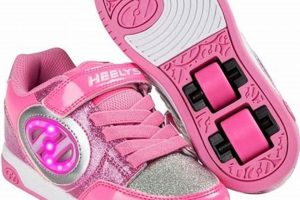
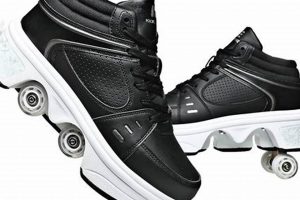
Footwear incorporating a recessed wheel in the heel presents a unique form of mobility. This design allows the user to transition seamlessly between walking and rolling by shifting their weight. The integrated wheel mechanism distinguishes this type of footwear from conventional skates, offering a combined walking and skating experience.
The appeal of this wheeled footwear stems from its portability and the potential for recreational activity in various environments. The user can enjoy a skating-like experience without needing a separate pair of skates. Furthermore, this particular kind of footwear has evolved over time to include models designed for increased safety and performance, contributing to its enduring popularity amongst specific demographics.
The subsequent sections will explore the technical aspects, safety considerations, and target demographic associated with this dual-function footwear design. Furthermore, the discussion will extend to applicable regulations and maintenance protocols to ensure prolonged use and user safety.
Essential Usage Guidance
The following guidelines aim to enhance safety and extend the longevity of wheeled heel footwear. Adhering to these recommendations promotes responsible use and minimizes potential hazards.
Tip 1: Prioritize Safety Equipment. It is imperative to wear protective gear, including helmets, knee pads, elbow pads, and wrist guards, particularly during initial learning phases and in areas with pedestrian traffic. Consistent use of such equipment mitigates the risk of injury.
Tip 2: Select Appropriate Surfaces. Utilize smooth, paved surfaces free from debris, cracks, and obstructions. Avoid areas with significant inclines or declines, as well as surfaces that may compromise wheel traction. This will help maintain control and prevent accidents.
Tip 3: Master Fundamental Techniques. Before attempting advanced maneuvers, practice basic skills such as starting, stopping, and turning. Ensure proficiency in weight shifting and balance to navigate effectively and safely.
Tip 4: Maintain Adequate Speed Control. Regulate velocity based on environmental conditions and personal skill level. Excessive speed increases the potential for loss of control and subsequent injury. Practice controlled braking techniques.
Tip 5: Regularly Inspect the Footwear. Conduct thorough inspections of the wheel mechanism, axles, and shoe structure before each use. Any signs of wear, damage, or looseness require immediate attention and potential repair or replacement. This will ensure reliable functionality.
Tip 6: Observe Local Regulations. Familiarize oneself with and adhere to all applicable laws and ordinances governing the use of wheeled footwear in public spaces. Compliance ensures both user safety and respect for pedestrian rights-of-way.
These guidelines underscore the importance of responsible operation and preventive maintenance. By implementing these suggestions, users can maximize enjoyment while minimizing potential risks.
The subsequent section will focus on maintenance procedures that further contribute to the extended life and safe usage of wheeled heel footwear.
1. Rolling Functionality

Rolling functionality constitutes the core operational principle of wheeled heel footwear. It directly dictates the user’s ability to translate between walking and a skating-like motion. The design and performance of the integrated wheel system are therefore paramount to the overall experience and safety associated with this type of footwear.
- Wheel Composition and Durability
The composition of the wheel itselftypically polyurethanedetermines its durability, grip, and rolling efficiency. A harder compound offers increased longevity but may compromise traction, particularly on uneven surfaces. Conversely, a softer compound provides enhanced grip but is subject to more rapid wear. Selection of wheel material influences the overall lifespan and performance characteristics of the product.
- Bearing System Performance
The bearing system within the wheel assembly plays a critical role in facilitating smooth, low-friction rotation. High-quality bearings minimize energy expenditure and enhance the user’s ability to maintain momentum. The performance of the bearings is directly correlated with the overall speed and ease of use; poorly maintained or low-grade bearings significantly impede rolling functionality.
- Wheel Recess Design and Integration
The design of the wheel recess within the heel dictates the degree to which the wheel can be deployed and retracted. A well-designed recess allows for seamless transitions between walking and rolling modes. The integration must be robust enough to withstand the forces generated during rolling, preventing damage to the shoe structure and ensuring user safety.
- Braking and Control Mechanisms
While the primary mode of propulsion is rolling, effective braking and control mechanisms are essential for safety. Users typically rely on heel pressure and weight distribution to initiate braking. The effectiveness of these techniques is intrinsically linked to the rolling functionality, as a compromised wheel or bearing system can impede control and increase the risk of accidents.
In summation, rolling functionality is not merely an attribute; it represents the defining operational characteristic of wheeled heel footwear. It’s quality is reliant on a synthesis of material choices, design implementation, and responsible maintenance to achieve the intended blend of mobility and recreational engagement. Understanding the nuances of this interrelationship promotes safer and more enjoyable use of this distinctive product.
2. Footwear Integration
Footwear integration, within the context of wheeled heel footwear, represents a crucial engineering challenge. It involves the seamless incorporation of a rolling mechanism into a standard shoe structure, necessitating careful consideration of structural integrity, user comfort, and functional reliability. The success of this integration directly impacts the performance, safety, and longevity of the product.
- Structural Reinforcement
The introduction of a wheel recess weakens the heel structure of conventional footwear. Therefore, adequate reinforcement is essential to maintain integrity under the stresses of both walking and rolling. This often involves the incorporation of durable materials such as reinforced polymers or metal inserts into the sole and heel counter. Insufficient reinforcement leads to premature failure of the footwear and increased risk of injury to the user.
- Wheel Housing Design
The wheel housing must be meticulously designed to ensure secure wheel retention while minimizing interference with the natural gait cycle. This often necessitates precise dimensions and ergonomic contours to avoid discomfort or restricted movement. A poorly designed housing can create pressure points, leading to discomfort and potential injury. Furthermore, the housing must protect the wheel mechanism from debris and environmental factors.
- Weight Distribution Considerations
The addition of a wheel and associated hardware alters the weight distribution of the footwear, which affects balance and stability. Manufacturers must carefully consider the placement and weight of the wheel assembly to maintain a natural and comfortable walking experience. Improper weight distribution can lead to instability, increasing the risk of falls and injuries.
- Material Compatibility and Durability
The materials used in the construction of the footwear must be compatible with the rolling mechanism and withstand the rigors of both walking and skating. This includes resistance to abrasion, impact, and environmental degradation. The durability of the materials directly affects the lifespan of the footwear and the safety of the user. Compromised materials can lead to structural failure and increased risk of accidents.
In summary, footwear integration represents a complex and critical aspect of wheeled heel footwear design. It encompasses considerations ranging from structural integrity to user comfort, and its effective implementation is paramount to the product’s performance, safety, and overall user experience. The interplay between these facets exemplifies the sophisticated engineering challenges inherent in creating functional and reliable rolling footwear.
3. Balance Requirement

The operation of wheeled heel footwear, necessitated by the integrated wheel design, inherently demands a heightened sense of balance compared to conventional footwear. The single, centrally located wheel alters the user’s center of gravity, thereby creating an unstable platform. This instability necessitates continuous adjustments by the user to maintain equilibrium. Failure to effectively manage weight distribution results in a loss of balance, potentially leading to falls and injuries. For instance, novice users often experience difficulty maintaining balance due to unfamiliarity with the altered mechanics of movement and the subtle weight shifts required for stable operation.
Mastering the balance requirement is a critical component for proficiently using wheeled heel footwear. Successful navigation involves the ability to seamlessly transition between walking and rolling by precisely adjusting body posture and weight distribution. This requires the user to develop a refined kinesthetic awareness and the ability to anticipate changes in momentum. Consider a user attempting a turn: a precise shift in weight towards the intended direction, coupled with a subtle lean, is required to execute the maneuver successfully. Insufficient or delayed adjustments will result in instability and a compromised turn.
The need for balance fundamentally shapes the user experience of wheeled heel footwear. Developing the requisite skills and awareness demands focused practice and a gradual progression of maneuvers. The enhanced risk of instability and subsequent falls underscores the importance of protective gear and adherence to safety guidelines. Moreover, it highlights the need for manufacturers to prioritize designs that optimize stability without compromising the fundamental rolling functionality. The correlation between balance, skill development, and safety remains a central determinant of overall product usability and the user’s ability to enjoy wheeled heel footwear responsibly.
4. Skill Development

The mastery of wheeled heel footwear operation directly correlates with the degree of skill attained by the user. Proficiency in the manipulation of this unique form of personal transportation necessitates a progressive acquisition of specific techniques and physical coordination. This development is not merely an optional enhancement; rather, it constitutes a fundamental requirement for safe and effective utilization. Insufficient skill development introduces elevated risks of injury and inhibits the ability to fully realize the intended recreational and mobility benefits.
A pertinent example illustrating this connection is the execution of controlled stops. A novice user may attempt to halt their forward motion abruptly by dragging their heel, leading to instability and potential loss of control. Conversely, a skilled user will employ a combination of subtle weight shifts and controlled heel pressure to decelerate gradually and maintain balance. This disparity underscores the importance of practicing foundational techniques and incrementally progressing to more complex maneuvers. Furthermore, the development of skill extends beyond mere physical dexterity; it encompasses an understanding of the footwear’s limitations, awareness of environmental conditions, and adherence to safe operating procedures.
The imperative for skill development presents both challenges and opportunities. Users must commit to consistent practice and seek guidance from experienced individuals or instructional resources. Manufacturers, in turn, bear the responsibility of providing clear and comprehensive training materials. The practical significance of this understanding lies in its direct impact on user safety and satisfaction. By acknowledging and actively promoting skill development, the potential for injury is minimized, and the inherent benefits of wheeled heel footwear are maximized, fostering a responsible and enjoyable user experience.
5. Surface Dependency
The performance and safety of wheeled heel footwear are inextricably linked to the characteristics of the surfaces on which they are utilized. This dependency dictates the potential for both effective locomotion and the risk of accidents, highlighting the importance of surface evaluation prior to use.
- Smoothness and Rolling Resistance
Wheeled heel footwear necessitates smooth, paved surfaces to achieve optimal rolling efficiency. Irregularities, such as cracks, pebbles, or uneven pavement, increase rolling resistance, hindering forward momentum and potentially causing abrupt stops. A smooth surface, conversely, allows for consistent and predictable rolling, enhancing control and reducing the risk of falls. The quality of the surface directly translates into the ease and safety of operation.
- Surface Friction and Grip
The material composition of the surface interacts directly with the wheels, influencing the level of grip and control available to the user. Highly polished or slippery surfaces, such as smooth concrete or tile, reduce friction, making it difficult to initiate turns or brake effectively. Conversely, surfaces with higher friction, such as textured asphalt, provide better grip, enhancing maneuverability and control. The available friction dictates the user’s ability to maintain balance and execute controlled movements.
- Surface Inclination and Grade
Inclined surfaces, whether uphill or downhill, significantly impact the operation of wheeled heel footwear. Uphill grades require increased effort to maintain momentum, while downhill grades can rapidly accelerate the user beyond their comfort or control threshold. Both situations increase the risk of loss of balance and accidents. Level surfaces are therefore preferable for safe and controlled use. The angle of inclination directly influences the required skill and effort to operate the footwear safely.
- Surface Obstructions and Hazards
The presence of obstructions, such as pedestrians, vehicles, or stationary objects, poses a significant risk to users of wheeled heel footwear. The ability to navigate around such hazards depends on the available space, the surface friction, and the user’s skill level. In congested environments, the risk of collision increases dramatically. Clear and unobstructed surfaces are essential for safe operation and collision avoidance. The nature and density of obstructions directly impact the potential for accidents and injuries.
The interplay between these surface characteristics and the operational mechanics of wheeled heel footwear underscores the need for careful surface selection. While skilled users may be able to navigate slightly more challenging conditions, novice users and those prioritizing safety should restrict their use to smooth, level, unobstructed surfaces with adequate friction. Understanding and respecting the inherent surface dependency is crucial for promoting responsible and safe utilization of this footwear.
Frequently Asked Questions about Wheeled Heel Footwear
This section addresses common inquiries regarding the use, safety, and maintenance of wheeled heel footwear, providing objective information for informed decision-making.
Question 1: Are wheeled heel footwear suitable for all age groups?
Wheeled heel footwear is not universally suitable for all age demographics. Children require adequate motor skill development and parental supervision to mitigate the risk of injuries. Adults must assess their physical capabilities and balance before attempting to use these products.
Question 2: What is the recommended frequency for inspecting wheeled heel footwear?
A thorough inspection of wheeled heel footwear should be conducted before each use. This includes examining the wheel mechanism, axles, and shoe structure for signs of wear, damage, or looseness. Regular inspection is crucial for ensuring user safety and preventing equipment failure.
Question 3: Can wheeled heel footwear be used on all surfaces?
Wheeled heel footwear should only be used on smooth, paved surfaces free from debris, cracks, and obstructions. Uneven or hazardous surfaces increase the risk of accidents and injuries. The selection of an appropriate surface is paramount to safe operation.
Question 4: What protective gear is recommended when using wheeled heel footwear?
The consistent use of protective gear, including helmets, knee pads, elbow pads, and wrist guards, is strongly recommended. These items provide essential protection against potential injuries resulting from falls or collisions. Prioritizing safety equipment significantly reduces the risk of harm.
Question 5: Are there any legal restrictions on the use of wheeled heel footwear in public spaces?
Users should familiarize themselves with and adhere to all applicable local laws and ordinances governing the use of wheeled heel footwear in public spaces. Restrictions may vary depending on the jurisdiction and may include limitations on usage in specific areas or during certain times. Compliance with legal regulations is essential for responsible operation.
Question 6: What maintenance procedures are necessary to ensure the longevity of wheeled heel footwear?
Regular maintenance, including cleaning the wheel mechanism, lubricating bearings, and replacing worn components, is crucial for extending the lifespan of wheeled heel footwear. Neglecting maintenance can lead to decreased performance, increased risk of failure, and reduced user safety. Consistent upkeep ensures continued functionality and reliability.
The information presented here underscores the importance of responsible usage, preventative measures, and adherence to safety guidelines. By addressing these common questions, users can make informed decisions and mitigate potential risks associated with wheeled heel footwear.
The subsequent section will provide information of safety considerations of wheeled heel footwear.
Conclusion
This article has comprehensively explored the multifaceted nature of wheeled heel footwear, examining its definition, essential usage guidelines, core attributes, rolling functionality, footwear integration, balance requirements, skill development, surface dependency, and frequently asked questions. A consistent emphasis has been placed on the intersection of performance, safety, and responsible usage.
Understanding the intricacies of wheeled heel footwear is crucial for mitigating potential risks and maximizing the intended recreational and mobility benefits. Continued diligence in safety practices, adherence to regulatory guidelines, and a commitment to ongoing skill development are paramount for ensuring a safe and enjoyable experience. It is through this informed and responsible approach that users can fully appreciate the distinct capabilities of wheeled heel footwear.