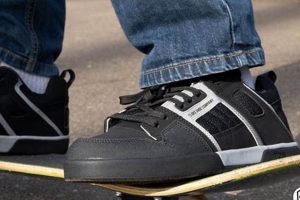
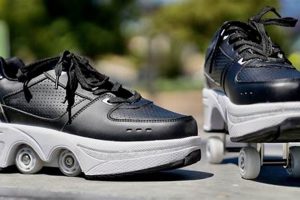
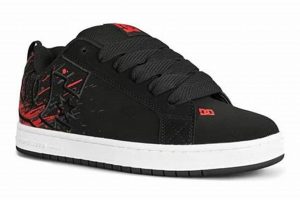
Footwear designed specifically for skateboarding often incorporates features that enhance performance and durability. A key characteristic of specialized skateboarding footwear is its construction, intended to withstand the rigors of repeated abrasive contact with the skateboard and the ground. For example, certain shoe designs integrate reinforced layers in high-wear areas, contributing to increased longevity and protection.
The functional attributes of these shoes are paramount for skateboarders. Enhanced grip, achieved through specialized outsole patterns and rubber compounds, enables greater board control. Impact absorption technology in the midsole cushions landings, reducing stress on joints. The historical development of this type of footwear reflects the evolving demands of the skateboarding discipline, with innovations aimed at improving both safety and performance.
This article will delve into specific elements of skateboarding footwear design, examining the materials used, the construction techniques employed, and the implications of these factors on the overall functionality and lifespan of these essential tools for the sport.
Optimizing Skateboard Footwear Performance
The following guidelines are intended to maximize the utility and lifespan of specialized skateboarding footwear, thereby enhancing the overall skateboarding experience. Adherence to these recommendations can contribute to improved performance and reduced equipment expenditure.
Tip 1: Reinforce High-Wear Areas: Prior to initial use, consider applying adhesive reinforcement patches to the ollie area and other high-contact zones. This proactive measure can significantly extend the shoe’s lifespan by preventing premature degradation of the upper material.
Tip 2: Implement Regular Cleaning Practices: Consistent removal of dirt and debris from the outsole and upper is crucial. Accumulated grime compromises grip and can accelerate material breakdown. A mild detergent and brush are generally sufficient for routine maintenance.
Tip 3: Rotate Footwear: Employing multiple pairs of skateboarding shoes allows for adequate drying time between sessions. This practice mitigates moisture buildup, preventing the development of odors and reducing the likelihood of material weakening.
Tip 4: Tighten Laces Appropriately: Secure lacing is essential for maintaining proper foot support and preventing slippage within the shoe. However, avoid excessive tightening, which can restrict circulation and compromise comfort.
Tip 5: Consider Insole Replacement: The insoles provided with many skateboarding shoes offer limited cushioning. Upgrading to aftermarket insoles with enhanced impact absorption can significantly improve comfort and reduce the risk of injury during high-impact maneuvers.
Tip 6: Repair Minor Damage Promptly: Small tears or separations in the upper should be addressed immediately with appropriate adhesives or stitching. Neglecting minor repairs can lead to more extensive damage and ultimately shorten the shoe’s usable life.
Tip 7: Avoid Exposure to Extreme Conditions: Prolonged exposure to excessive heat or moisture can negatively impact the structural integrity of skateboarding footwear. Storing shoes in a cool, dry environment is recommended.
By adhering to these recommendations, skateboarders can expect to realize a greater return on their investment in specialized footwear, while simultaneously enhancing their performance and comfort on the board.
The subsequent sections of this article will explore advanced topics in skateboarding footwear technology, including material science and biomechanical considerations.
1. Instant Board Feel

Instant board feel, a critical attribute of high-performance skateboarding footwear, directly impacts a skateboarder’s control and responsiveness. Specialized “pop out skate shoes” are engineered to maximize this sensory connection, enabling precise maneuvers and heightened board awareness.
- Sole Thinness and Flexibility
A thinner sole construction, often constructed from vulcanized rubber, minimizes the distance between the foot and the skateboard deck. This reduced material stack allows for increased tactile feedback, enabling the skateboarder to perceive subtle shifts in the board’s angle and pressure distribution. For example, a skateboarder executing a kickflip can more accurately gauge the board’s rotation and adjust foot positioning accordingly.
- Minimal Midsole Cushioning
While cushioning is important for impact absorption, excessive midsole material can dampen board feel. “Pop out skate shoes” typically feature a minimal midsole, prioritizing board feel over maximal cushioning. This design choice allows the skateboarder to maintain a direct connection with the board, enhancing precision during technical tricks. The trade-off is that the user sacrifices a level of impact absorption.
- Outsole Pattern and Durometer
The outsole pattern significantly influences the level of grip and board feel. Softer rubber compounds and specific tread patterns, such as herringbone or waffle designs, conform to the board’s surface, providing increased traction and tactile sensitivity. This enhanced grip allows for more confident foot placement and improved control during slides and grinds. The durometer of the rubber will also affect durability, as a softer rubber will wear out sooner.
- Upper Construction and Flexibility
The upper construction contributes to overall board feel by allowing for natural foot movement and flexibility. A less rigid upper, constructed from materials like suede or canvas, allows the foot to flex and articulate freely, enhancing board control and responsiveness. For instance, a flexible upper allows the skateboarder to easily adjust their foot position during a manual or nose manual.
The pursuit of instant board feel within “pop out skate shoes” represents a design philosophy that prioritizes tactile sensitivity and responsiveness over maximal cushioning or support. This emphasis on board feel directly translates to enhanced control, precision, and overall performance for the skateboarder, allowing for a more intuitive and connected riding experience.
2. Enhanced Grip

Enhanced grip is a paramount characteristic of specialized skateboarding footwear, significantly impacting board control and the execution of technical maneuvers. The design and materials of “pop out skate shoes” are carefully considered to maximize traction between the shoe and the skateboard deck, allowing for optimal performance.
- Outsole Rubber Compound
The specific rubber compound used in the outsole construction directly influences grip. Softer rubber formulations generally provide superior traction due to their increased flexibility and ability to conform to the textured surface of the skateboard. This increased grip is crucial for maintaining board control during ollies, kickflips, and other technical tricks. Certain “pop out skate shoes” utilize proprietary rubber blends formulated for enhanced grip performance, contributing to a more secure and reliable connection with the board.
- Outsole Tread Pattern
The tread pattern on the outsole also plays a significant role in grip. Patterns featuring geometric shapes, such as herringbone or waffle designs, increase the surface area in contact with the board, maximizing friction. Deeper grooves within the tread pattern can further enhance grip by channeling away debris and water, maintaining a consistent point of contact. The strategic placement and depth of the tread pattern in “pop out skate shoes” are engineered to optimize grip across diverse skateboarding environments.
- Lateral Support Structures
While not directly related to the outsole, lateral support structures integrated into the shoe’s design contribute to overall grip and stability. These structures, often in the form of reinforced panels or overlays, prevent excessive lateral movement of the foot within the shoe. This enhanced stability allows for more precise foot placement and improved control during lateral maneuvers, such as powerslides or heelflips. Stiff sidewalls provide additional board feel and grip when turning. “Pop out skate shoes” often incorporate lateral support elements to complement the outsole’s grip capabilities.
- Insole Texture
The insole texture can add grip as well. Some insoles in skate shoes have a rougher texture that stops the foot from moving around inside the shoe. This is more common with custom insoles but some stock insoles feature this as well. The overall point is that the foot is locked in place within the shoe and the shoe is locked to the board, creating a total package of grip.
The collective effect of these elementsrubber compound, tread pattern, lateral support, and insole texturedetermines the overall grip performance of skateboarding footwear. “Pop out skate shoes” prioritize these features to offer skateboarders a secure and responsive connection with their boards, facilitating enhanced control and improved execution of skateboarding tricks.
3. Impact Distribution

Effective impact distribution is a critical performance and safety consideration in skateboarding footwear design. The repetitive and high-force impacts experienced during skateboarding, such as landings from aerial maneuvers or prolonged riding over rough terrain, place significant stress on the musculoskeletal system. “Pop out skate shoes” address this challenge through strategically engineered impact distribution mechanisms, aiming to mitigate the risk of injury and enhance comfort during prolonged use. The effectiveness of impact distribution directly influences a skater’s ability to progress, minimizing fatigue and maximizing time spent skateboarding. Failure to properly distribute impact forces can lead to conditions such as heel bruises, ankle sprains, and knee pain, hindering performance and potentially causing chronic issues.
Various design elements contribute to impact distribution in “pop out skate shoes.” Midsole materials, such as ethylene-vinyl acetate (EVA) or polyurethane (PU), play a crucial role in absorbing and dispersing impact energy. Different densities and configurations of these materials can be employed to target specific areas of the foot, such as the heel and forefoot. Furthermore, specialized cushioning technologies, including air pockets or gel inserts, can be integrated into the midsole to provide enhanced impact absorption. Outsole construction also contributes to impact distribution by providing a stable platform and dissipating force across a wider surface area. For instance, a wider outsole base can improve stability upon landing, reducing the concentration of impact forces on specific joints. Skateboarding shoes can have enhanced heel support to protect against heel bruises from high impact landings, or reinforced materials to prevent excessive wear.
In summary, impact distribution is a vital component of “pop out skate shoes,” contributing to both performance enhancement and injury prevention. By strategically employing advanced materials, innovative designs, and targeted cushioning technologies, manufacturers strive to create footwear that effectively manages impact forces, enabling skateboarders to push their limits with reduced risk. Understanding the principles of impact distribution and the design features that contribute to it is essential for skateboarders seeking to optimize their footwear choices and prioritize their long-term well-being. Choosing the right shoe could not only enhance their skating performance, but also promote their overall health by preventing possible injuries.
4. Sole Adherence
Sole adherence, referring to the consistent and reliable connection between the shoe’s outsole and the skateboard deck, constitutes a critical performance characteristic of specialized skateboarding footwear. In the context of “pop out skate shoes,” this attribute transcends mere traction, representing a fundamental component influencing board feel, control, and overall maneuverability. Compromised sole adherence directly translates to decreased board feel, unpredictable board response, and an increased risk of slippage, particularly during technical maneuvers. The correlation is causal: inadequate sole adherence diminishes the skateboarder’s ability to precisely manipulate the board, negatively impacting performance and potentially leading to injury. A “pop out skate shoe” must prioritize materials and construction techniques that ensure consistent and unwavering sole adherence to achieve its intended functional superiority.
The specific materials and construction methods employed in “pop out skate shoes” directly influence sole adherence. Vulcanized rubber outsoles, for example, are commonly utilized due to their inherent flexibility and ability to conform to the textured surface of the skateboard deck, enhancing friction and grip. Similarly, specialized tread patterns, such as the classic waffle design, increase the surface area in contact with the board, further contributing to sole adherence. Cemented construction, in which the outsole is bonded to the upper, offers a balance of durability and flexibility, maintaining a reliable connection between the sole and the rest of the shoe. In contrast, a poorly constructed shoe with a rigid outsole or an inferior adhesive bond will exhibit reduced sole adherence, hindering performance and increasing the risk of board separation during critical moments. Instances of sole separation during high-impact tricks underscore the practical significance of prioritizing sole adherence in skateboarding footwear design and selection. A loose or poorly connected sole can cause a loss of board control and a subsequent fall, highlighting the life of death implications.
In conclusion, sole adherence represents a non-negotiable characteristic of “pop out skate shoes,” directly impacting performance, safety, and overall user experience. The selection of appropriate materials, the implementation of robust construction techniques, and the consideration of tread pattern design are all crucial factors in optimizing sole adherence. While other features, such as cushioning and durability, contribute to the overall quality of skateboarding footwear, sole adherence forms the foundation upon which board control and technical proficiency are built. Continued research and development in this area are essential for advancing the performance capabilities of “pop out skate shoes” and enhancing the safety of skateboarders.
5. Durability increase
Durability increase is a critical attribute of skateboarding footwear, directly influencing the lifespan and cost-effectiveness of “pop out skate shoes.” Skateboarding, by its very nature, subjects shoes to extreme abrasion, impact, and stress. The ability of specialized footwear to withstand these forces directly correlates to its value proposition. Increased durability translates to a longer usable lifespan, reducing the frequency of replacements and minimizing the overall expenditure for skateboarders. For example, a shoe constructed with reinforced ollie patches and durable stitching will inherently resist wear in high-stress areas, extending its utility compared to a less robustly designed alternative. The incorporation of higher quality materials, such as premium suede or ballistic nylon, also contributes to enhanced durability, resisting tearing and abrasion that would quickly degrade lesser materials. This focus on durability is not merely a matter of economic efficiency; it’s a practical necessity for skateboarders who rely on their footwear to perform consistently under demanding conditions. The more complex the shoe, the more likely that it will fall apart.
The connection between “durability increase” and “pop out skate shoes” also extends to performance enhancement. A shoe that retains its structural integrity over time provides consistent support and board feel. A shoe with worn-out sides can change how the user is able to interact with the board. Deterioration of the sole, the upper, or the stitching can compromise these attributes, negatively impacting the skateboarder’s control and confidence. For example, delamination of the sole from the upper can result in unpredictable board contact, increasing the risk of accidents. Therefore, the pursuit of “durability increase” in “pop out skate shoes” is inextricably linked to maintaining optimal performance characteristics throughout the shoe’s lifespan. The increased cost of “pop out skate shoes” are a direct result of its increased durability.
In summary, “durability increase” is not merely a desirable feature of “pop out skate shoes,” but a fundamental requirement. The ability of these shoes to withstand the rigors of skateboarding directly impacts their economic value, performance characteristics, and ultimately, the safety and satisfaction of the skateboarder. Manufacturers prioritizing “durability increase” through strategic material selection, reinforced construction, and innovative design are contributing to a more sustainable and performance-driven approach to skateboarding footwear. The practical implications of understanding this connection are significant, enabling skateboarders to make informed purchasing decisions and maximize the lifespan and utility of their equipment.
Frequently Asked Questions
The following addresses common inquiries regarding specialized skateboarding footwear, specifically focusing on attributes associated with the term “pop out skate shoes.”
Question 1: What defines “pop out skate shoes” beyond marketing terminology?
The term, while often used in marketing, typically refers to skateboarding footwear engineered for enhanced board feel, grip, impact distribution, sole adherence, and durability. These characteristics are crucial for optimal skateboarding performance.
Question 2: How does the construction of “pop out skate shoes” differ from that of general athletic shoes?
Construction differences are significant. “Pop out skate shoes” typically feature reinforced ollie pads, durable stitching, vulcanized rubber soles, and abrasion-resistant materials tailored to withstand the specific stresses of skateboarding. General athletic shoes lack these specialized reinforcements.
Question 3: Is enhanced grip in “pop out skate shoes” solely dependent on the outsole pattern?
No. The outsole rubber compound, tread pattern, and internal structural support all contribute to enhanced grip. Softer rubber compounds and specific tread designs maximize board adhesion, while lateral support prevents excessive foot movement within the shoe.
Question 4: How does impact distribution in “pop out skate shoes” contribute to injury prevention?
Strategic impact distribution, achieved through specialized midsole materials and cushioning technologies, mitigates stress on joints during high-impact landings. This reduces the risk of heel bruises, ankle sprains, and other skateboarding-related injuries.
Question 5: What is the significance of sole adherence in the context of “pop out skate shoes?”
Sole adherence, referring to the consistent connection between the outsole and the skateboard deck, directly influences board feel, control, and maneuverability. Compromised sole adherence diminishes the ability to precisely manipulate the board.
Question 6: Does “durability increase” in “pop out skate shoes” solely relate to material quality?
While material quality is a factor, construction techniques also contribute significantly. Reinforced stitching, strategically placed overlays, and robust sole attachment methods enhance the overall lifespan of the footwear.
In summary, “pop out skate shoes” represent a category of skateboarding footwear engineered for performance enhancement and durability through a combination of specialized design features and construction techniques.
The subsequent section of this article will delve into specific maintenance procedures for maximizing the lifespan of specialized skateboarding footwear.
Conclusion
This article has explored the defining characteristics of “pop out skate shoes,” emphasizing their specialized design intended for enhanced skateboarding performance. Key attributes discussed include the importance of instant board feel, optimized grip, strategic impact distribution, consistent sole adherence, and increased overall durability. The integration of these elements reflects a commitment to providing skateboarders with footwear engineered to withstand the rigors of the sport while maximizing control and responsiveness.
The informed selection of skateboarding footwear directly impacts both performance and safety. Continued advancements in materials science and construction techniques promise further refinements in “pop out skate shoe” design, potentially leading to even greater levels of board feel, impact protection, and product longevity. The skateboarding community benefits from ongoing research and development focused on optimizing the interface between the skater and the board.
![Best Men's Roller Skate Shoes: [Year] Guide & Reviews | Learn to Surf & Skate: A Beginner's Step-by-Step Guide](https://universitysurfandskate.com/wp-content/uploads/2026/03/th-402-300x200.jpg "Best Men's Roller Skate Shoes: [Year] Guide & Reviews Learn to Surf & Skate: A Beginner's Step-by-Step Guide")