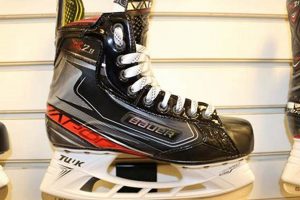
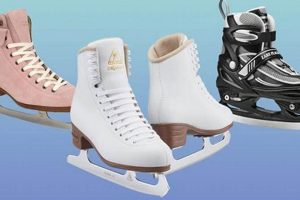
Specialized footwear designed for ice skating at a high level of skill, often used in competitive figure skating, ice hockey, and other disciplines, facilitates enhanced performance. This equipment typically exhibits superior blade quality, boot construction, and customization options compared to recreational models. Examples include models designed for intricate figure skating maneuvers or those built for the rigorous demands of ice hockey.
The significance of this specialized equipment lies in its contribution to improved agility, control, and safety for athletes. Historically, the evolution of these skates has paralleled advancements in materials science and biomechanical understanding, resulting in designs that optimize energy transfer and reduce the risk of injury. The utilization of tailored equipment allows athletes to execute complex techniques with greater precision and confidence.
Subsequent sections will delve into the specific attributes of different types of high-performance skates, covering aspects such as blade materials, boot fitting techniques, and the role of this specialized equipment in various ice sports. Furthermore, discussion will focus on maintenance protocols and the impact of proper equipment selection on an athlete’s overall performance trajectory.
Selecting and Maintaining Specialized Ice Footwear
This section provides critical information for athletes and coaches involved in selecting and maintaining high-performance ice footwear to optimize performance and longevity.
Tip 1: Prioritize Boot Fit: A precise boot fit is paramount. Ill-fitting boots can lead to discomfort, blisters, and compromised control. Seek professional fitting services to ensure proper heel lock, ankle support, and overall comfort. Consider heat molding for enhanced customization.
Tip 2: Blade Selection Considerations: The blade profile and material influence glide, edge control, and turning ability. Figure skates require different blades compared to hockey skates. Consult with experienced professionals to determine the appropriate blade type based on skating style and discipline.
Tip 3: Regular Blade Sharpening: Consistent blade sharpening is essential for maintaining optimal edge control. The frequency of sharpening depends on usage and ice conditions. Utilize a qualified sharpener to ensure proper edge geometry.
Tip 4: Moisture Management: Moisture can degrade boot materials and lead to rust on blades. After each use, thoroughly dry the boots and blades. Consider using blade soakers and storing the equipment in a well-ventilated area.
Tip 5: Inspect for Damage: Regularly inspect the boots and blades for signs of wear and tear, such as cracks, loose rivets, or blade damage. Address any issues promptly to prevent further deterioration and potential safety hazards.
Tip 6: Lacing Technique: Proper lacing is crucial for ankle support and overall boot stability. Adjust the lacing tension according to individual needs and skating style. Ensure consistent lacing throughout the boot.
Tip 7: Seek Professional Guidance: Consult with experienced skating coaches, equipment specialists, and skate technicians for personalized advice on selection, fitting, and maintenance. Their expertise can significantly enhance performance and extend the lifespan of the equipment.
Adhering to these guidelines regarding selection and maintenance can significantly enhance an athlete’s performance, safety, and the lifespan of the specialized ice footwear. Neglecting these aspects can lead to decreased performance, increased risk of injury, and premature equipment failure.
The subsequent section will discuss the economic considerations of professional-grade ice footwear and long-term value to skating level.
1. Blade Material Composition

The composition of the blade material in professional ice skates is a critical determinant of performance, directly affecting glide efficiency, edge control, and durability. High-quality skates utilize blades crafted from hardened carbon steel or stainless steel alloys, each offering a unique set of properties. Carbon steel blades, known for their superior edge retention, allow skaters to maintain a precise and consistent edge for longer periods. This is especially crucial in figure skating, where intricate footwork and precise turns are paramount. The inherent strength and hardness of carbon steel contribute to sharper, more defined edges, enabling skaters to execute complex maneuvers with greater control. For example, figure skaters executing triple or quadruple jumps rely on the consistent bite of carbon steel blades to maintain stability during take-off and landing.
Stainless steel blades, conversely, offer enhanced resistance to corrosion and require less frequent sharpening than carbon steel. This characteristic is advantageous for hockey players, who often encounter wet or abrasive ice conditions that can rapidly degrade blade edges. The reduced maintenance requirements of stainless steel blades allow hockey players to focus on the game without constantly concerning themselves with blade condition. Furthermore, the composition of the steel alloy affects its flexibility and shock absorption properties. A well-chosen alloy provides a balance between stiffness for power transfer and flexibility for comfort, reducing the strain on the skater’s joints. The layering or coating of blades with materials such as titanium can further enhance hardness and reduce friction, optimizing glide performance.
In summary, the selection of blade material is a crucial decision in choosing professional ice skates. The trade-offs between edge retention, corrosion resistance, and maintenance requirements dictate the optimal choice depending on the intended use. Understanding the properties of different blade materials allows athletes and coaches to make informed decisions, maximizing performance and ensuring longevity of the equipment. Continued advancements in materials science promise further innovations in blade composition, driving improved performance and durability in the future.
2. Boot Stiffness Rating

Boot stiffness rating is a critical specification in professional ice skates, directly influencing energy transfer, support, and overall performance. It quantifies the resistance of the boot to flexion, impacting a skater’s ability to execute precise movements and maintain stability. The appropriate stiffness level is highly dependent on the skater’s skill level, weight, and skating discipline.
- Energy Transfer Efficiency
Higher stiffness ratings facilitate more efficient energy transfer from the skater’s leg muscles to the blade. This is particularly beneficial for advanced skaters who require rapid acceleration and powerful jumps. Inadequate stiffness results in energy loss through boot deformation, reducing propulsive force. For example, hockey players often favor stiffer boots to maximize power during sprints and explosive turns.
- Ankle Support and Stability
Increased stiffness provides enhanced ankle support, crucial for preventing injuries and maintaining balance during demanding maneuvers. The rigid structure minimizes ankle pronation and supination, reducing the risk of sprains and strains. Figure skaters performing complex spins and jumps rely on stiff boots to maintain precise alignment and control. Conversely, overly stiff boots can restrict range of motion and impede agility for certain skating styles.
- Responsiveness and Control
Stiffer boots offer greater responsiveness to the skater’s movements, enabling precise edge control and rapid adjustments. This is essential for executing intricate footwork and maintaining stability on the ice. The enhanced feedback allows skaters to anticipate and react quickly to changes in ice conditions or opponent maneuvers. However, a high stiffness rating can also make the skate less forgiving, requiring greater skill and control from the skater.
- Progressive Adaptation
Boot stiffness should align with the skater’s skill level and physical development. Beginner skaters typically benefit from softer boots, which allow for greater flexibility and ease of movement. As skaters progress, they require increasingly stiffer boots to support their advanced techniques and increased power output. Improperly matched boot stiffness can hinder skill development and increase the risk of injury. Regular assessment and professional fitting are essential to ensure optimal boot stiffness for individual skaters.
In summary, boot stiffness rating is a key factor in the selection of professional ice skates. Understanding the relationship between stiffness, energy transfer, support, and responsiveness enables skaters to choose equipment that optimizes their performance and minimizes the risk of injury. Professional guidance and regular equipment assessments are crucial for adapting boot stiffness to individual needs and skill development. Further innovation in materials and construction techniques continues to refine boot stiffness ratings, providing increasingly tailored solutions for elite athletes.
3. Ankle Support System

The ankle support system within specialized ice footwear constitutes a critical element of the overall design, directly influencing stability, injury prevention, and the skater’s ability to execute technically demanding maneuvers. Its effectiveness depends on the integration of various components and their collective contribution to restricting excessive joint movement.
- Lateral Stability Reinforcement
Lateral stability reinforcement involves structural elements integrated into the boot’s construction to resist excessive side-to-side movement of the ankle. These reinforcements may include molded polymer panels, reinforced stitching patterns, or strategically placed padding. For instance, in high-end figure skates, carbon fiber supports are often employed to limit lateral ankle displacement during landings from jumps, minimizing the risk of inversion sprains. Similarly, hockey skates utilize robust quarter packages that provide significant lateral support to withstand the forces generated during sharp turns and collisions.
- Medial Support Mechanisms
Medial support mechanisms focus on preventing inward rolling of the ankle, which is a common source of injury. These mechanisms often involve the use of anatomical padding systems that conform to the contours of the medial malleolus. Moreover, advanced lacing systems, featuring strategically positioned eyelets and reinforced lace patterns, can provide adjustable medial support. Incorrect medial support, such as excessively tight lacing, can lead to compression injuries or restricted blood flow.
- Heel Counter Integration
The heel counter, a rigid or semi-rigid structure enclosing the heel, plays a crucial role in stabilizing the rearfoot and preventing excessive pronation or supination. The heel counter’s effectiveness depends on its material properties, shape, and integration with the boot’s sole. A well-designed heel counter should provide a secure and comfortable fit, limiting heel slippage and minimizing the risk of plantar fasciitis and Achilles tendinitis. For instance, professional-grade skates often incorporate heat-moldable heel counters that can be customized to the individual skater’s foot shape, enhancing both comfort and support.
- Range of Motion Control
Effective ankle support systems balance the need for stability with the requirement for adequate range of motion. Excessive restriction can impede agility and limit the skater’s ability to execute complex techniques. Therefore, sophisticated designs incorporate flexible zones in strategic areas, such as the ankle joint and the upper portion of the boot, allowing for controlled dorsiflexion and plantarflexion. These flexible zones are often constructed using specialized materials that provide a combination of support and elasticity, ensuring that the skater can maintain a full range of motion without compromising stability. Examples include flexible materials around the tendon area.
In conclusion, the ankle support system in specialized ice footwear represents a complex interplay of structural elements and biomechanical considerations. The effectiveness of this system hinges on the appropriate balance of lateral stability, medial support, heel counter integration, and range of motion control. Professional athletes and coaches must carefully consider these factors when selecting and fitting skates to optimize performance and minimize the risk of ankle injuries. The continuous evolution of materials science and biomechanical engineering promises further advancements in ankle support systems, enhancing both the safety and performance of specialized ice footwear.
4. Heat Moldability Feature
The heat moldability feature in professional ice skates represents a significant advancement in achieving personalized fit and enhanced performance. This capability allows the skate boot’s internal structure to conform more precisely to the individual skater’s foot, thereby optimizing comfort, support, and energy transfer. The following outlines key facets of this technology.
- Custom Contour Adaptation
The primary function of heat moldability is to enable the skate boot to conform precisely to the unique contours of the skater’s foot. This is achieved through the use of heat-sensitive materials within the boot’s construction that soften when heated, allowing them to be shaped to the foot’s anatomy. For instance, skaters with bone spurs or asymmetrical foot shapes benefit significantly, as the boot can be molded to accommodate these irregularities, minimizing pressure points and potential discomfort. This customization contrasts sharply with traditional skate fitting methods that rely solely on standardized sizing.
- Enhanced Energy Transfer
A more precise fit translates directly to improved energy transfer from the skater’s foot to the blade. When the boot conforms closely to the foot, there is less slippage and wasted movement within the skate. This improved connection enables the skater to generate more power and execute movements with greater efficiency. Professional hockey players, for example, rely on this enhanced energy transfer to accelerate quickly and maintain agility on the ice. A well-molded boot ensures that every ounce of force applied by the skater is translated into propulsion.
- Reduction of Break-in Period
Traditional ice skates often require a lengthy break-in period, during which the boot gradually conforms to the skater’s foot through repeated use. Heat moldability significantly reduces or eliminates this break-in period, allowing skaters to experience optimal comfort and performance from the first use. This is particularly beneficial for athletes who compete frequently and cannot afford to spend weeks or months breaking in new skates. The immediate comfort and performance gains offered by heat moldable boots provide a distinct competitive advantage.
- Long-Term Fit Maintenance
While the initial molding process is critical, heat moldability also allows for subsequent adjustments to maintain a consistent fit over time. As the skater’s foot changes due to growth, injury, or other factors, the boot can be re-molded to accommodate these changes. This adaptability extends the lifespan of the skates and ensures that the skater consistently benefits from a personalized fit. For example, if a skater develops a minor foot injury, the boot can be molded to relieve pressure on the affected area, allowing them to continue training comfortably.
In summary, the heat moldability feature represents a paradigm shift in the design and fitting of professional ice skates. By enabling personalized fit, enhancing energy transfer, reducing break-in time, and facilitating long-term fit maintenance, this technology provides significant benefits for athletes across various ice sports. The adoption of heat moldable boots reflects a broader trend towards customized equipment that optimizes performance and reduces the risk of injury.
5. Customization Capabilities
The ability to tailor professional ice skates to individual athlete’s needs constitutes a pivotal aspect of optimizing performance and mitigating injury risk. Customization extends beyond mere aesthetics, encompassing modifications that directly impact biomechanics and energy transfer.
- Blade Mounting Adjustments
Precise blade alignment significantly impacts stride efficiency and edge control. Skilled technicians can adjust blade position laterally and longitudinally to accommodate individual skating styles and biomechanical asymmetries. For example, a skater exhibiting a tendency towards pronation may benefit from lateral blade adjustment to promote a more neutral ankle position. This customization minimizes compensatory movements and reduces the likelihood of overuse injuries.
- Boot Modification for Anatomical Variations
Skaters frequently present with anatomical variations such as bunions, bone spurs, or hallux valgus. Custom boot modifications, including heat molding, punching, or the addition of specialized padding, address these irregularities. This ensures a comfortable and secure fit, preventing pressure points and reducing the risk of blisters or other foot-related ailments. The ability to modify the boot’s internal structure allows athletes to perform without distraction from discomfort.
- Custom Tongue and Lacing Systems
The tongue and lacing system contribute significantly to ankle support and overall boot fit. Custom tongues, crafted from varying densities of foam or felt, provide personalized pressure distribution and reduce lace bite. Custom lacing patterns, utilizing specialized eyelets and hooks, allow for targeted adjustments to optimize ankle stability and range of motion. A skater requiring enhanced ankle support might benefit from a lacing system that provides increased lockdown in the ankle region.
- Orthotic Integration
Custom orthotics, designed based on a comprehensive biomechanical assessment, provide personalized arch support and correct foot alignment issues. These orthotics can be integrated into professional ice skates to improve posture, reduce stress on lower extremity joints, and enhance overall skating efficiency. For example, an athlete with flat feet may experience improved power transfer and reduced fatigue through the use of custom orthotics that provide appropriate arch support within the skate boot.
These multifaceted customization options, when applied judiciously by experienced professionals, allow for the creation of professional ice skates that are uniquely tailored to each athlete’s specific needs and biomechanical profile. Such individualized attention to detail contributes significantly to enhanced performance, injury prevention, and long-term athletic success.
Frequently Asked Questions
This section addresses common inquiries regarding high-performance ice skating equipment, providing clarity on selection, maintenance, and performance considerations. The information presented aims to offer a comprehensive understanding for skaters and coaches alike.
Question 1: What distinguishes professional ice skates from recreational models?
Professional-grade skates incorporate advanced materials and construction techniques to enhance performance. These models typically exhibit superior blade quality, boot stiffness, and customization options compared to recreational counterparts. Design emphasis prioritizes energy transfer, ankle support, and precise control.
Question 2: How frequently should blades be sharpened on professional ice skates?
Sharpening frequency depends on usage intensity, ice quality, and blade material. Blades used consistently on abrasive ice require more frequent sharpening. Regular inspection for nicks or dull edges is crucial. Consultation with a qualified skate technician is recommended to determine an appropriate sharpening schedule.
Question 3: What role does boot stiffness play in performance?
Boot stiffness directly influences energy transfer and ankle support. Higher stiffness ratings are beneficial for advanced skaters who require rapid acceleration and powerful jumps. However, overly stiff boots can restrict range of motion and impede agility. The optimal stiffness level depends on skill level, weight, and skating discipline.
Question 4: What are the key considerations when selecting a blade profile?
Blade profile significantly impacts glide, edge control, and turning ability. Figure skates require different blade profiles compared to hockey skates. Factors such as rocker radius, blade length, and stanchion height should be considered in relation to skating style and discipline. Seek expert guidance to determine the appropriate blade profile.
Question 5: How does heat molding enhance the fit of ice skate boots?
Heat molding allows the skate boot’s internal structure to conform more precisely to the skater’s foot. This process minimizes pressure points, improves energy transfer, and reduces the break-in period. Heat-sensitive materials within the boot soften when heated, allowing them to be shaped to the foot’s anatomy. Proper execution of the heat molding process is essential.
Question 6: What steps should be taken to properly maintain professional ice skates?
Proper maintenance includes regular blade sharpening, moisture management, and inspection for damage. Boots should be thoroughly dried after each use to prevent material degradation. Blade soakers should be used to absorb moisture and prevent rust. Any signs of wear and tear, such as cracks or loose rivets, should be addressed promptly.
Selecting and maintaining high-performance ice skating equipment requires careful consideration of numerous factors. Consulting with experienced coaches, equipment specialists, and skate technicians is highly recommended to optimize performance and ensure longevity of equipment.
The subsequent section will examine emerging trends in specialized ice footwear technology and their potential impact on the future of ice sports.
Conclusion
The preceding sections have explored critical aspects of professional ice skates, encompassing materials, design features, maintenance protocols, and customization options. The performance capabilities and longevity of this specialized equipment are directly contingent upon informed selection, diligent maintenance, and appropriate adaptation to individual athlete’s needs. Understanding the nuanced relationships between blade composition, boot stiffness, ankle support systems, and heat moldability is paramount for optimizing athletic potential and minimizing injury risk. Furthermore, consistent adherence to established maintenance practices extends the lifespan of professional ice skates, representing a significant long-term investment.
Continued advancements in materials science and biomechanical engineering hold the promise of further innovation within the realm of professional ice skates. As technology progresses, athletes and coaches must remain informed about emerging trends and actively engage with experts to leverage these advancements effectively. The ongoing pursuit of optimized performance and enhanced safety will inevitably shape the future of specialized ice footwear, influencing competitive outcomes and athlete well-being across various ice sports.