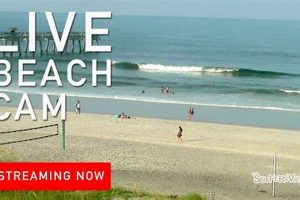
A live, streaming video feed provides a real-time view of ocean conditions at a specific beach location in Volusia County, Florida. This visual data source is typically deployed to observe wave activity, weather patterns, and beach crowds. The imagery enables remote assessment of surf conditions for recreational purposes or monitoring coastal changes for scientific study.
Accessibility to visual, current conditions offers several advantages. Surfers can evaluate wave quality before traveling to the beach, saving time and resources. Lifeguards can remotely monitor beach density and potential hazards, improving response times in emergency situations. Coastal researchers can analyze time-lapse imagery for long-term data collection on erosion or the impact of weather events.
The continuous availability of this visual information facilitates better decision-making, increases beach safety, and supports valuable research. The deployment of such technology is increasingly common along coastal regions seeking to provide readily available environmental data.
This section presents guidance on effectively utilizing available live visual data to make informed decisions regarding beach activities and coastal observations.
Tip 1: Observe Wave Height Trends: Monitor the live feed over a period of time, noting changes in wave height and frequency. This provides a more accurate assessment than a single, momentary glance.
Tip 2: Assess Tidal Influence: Correlate the visual data with published tide charts. Understanding the current tide stage enhances prediction of wave break quality and beach accessibility.
Tip 3: Evaluate Crowd Density: Use the camera’s view to gauge the number of individuals in the water and on the beach. High density may indicate favorable conditions but can also increase safety concerns.
Tip 4: Analyze Weather Patterns: Pay attention to visibility and cloud cover. These factors influence the overall beach experience and can impact water safety.
Tip 5: Cross-Reference with Weather Forecasts: Supplement the visual feed with meteorological data. Combining observed conditions with predicted weather patterns provides a comprehensive understanding of potential coastal changes.
Tip 6: Assess Water Clarity: Evaluate the water’s clarity via the live feed. Poor visibility can increase risks for swimmers and surfers. Note any visible debris or discoloration.
Tip 7: Check for Rip Currents: While not always visible, carefully observe the surf for telltale signs such as channels of choppy, discolored water moving seaward.
Adhering to these guidelines allows for a more comprehensive understanding of coastal conditions, ultimately leading to safer and more informed decisions.
The insights gained from these resources can contribute to a more predictable and enjoyable beach experience, while also aiding in responsible coastal stewardship.
1. Real-time wave observation

The core function of the live-streaming video feed is the provision of real-time wave observation. This capability allows users to remotely assess the surf conditions at the beach in question. The observable characteristics include wave height, wave period, breaking pattern, and overall surf quality. The availability of this real-time data enables surfers, lifeguards, and coastal researchers to make informed decisions without physically being present at the location. For example, a surfer contemplating a trip to the beach can view the live feed and determine if the waves meet their desired criteria, potentially saving time and fuel if conditions are unfavorable.
The accuracy and reliability of the real-time wave observation depend on the camera’s quality, placement, and internet connectivity. Factors such as weather conditions (fog, rain) and lighting (nighttime) can impact the clarity of the image and therefore the usefulness of the data. Furthermore, wave size assessment from a distant camera view can be subjective and prone to error. To mitigate this, some deployments include calibrated scales or visual markers to provide a more objective measure of wave height. Many now offer high definition and zoom functionality to offer a granular view.
In conclusion, real-time wave observation forms the foundational element of the data stream. While subject to inherent limitations, this capability empowers users to make more informed decisions, contributing to safety, efficiency, and a greater understanding of dynamic coastal processes. Improvements in camera technology and data processing continue to enhance the value of this readily accessible resource.
2. Tidal Influence Correlation
The utility of live, streaming video of coastal conditions is significantly enhanced by correlating visual data with tidal information. The gravitational forces exerted by the moon and sun cause predictable fluctuations in sea level, directly affecting wave characteristics, beach accessibility, and current patterns. A visual feed, in isolation, provides only a snapshot in time. Integrating tidal data allows for a more comprehensive understanding of the dynamic coastal environment and enables users to anticipate changes in conditions.
For instance, a rising tide can flood sandbars, altering wave breaking patterns and creating more challenging surf conditions. Conversely, a falling tide may expose previously submerged features, making the beach more accessible but potentially increasing the risk of rip currents as water drains back to the ocean. By cross-referencing the live feed with readily available tide charts, surfers can anticipate optimal wave conditions, lifeguards can proactively manage potential hazards, and researchers can better interpret observed coastal changes. A real-world example includes observing a low tide exposing a sandbar ideal for beginner surfers in the visual feed and confirming this condition persists for a limited time via tide charts. The practical significance translates to safer and more enjoyable beach experiences through informed decision-making.
In summary, the effective interpretation of live coastal visual data necessitates consideration of tidal influence. This correlation provides temporal context, enabling users to forecast changes and make informed decisions regarding beach activities and coastal monitoring. The integration of tidal data addresses the inherent limitations of static visual information, fostering a more comprehensive and dynamic understanding of the coastal environment. Further, awareness of this interconnectedness reinforces responsible stewardship of coastal resources.
3. Beach crowd assessment

Live, streaming video provides a mechanism for remotely assessing crowd density at the beach. This capability, delivered through a network-connected camera, offers valuable information for diverse user groups. Efficient crowd management is facilitated through accurate visual data.
- Real-Time Density Monitoring
The primary function allows continuous monitoring of the number of individuals present on the beach and in the water. This enables lifeguards and beach management personnel to identify potential overcrowding situations that may compromise safety and require proactive intervention. For instance, if the visual data reveals a significant influx of visitors during a holiday weekend, resources can be strategically allocated to maintain a safe environment.
- Resource Allocation Optimization
Visual data can inform decisions regarding resource allocation. By analyzing crowd density patterns, beach management can determine the optimal number of lifeguards, first aid stations, and restroom facilities required at different times of day and during different seasons. The distribution of these resources is more effectively guided by real-time needs.
- Parking Management Strategies
Observed beach attendance can be correlated with parking lot occupancy. This correlation assists in the development and implementation of parking management strategies, such as adjusting parking fees, implementing shuttle services, or restricting access when capacity is reached. By addressing parking issues proactively, traffic congestion and visitor frustration can be minimized.
- Risk Assessment and Mitigation
High crowd density contributes to increased risk of accidents, injuries, and water-related incidents. The visual feed facilitates risk assessment by allowing personnel to identify potential hazards, such as large groups congregating near known rip current areas. This awareness enables proactive mitigation measures, including increased surveillance, public announcements, and preventative interventions.
The various facets of beach crowd assessment, facilitated by live-streaming video, collectively enhance beach safety, improve resource management, and contribute to a more positive visitor experience. This data-driven approach allows for proactive decision-making, minimizing potential risks and maximizing the benefits of coastal recreation. The integration of visual data into overall beach management strategies proves increasingly essential for maintaining a safe and enjoyable environment for all beachgoers.
4. Weather pattern monitoring
The integration of weather pattern monitoring enhances the utility of a coastal streaming video feed significantly. Weather conditions exert a direct influence on surf conditions, beach safety, and overall visitor experience. Continuous observation of weather patterns allows for a more comprehensive understanding of the dynamic coastal environment. Changes in wind direction and strength, cloud cover, precipitation, and visibility all impact wave formation, water clarity, and potential hazards. Without monitoring these elements, the value of the visual feed is diminished, rendering it a static view lacking temporal context. For example, the sudden onset of fog dramatically reduces visibility, negating the ability to assess wave quality or crowd density. Similarly, an approaching thunderstorm poses immediate risks to beachgoers, necessitating prompt evacuation procedures. The visual feed, coupled with weather data, enables timely and informed decision-making.
The practical applications of weather pattern monitoring within the context of a coastal streaming video are varied. Surfers can assess the impact of offshore winds on wave shape and size, optimizing their timing for ideal surf conditions. Lifeguards can use visual cues, such as the development of storm clouds, to anticipate potential safety risks and implement preventative measures. Coastal researchers can correlate observed weather patterns with long-term changes in shoreline erosion or marine ecosystems. Furthermore, the visual feed serves as a valuable tool for verifying weather forecasts, providing real-time confirmation of predicted conditions. The capacity to observe and respond to dynamic weather events enhances the proactive management of coastal resources and the safety of beach visitors. The monitoring often includes temperature, wind speed, precipitation, and UV index allowing beach visitors to adequately plan for the conditions.
In conclusion, weather pattern monitoring represents a crucial component in maximizing the effectiveness of a coastal streaming video. The integration of meteorological data transforms a static visual representation into a dynamic and informative tool. This enhanced understanding of coastal conditions leads to improved decision-making for a range of stakeholders, from recreational users to coastal managers. The continuous monitoring of weather, coupled with visual data, empowers stakeholders to respond proactively to potential hazards, optimize resource allocation, and contribute to the long-term sustainability of coastal environments.
5. Water clarity evaluation

The capability to evaluate water clarity via a streaming video of New Smyrna Beach’s surf conditions represents a critical, albeit often overlooked, element of the data stream. Water clarity, or the lack thereof, functions as a key indicator of potential hazards and impacts decision-making for beachgoers and coastal managers alike. Turbidity can result from various factors, including recent rainfall, algal blooms, sediment resuspension from wave action, and pollution runoff. Reduced visibility diminishes the ability to identify underwater obstacles, marine life, or swimmers in distress, thereby increasing the risk of accidents and injuries. A live video feed offers a remote means of assessing this parameter, informing decisions about water safety.
The practical significance of water clarity evaluation within the context of New Smyrna Beach’s surf conditions is multifaceted. Lifeguards can remotely assess visibility to determine the need for increased surveillance or water closures. Surfers can evaluate the potential for encountering debris or hazardous marine life, such as jellyfish, which are more difficult to spot in turbid water. Coastal researchers can utilize time-lapse imagery to monitor changes in water clarity over time, providing insights into the impacts of storm events, seasonal variations, or anthropogenic activities on water quality. For instance, following a heavy rainfall event, a significant decrease in water clarity observed via the streaming video could trigger increased water quality testing to assess potential health risks associated with runoff contamination.
In summary, water clarity evaluation is an integral component of a comprehensive assessment of New Smyrna Beach’s surf conditions via streaming video. This capability enhances safety, facilitates informed decision-making, and supports responsible coastal management practices. While visual assessment has inherent limitations, it provides a valuable, real-time indicator of water quality and potential hazards, supplementing traditional monitoring methods. The ability to remotely observe and interpret water clarity contributes to the overall utility and effectiveness of the streaming video as a tool for promoting coastal safety and environmental awareness.
Frequently Asked Questions
The following section addresses common inquiries regarding the utilization and interpretation of live, streaming video data pertaining to surf conditions at New Smyrna Beach.
Question 1: What is the primary purpose of the surf cam?
The primary purpose is to provide a real-time visual representation of surf conditions, enabling remote observation of wave characteristics, crowd density, and weather patterns.
Question 2: How frequently is the visual data updated?
The visual data is updated continuously, providing a live stream of current conditions. Occasional interruptions may occur due to technical issues or maintenance.
Question 3: Can the surf cam be used to predict future wave conditions?
The surf cam provides a snapshot of current conditions only. Prediction of future wave conditions requires integration with weather forecasts and tidal data.
Question 4: Is the image quality affected by weather conditions?
Yes, image quality can be affected by weather conditions such as fog, rain, or low light. Clarity may be reduced during adverse weather.
Question 5: How is the surf cam data used for safety purposes?
Lifeguards and beach management personnel utilize the surf cam to monitor crowd density, identify potential hazards, and allocate resources effectively.
Question 6: Is the surf cam data archived for historical analysis?
Select deployments archive the visual data for purposes such as coastal erosion monitoring or research into the impacts of storm events.
Understanding these elements contributes to more informed utilization of available resources in the area.
This knowledge enables safer decision-making and provides a better perspective of coastal conditions.
surf cam new smyrna Conclusion
This examination of the “surf cam new smyrna” has revealed its importance as a tool for observing coastal conditions. The visual data obtained facilitates informed decision-making regarding recreation, safety, and resource management. The correlation of this visual information with tidal data, weather patterns, and water clarity assessments enhances the understanding of this dynamic environment.
The ongoing collection and responsible utilization of data from the “surf cam new smyrna” contributes to safer coastal experiences and informed environmental stewardship. The continued development and implementation of these technologies is crucial for protecting and appreciating coastal regions.



![Watch Scripps Surf Cam: [Live] See San Diego Waves Now | Learn to Surf & Skate: A Beginner's Step-by-Step Guide](https://universitysurfandskate.com/wp-content/uploads/2026/05/th-91-300x200.jpg "Watch Scripps Surf Cam: [Live] See San Diego Waves Now Learn to Surf & Skate: A Beginner's Step-by-Step Guide")