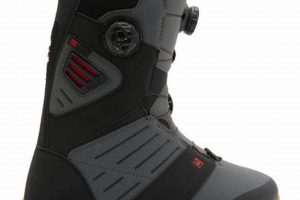
Footwear designed specifically for skateboarding frequently features a contrasting monochrome color scheme. This aesthetic choice presents a classic and versatile look, making such items adaptable to various personal styles and environments. A visual example would be a low-profile shoe constructed with a black canvas upper, complemented by white rubber soles and laces.
The popularity of this color combination in skateboarding stems from its blend of practicality and style. The darker upper conceals dirt and scuffs acquired during skateboarding activities, while the lighter sole provides visual contrast. Historically, this design has been favored for its timeless appeal, transcending fleeting fashion trends within the skateboarding community and broader subcultures.
The subsequent discussion will address specific features, durability considerations, and popular models within the broader category of skateboarding footwear, while also examining how the color scheme influences purchasing decisions and overall user satisfaction.
Selection Guidance for Skateboarding Footwear with a Monochrome Aesthetic
The following guidelines provide objective criteria for evaluating skateboarding footwear featuring a contrasting black and white color palette. These considerations are designed to assist in informed purchasing decisions, optimizing both performance and longevity.
Tip 1: Prioritize Upper Material Durability: The upper section of the shoe experiences significant abrasion during skateboarding. Canvas or suede are common choices; however, reinforced options such as ballistic nylon or leather alternatives offer enhanced resistance to wear and tear, particularly in high-impact areas like the toe and ollie zone.
Tip 2: Evaluate Sole Construction: The sole unit should provide adequate cushioning and board feel. Vulcanized construction, where the sole is chemically bonded to the upper, is a traditional choice offering flexibility. Alternatively, cupsole construction, where the upper is stitched to a pre-molded sole, often provides greater impact absorption and support.
Tip 3: Examine Stitching Quality: Robust stitching is crucial for preventing separation of the upper and sole. Double or triple stitching along stress points, such as the side panels and around the toe cap, contributes to overall durability. Inadequate stitching can lead to premature failure of the footwear.
Tip 4: Assess Midsole Cushioning: The midsole provides cushioning and impact protection. Polyurethane (PU) midsoles offer better cushioning and energy return compared to Ethylene-vinyl acetate (EVA) midsoles. Consider the level of impact protection required based on the intended skateboarding style and terrain.
Tip 5: Inspect Tread Pattern and Grip: The outsole tread pattern affects grip and board feel. A herringbone or waffle pattern is commonly used to provide a balance of traction and flexibility. Examine the depth and spacing of the tread to ensure adequate grip on the skateboard deck.
Tip 6: Verify Heel Support: Adequate heel support minimizes the risk of ankle injuries. Look for features such as internal heel counters or padded collars that provide a secure and stable fit. A poorly fitting heel can lead to slippage and increased risk of sprains.
Tip 7: Consider Lacing System Design: The lacing system should provide a secure and customizable fit. Recessed eyelets or lace protection features prevent abrasion of the laces during skateboarding activities. Avoid designs with exposed laces that are prone to tearing.
Adhering to these guidelines ensures the selection of skateboarding footwear that balances aesthetics with functional requirements, ultimately contributing to improved performance and extended product lifespan.
The subsequent sections will delve into maintenance practices and address frequently asked questions regarding the care and preservation of skateboarding footwear.
1. Timeless Aesthetic

The enduring appeal of skateboarding footwear employing a black and white color scheme stems from its inherent ability to transcend transient fashion cycles. This aesthetic choice avoids the pitfalls of stylistic obsolescence, maintaining relevance across generations within the skateboarding subculture and the broader fashion landscape.
- Minimization of Visual Distraction
The absence of vibrant colors or intricate patterns reduces visual noise, allowing the focus to remain on the skater’s technique and the lines they execute. This minimalist approach emphasizes form and function, aligning with the practical demands of skateboarding. A skate shoe with clashing patterns or garish colors can be distracting and detract from the overall aesthetic of the skater’s performance.
- Adaptability Across Diverse Styles
A monochrome palette readily complements a wide range of apparel and accessories, facilitating integration into diverse personal styles. Whether paired with casual street wear or more tailored ensembles, this design choice offers unparalleled versatility. A black and white skate shoe can be worn with jeans, chinos, shorts, or even more unconventional attire without appearing out of place.
- Association with Iconic Historical Designs
Certain black and white skateboarding footwear designs have achieved iconic status within the skateboarding community, solidifying their position as enduring classics. These designs serve as touchstones, connecting contemporary skateboarding culture to its historical roots. For example, the Vans Sk8-Hi in black and white has become a symbolic representation of skateboarding culture.
- Emphasis on Silhouette and Form
The simplicity of a monochrome color scheme accentuates the shoe’s silhouette and construction details. This allows for a greater appreciation of the design’s form, highlighting subtle nuances that might be obscured by more complex color combinations. The clean lines of a well-designed black and white skate shoe are enhanced by the monochromatic palette.
Consequently, the “timeless aesthetic” inherent in skateboarding footwear with a black and white color scheme is not merely a superficial attribute, but rather a calculated design choice that optimizes visual clarity, stylistic versatility, and historical resonance, ultimately contributing to its sustained popularity.
2. Versatile Style

The adaptable nature of skateboarding footwear presented in a black and white color palette derives from its capacity to seamlessly integrate into diverse stylistic expressions. This adaptability renders such items suitable for both athletic performance and casual wear, extending their utility beyond the confines of skateboarding activities.
- Adaptability to Varied Apparel Combinations
The neutral nature of black and white facilitates pairing with a broad spectrum of clothing styles and colors. These items can complement athletic attire, casual streetwear, or even semi-formal ensembles without creating visual discord. For instance, a black and white skateboarding shoe can be worn effectively with denim jeans, chinos, cargo pants, and even skirts, offering an extended range of wardrobe options.
- Suitability for Multiple Environments
The understated design allows the footwear to be appropriate across a range of environments, from skateboarding parks and urban settings to casual social gatherings. The lack of ostentatious colors or embellishments ensures the footwear does not appear out of place in more professional or subdued settings. A monochrome shoe can transition from skateboarding activities to a coffee shop or informal meeting without raising stylistic concerns.
- Compatibility with Diverse Subcultures
The appeal of this aesthetic transcends specific subcultural affiliations. While strongly associated with skateboarding, it also resonates with individuals involved in punk rock, alternative music, and various forms of urban art. The design avoids commitment to overly specific aesthetic codes, enabling broader adoption across disparate social groups. Individuals affiliated with different subcultures often find common ground in the shared appreciation for the simple and unpretentious design.
- Facilitation of Personal Expression
The neutral canvas provided by the monochrome palette allows individuals to express their personality through other elements of their attire. The footwear serves as a foundation upon which other stylistic choices can be built, without imposing a pre-defined aesthetic. Accessories, outerwear, and specific clothing cuts can be employed to personalize the overall look, while the underlying footwear provides a consistent and unobtrusive base.
The versatility inherent in skateboarding footwear presented in black and white is not merely a superficial attribute. It represents a deliberate design choice that maximizes adaptability, broadening the item’s applicability across diverse contexts and personal preferences. This inherent adaptability contributes significantly to the sustained popularity of this particular style within the broader footwear market.
3. Grip performance

Grip performance in skateboarding footwear is paramount for board control, trick execution, and overall safety. The interaction between the shoe’s outsole and the skateboard deck directly influences the skater’s ability to maintain balance and execute maneuvers. The color scheme of the shoe, while primarily aesthetic, can indirectly relate to grip performance through material selection and construction techniques often associated with particular visual designs.
- Outsole Compound Composition
The rubber compound used in the outsole construction directly dictates the coefficient of friction between the shoe and the skateboard deck. Certain rubber formulations, often denoted by proprietary names, are engineered to provide superior grip. While the black and white color scheme does not inherently determine the rubber compound, manufacturers may associate specific compounds with certain visual designs. For instance, a particular shade of white rubber might be coupled with a high-grip formulation to enhance market appeal. This correlation, however, is not a universal rule.
- Tread Pattern Design and Depth
The geometric arrangement of the outsole tread significantly impacts grip performance. Waffle patterns, herringbone patterns, and variations thereof are commonly employed to maximize surface area contact and facilitate multi-directional grip. The depth of the tread channels also plays a role in channeling away debris and maintaining grip on varying surfaces. The black and white contrast can visually accentuate the tread pattern, but the pattern’s effectiveness is independent of the color itself. A well-defined pattern, regardless of color, provides superior traction.
- Sole Flexibility and Board Feel
The flexibility of the sole unit influences the skater’s ability to feel the contours of the skateboard deck and react accordingly. A more flexible sole provides enhanced board feel, allowing for more nuanced control. Vulcanized construction, commonly found in skateboarding footwear, typically offers greater flexibility than cupsole construction. The black and white aesthetic does not directly determine sole flexibility; however, it can be indicative of the overall design philosophy, which may prioritize flexibility in some instances.
- Abrasion Resistance and Grip Longevity
The outsole’s ability to withstand abrasion from the skateboard deck is crucial for maintaining grip performance over time. High-quality rubber compounds and reinforced construction techniques contribute to greater abrasion resistance. While the black and white color scheme does not inherently affect abrasion resistance, darker colors, such as black, may visually conceal wear and tear more effectively than lighter colors. This is a purely cosmetic consideration and does not impact the actual grip performance of the outsole.
The connection between grip performance and skateboarding footwear featuring a black and white color scheme is primarily indirect. While the color scheme itself does not directly influence grip, it can be associated with material choices, construction techniques, and design philosophies that collectively contribute to overall grip performance. Evaluating the outsole compound, tread pattern, sole flexibility, and abrasion resistance remains crucial for selecting skateboarding footwear that provides optimal board control and safety, irrespective of its color scheme.
4. Material durability

Material durability constitutes a critical performance parameter in skateboarding footwear, irrespective of its color scheme. However, the black and white aesthetic can influence material choices and user perception of durability. The rigorous demands of skateboarding, characterized by repetitive abrasion against concrete, wood, and grip tape, necessitate robust material selection and construction methods. Specifically, the upper, sole, and stitching must withstand considerable stress to prevent premature failure. For instance, a black suede upper might conceal scuff marks more effectively than a white canvas upper, even if both materials possess similar abrasion resistance. This visual difference impacts user perception of long-term wear.
The selection of materials like suede, leather, canvas, or synthetic alternatives directly affects the lifespan of skateboarding footwear. Reinforced stitching, particularly in high-stress areas like the ollie zone and around the toe, mitigates separation between the upper and the sole. Sole construction techniques, such as vulcanization or cupsole construction, impact both durability and board feel. Vulcanized soles offer greater flexibility but may exhibit lower abrasion resistance compared to cupsole designs. An example of durability consideration is the use of double-layered canvas in the upper construction to withstand increased wear and tear. The contrasting black and white components may utilize different materials for aesthetic or functional reasons; for example, a black suede upper paired with a white rubber sole demands that both materials meet the specific durability needs of their respective areas.
In summary, the material durability of skateboarding footwear is paramount for withstanding the demanding conditions of skateboarding. While the black and white color scheme itself does not inherently enhance or diminish durability, it can influence material choices and user perception of wear and tear. Understanding the material composition, construction techniques, and reinforcement methods allows for informed purchasing decisions, maximizing the lifespan of skateboarding footwear and ensuring continued performance. The ability of a skate shoe to withstand wear is inextricably linked to material durability, a feature of vital importance to skate shoe.
5. Ankle support
Ankle support in skateboarding footwear, including models featuring a black and white aesthetic, serves as a critical component for injury prevention and performance enhancement. The inherent instability of skateboarding maneuvers places significant stress on the ankle joint, necessitating adequate support to mitigate the risk of sprains, strains, and other related injuries. High-top designs, prevalent in some black and white skateboarding shoe models, often incorporate padded collars and reinforced heel counters to provide enhanced lateral stability. Low-top designs, conversely, rely on snug lacing systems and strategically placed reinforcements to achieve a comparable level of support. An example of insufficient ankle support is a skater landing an ollie incorrectly, leading to an ankle roll due to inadequate stabilization. Effective support mechanisms restrict excessive pronation and supination, maintaining proper alignment and reducing the likelihood of injury.
The level of ankle support required varies based on individual skating style, experience level, and terrain preference. Skaters who engage in aggressive street skating or vert ramp riding may benefit from higher levels of support, while those who primarily cruise or perform flat ground tricks may find lower-profile designs more suitable. Furthermore, the integration of features such as internal heel stabilizers and articulated ankle collars contributes to a more secure and customized fit, enhancing overall support. The practical significance of this understanding lies in the skater’s ability to select footwear that aligns with their specific needs, optimizing both safety and performance. A skater experiencing chronic ankle instability may opt for a high-top black and white skate shoe with a reinforced heel counter to provide additional support and prevent re-injury. Without adequate support, the skater could be exposed to repetitive injuries.
In summary, ankle support represents a crucial aspect of skateboarding footwear design, directly influencing skater safety and performance. Understanding the various mechanisms and features that contribute to ankle stabilization allows for informed purchasing decisions. While the black and white color scheme does not inherently dictate the level of support provided, it frequently coincides with specific design elements that cater to varying support needs. The challenge remains in balancing ankle support with board feel and flexibility, ensuring that skaters can perform maneuvers effectively without compromising stability. This balance is vital in black and white skate shoes for their integration with skating activity.
6. Impact absorption
Impact absorption in skateboarding footwear is crucial for mitigating the forces generated during landings and other high-impact maneuvers. While the aesthetic design, including a black and white color scheme, does not directly influence impact absorption, the construction and materials employed significantly affect the shoe’s ability to dissipate energy and protect the skater’s feet and joints.
- Midsole Material Composition
The midsole, situated between the outsole and the upper, serves as the primary shock-absorbing component. Materials such as Ethylene-vinyl acetate (EVA) and polyurethane (PU) are commonly used. PU generally offers superior impact absorption and energy return compared to EVA, though at a higher cost. For instance, a black and white skate shoe designed for vert skating may incorporate a thicker PU midsole to provide enhanced cushioning during high-impact landings. Conversely, a shoe intended for flat ground tricks may utilize a thinner EVA midsole to prioritize board feel. The choice of midsole material directly impacts the level of protection offered.
- Heel Cushioning Technology
The heel region experiences the highest impact forces during many skateboarding activities. Consequently, specialized cushioning technologies are often incorporated into the heel of skateboarding footwear. These technologies may involve gel inserts, air pockets, or advanced foam formulations. A black and white skate shoe featuring a visible air pocket in the heel exemplifies the integration of such technology to enhance impact absorption. These specialized features aim to dissipate energy and reduce stress on the heel bone and surrounding tissues. The effectiveness of these technologies varies depending on the specific design and materials used.
- Insole Design and Material
The insole, the removable insert within the shoe, contributes to overall comfort and impact absorption. Insoles constructed from memory foam or gel-based materials can provide additional cushioning and support. A black and white skate shoe may feature a contoured insole designed to conform to the foot’s natural arch, enhancing both comfort and impact absorption. While the insole’s contribution to impact absorption is typically less significant than that of the midsole, it nonetheless plays a role in mitigating the forces experienced during skateboarding activities.
- Outsole Construction and Thickness
The outsole, the outermost layer of the shoe, provides both grip and a degree of impact absorption. Thicker outsoles, particularly those constructed from durable rubber compounds, can help to dissipate energy and protect the foot from ground impact. A black and white skate shoe with a cupsole construction, where the outsole wraps around the entire foot, often provides greater impact absorption than a shoe with a vulcanized sole. The outsole’s thickness and material composition directly influence its ability to absorb and distribute impact forces.
Impact absorption is a critical factor to consider when selecting skateboarding footwear, regardless of the color scheme. The midsole, heel cushioning technology, insole design, and outsole construction all contribute to the shoe’s ability to mitigate impact forces and protect the skater’s feet and joints. While the black and white aesthetic may influence the overall style of the shoe, it does not directly determine its impact absorption capabilities. Evaluating these functional features ensures that skateboarding footwear provides adequate protection and enhances performance. This attribute is what protects the skater while in movement with his black and white skate shoes.
Frequently Asked Questions
The following section addresses common inquiries and misconceptions regarding skateboarding footwear featuring a monochrome aesthetic. These questions are intended to provide clarity and aid in making informed purchasing and usage decisions.
Question 1: Does the color scheme of skateboarding footwear affect its durability?
The color scheme, specifically black and white, does not inherently influence the durability of skateboarding footwear. Durability is primarily determined by the materials used (e.g., suede, canvas, leather), construction methods (e.g., vulcanized, cupsole), and reinforcement techniques (e.g., double stitching, reinforced ollie patches).
Question 2: Are black and white skate shoes suitable for all skateboarding styles?
Yes, skateboarding footwear with a black and white color scheme is generally suitable for all skateboarding styles, including street skating, park skating, vert skating, and cruising. The versatility of the color combination allows it to complement diverse styles and environments.
Question 3: How does the sole construction impact the performance of black and white skateboarding shoes?
Sole construction significantly impacts performance. Vulcanized soles offer greater flexibility and board feel, while cupsole soles provide enhanced impact absorption and support. The choice between vulcanized and cupsole construction depends on individual preferences and skateboarding style.
Question 4: What features contribute to ankle support in skateboarding footwear with a monochrome palette?
Ankle support is achieved through various design elements, including high-top designs, padded collars, reinforced heel counters, and secure lacing systems. The presence and effectiveness of these features determine the level of ankle support provided.
Question 5: How can grip performance be maximized in black and white skateboarding shoes?
Grip performance is maximized through the selection of high-quality rubber compounds for the outsole, the incorporation of effective tread patterns (e.g., waffle, herringbone), and the maintenance of a clean outsole surface. Regular cleaning of the outsole enhances grip and prolongs its lifespan.
Question 6: Are there specific brands known for producing high-quality black and white skateboarding footwear?
Several established brands are recognized for their production of durable and high-performing skateboarding footwear featuring a monochrome color scheme. These brands often employ advanced materials, innovative construction techniques, and rigorous quality control measures to ensure product excellence.
In summary, the selection of skateboarding footwear with a black and white aesthetic should prioritize functional characteristics, such as material durability, sole construction, ankle support, and grip performance. The color scheme itself is primarily an aesthetic consideration.
The subsequent section will provide recommendations for the care and maintenance of skateboarding footwear, extending its lifespan and preserving its aesthetic appeal.
Black and White Skate Shoes
This exploration has addressed the multifaceted attributes of skateboarding footwear characterized by a monochrome color scheme. The analysis encompassed aesthetic considerations, material properties, functional performance parameters, and practical selection guidance. Durability, grip, ankle support, and impact absorption were identified as key performance indicators, independent of the visual design, but significantly impacting the footwear’s utility.
The enduring popularity of black and white skate shoes stems from their versatile style and timeless appeal. However, potential purchasers should prioritize construction quality and functional features over purely aesthetic considerations. Selecting appropriate footwear contributes to skater safety, performance enhancement, and long-term product satisfaction. Therefore, an informed approach to selection and maintenance is crucial.
![Best Adio Skate Shoes: Styles & Reviews [Year] | Learn to Surf & Skate: A Beginner's Step-by-Step Guide](https://universitysurfandskate.com/wp-content/uploads/2026/04/th-28-300x200.jpg "Best Adio Skate Shoes: Styles & Reviews [Year] Learn to Surf & Skate: A Beginner's Step-by-Step Guide")
![Top ASICS Skate Shoes: Find Your Perfect Ride [Year] | Learn to Surf & Skate: A Beginner's Step-by-Step Guide](https://universitysurfandskate.com/wp-content/uploads/2026/04/th-9-300x200.jpg "Top ASICS Skate Shoes: Find Your Perfect Ride [Year] Learn to Surf & Skate: A Beginner's Step-by-Step Guide")