The inquiry into optimal footwear for skateboarding centers on a comparative analysis of various models, considering factors such as durability, board feel, impact absorption, and overall comfort. A skater’s chosen footwear significantly influences performance and protection against injury.
Selecting appropriate footwear is paramount for executing tricks effectively and mitigating the risks associated with high-impact landings. Historically, advancements in skateboarding shoe technology have directly correlated with increased performance levels and reduced instances of foot and ankle injuries within the skateboarding community. The right choice enhances control and confidence while navigating challenging terrain.
The subsequent discussion will delve into specific criteria for evaluating skateboarding footwear, explore prominent brands and models currently available, and provide guidance on selecting shoes tailored to individual skating styles and preferences.
Guidance for Selecting Optimal Skateboarding Footwear
The selection process should prioritize the skater’s specific needs, considering both performance requirements and safety concerns.
Tip 1: Assess Durability. Reinforcement in high-wear areas, such as the ollie patch and toe cap, is crucial for prolonged shoe life. Look for double stitching and robust materials like suede or reinforced canvas.
Tip 2: Evaluate Board Feel. A thinner sole enhances sensitivity to the skateboard, facilitating improved control. Vulcanized soles are often preferred for their flexibility and board feel.
Tip 3: Consider Impact Absorption. Skateboarding involves repetitive high-impact landings; therefore, adequate cushioning in the heel and midsole is essential. Look for shoes incorporating technologies like air pockets or specialized foam compounds.
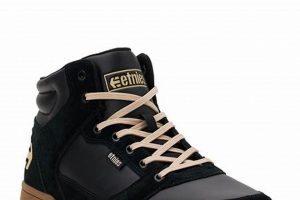
Tip 4: Examine Ankle Support. High-top designs and padded collars can offer additional ankle support, mitigating the risk of sprains and injuries, particularly for aggressive skating styles.
Tip 5: Prioritize Comfort. A comfortable fit is crucial for extended skate sessions. Consider features like breathable materials and moisture-wicking linings to minimize discomfort and blisters.
Tip 6: Select the Correct Size. Proper sizing ensures optimal performance and prevents discomfort. Measure foot length and width and consult the manufacturer’s sizing chart to determine the appropriate size.
Tip 7: Check Sole Pattern. Sole patterns, such as herringbone or waffle grip, offer enhanced traction and board control. Inspect the pattern for depth and spacing to ensure optimal grip.
Adhering to these guidelines will aid in making an informed decision, ultimately leading to enhanced performance and increased protection while skateboarding.
The following section will address common misconceptions regarding skateboarding footwear and provide insights into long-term shoe care and maintenance.
1. Durability

Durability is a paramount consideration in evaluating skateboarding footwear. Its significance stems directly from the abrasive nature of the sport, where shoes are subjected to constant friction against grip tape, concrete, and other rough surfaces. Frequent ollies, kickflips, and other maneuvers inflict considerable wear and tear, making a shoe’s ability to withstand these stresses a primary determinant of its value. A durable skateboarding shoe translates to a longer lifespan, reducing the frequency of replacements and ultimately minimizing the skater’s expenditure on footwear.
The correlation between robust construction and longevity is evident in the materials and manufacturing techniques employed. Shoes constructed from suede, leather, or reinforced canvas typically exhibit superior abrasion resistance compared to those made from synthetic fabrics. Double or triple stitching in high-stress areas, such as the ollie patch and toe cap, further enhances durability. For example, models featuring a rubber underlay beneath the suede in the ollie area demonstrably resist wear from grip tape, extending the shoe’s lifespan. Furthermore, cupsole constructions, where the upper is stitched and/or glued to a pre-molded sole unit, often provide greater durability compared to vulcanized constructions, although the latter can offer superior board feel.
Ultimately, the choice of skateboarding shoe hinges on a balance between durability, performance characteristics, and individual preferences. While maximizing durability is crucial for cost-effectiveness, it should not come at the expense of board feel or impact protection. Skaters must carefully evaluate their individual skating style and the environments in which they primarily skate to determine the optimal level of durability. Footwear that quickly degrades due to low-quality materials or poor construction practices fails to meet the demands of skateboarding, thereby impacting performance and necessitating frequent replacements. Therefore, a durable shoe is an investment in both performance and long-term cost savings.
2. Board Feel

Board feel, in the context of skateboarding footwear, refers to the sensitivity and tactile feedback a skater experiences between their feet and the skateboard. This connection is critically important because it enables precise control and nuanced adjustments during tricks and maneuvers. A shoe providing excellent board feel allows the skater to perceive the board’s orientation, pressure distribution, and subtle movements with greater accuracy. This heightened sensory input translates directly into improved board control, enhanced consistency in trick execution, and ultimately, safer and more progressive skateboarding.
The construction of the sole directly influences board feel. Thinner soles, typically found in vulcanized shoe constructions, generally offer superior board feel compared to thicker, cupsole constructions. Vulcanized soles are more flexible, allowing the skater to more closely feel the contours and movements of the board. Conversely, cupsole constructions, while offering greater impact protection and durability, can reduce board feel due to the thicker layer of material between the foot and the board. The rubber compound used in the sole also plays a role; softer, more pliable rubber compounds tend to enhance board feel, while harder compounds prioritize durability. For example, a skater attempting a complex ledge trick requires precise knowledge of where their feet are positioned on the board; a shoe with excellent board feel allows them to make the necessary micro-adjustments to maintain balance and control.
The optimal choice of footwear invariably necessitates a compromise between board feel, durability, and impact protection. While some skaters prioritize board feel for technical street skating, others require greater impact protection for vert or park skating. Understanding the relationship between sole construction, material properties, and board feel empowers skaters to make informed decisions based on their individual needs and skating style. The pursuit of improved board feel remains a central tenet in the ongoing development and refinement of skateboarding footwear, directly impacting performance and pushing the boundaries of what is possible on a skateboard.
3. Impact Cushioning

Effective impact cushioning is a critical attribute of skateboarding footwear. The repetitive, high-force landings inherent in skateboarding subject the skater’s feet, ankles, and joints to substantial stress. Inadequate cushioning leads to increased risk of injuries, including heel bruises, stress fractures, and ankle sprains. Consequently, the level of impact cushioning provided directly influences the determination of optimal skateboarding shoes. Footwear lacking sufficient impact absorption compromises skater safety and hinders performance by causing discomfort and fatigue.
The design and materials used in the midsole and insole largely dictate a shoe’s impact cushioning capabilities. Technologies such as air pockets, gel inserts, and specialized foam compounds, like polyurethane or ethylene-vinyl acetate (EVA), are commonly incorporated to dissipate impact forces. For instance, a skater performing a large gap or drop places considerable stress on the heel upon landing; footwear equipped with a substantial heel airbag effectively absorbs this force, minimizing the strain on the musculoskeletal system. Furthermore, the density and thickness of the insole contribute to overall cushioning; a thicker insole constructed from a high-density foam provides greater shock absorption than a thinner, less dense alternative. The selection of appropriate cushioning technology depends on the skater’s weight, skating style, and the types of terrain encountered. Transitioning from flat ground to larger obstacles necessitates a corresponding increase in impact protection.
Ultimately, impact cushioning is a non-negotiable attribute in skateboarding footwear. Shoes lacking adequate cushioning are demonstrably detrimental to skater well-being and hinder performance. The optimal choice balances cushioning with board feel and durability, prioritizing safety and enabling skaters to progress without undue risk. Continued advancements in cushioning technology underscore its significance in the evolution of skateboarding footwear, allowing skaters to push the limits of the sport while minimizing the potential for injury. Careful consideration of impact cushioning is therefore essential when evaluating various skateboarding shoe models.
4. Ankle Support

Ankle support constitutes a critical element in evaluating skateboarding footwear, impacting skater safety and performance. The repetitive stress and potential for missteps inherent in skateboarding maneuvers render the ankle joint vulnerable to injury. Footwear providing adequate ankle support mitigates the risk of sprains, strains, and other ankle-related injuries, thereby influencing the determination of which skateboarding shoes are superior. Models featuring heightened collars, reinforced side panels, and internal or external support structures actively stabilize the ankle joint during skating. Consider, for instance, a skater landing a trick awkwardly; footwear with robust ankle support can prevent the ankle from rolling excessively, reducing the likelihood of injury. Absence of adequate support necessitates increased caution and limits the skater’s ability to perform challenging maneuvers confidently.
High-top designs inherently offer greater ankle support compared to low-top styles, though variations exist within each category. Some low-top models incorporate strategically placed padding or reinforced materials to enhance support without sacrificing board feel. Mid-top designs represent a compromise, offering a balance between ankle support and range of motion. The choice between high-top, mid-top, and low-top shoes often depends on individual skater preferences and skating style. Aggressive skating involving larger obstacles or technical tricks typically benefits from increased ankle support. Furthermore, skaters with pre-existing ankle injuries may require footwear offering enhanced stability. The market offers a spectrum of options, from minimalist designs prioritizing flexibility to heavily reinforced models engineered for maximum protection. Examination of footwear specifications, including collar height, padding density, and the presence of internal support systems, allows skaters to assess the level of ankle support provided.
Selecting skateboarding footwear demands a comprehensive evaluation encompassing ankle support alongside other critical factors. While maximizing ankle stability is crucial for injury prevention, it must be balanced against the need for board feel and mobility. Shoes that excessively restrict ankle movement can hinder performance, particularly in technical street skating scenarios. The optimal choice reflects an informed compromise that addresses the skater’s individual needs, skill level, and risk tolerance. The continued emphasis on ankle support in skateboarding shoe design underscores its importance in fostering safer and more progressive skateboarding. Neglecting this aspect introduces unnecessary risk and potentially limits the skater’s long-term participation in the sport.
5. Grip Quality
Grip quality represents a fundamental characteristic of skateboarding footwear, directly influencing board control, trick execution, and overall skater safety. The coefficient of friction between the shoe’s sole and the skateboard’s grip tape dictates the degree to which the skater can maintain a stable connection with the board. Insufficient grip compromises the ability to perform ollies, kickflips, and other essential maneuvers, increasing the risk of slipping and losing control. Consequently, grip quality is a pivotal determinant in assessing footwear suitability, strongly influencing the selection of optimal skateboarding shoes. For instance, a skater attempting a backside 180 requires a secure and consistent grip to rotate the board and maintain balance; inadequate grip renders this maneuver considerably more challenging and dangerous. Therefore, evaluating grip quality is essential for effective performance and injury prevention.
The rubber compound used in the sole and the tread pattern are the primary factors influencing grip. Softer rubber compounds generally provide superior grip compared to harder compounds, though this often comes at the expense of durability. Tread patterns, such as herringbone or waffle designs, increase the surface area in contact with the grip tape, enhancing traction. Deeper tread patterns tend to offer better grip but may wear down more quickly. Furthermore, the sole’s flexibility contributes to grip quality; a more flexible sole allows the foot to conform to the contours of the board, maximizing contact area. The condition of the grip tape itself also plays a role, as worn or dirty grip tape reduces traction. Regular cleaning and replacement of grip tape are necessary to maintain optimal performance, regardless of the shoe’s grip capabilities. A professional skateboarder selecting footwear for a competition would prioritize a model with a high-grip sole, even if it means sacrificing some durability, to ensure maximum control during complex trick combinations.
Grip quality’s paramount importance dictates its inclusion in any comprehensive evaluation of skateboarding footwear. While other factors, such as durability, board feel, and impact protection, are also significant, inadequate grip renders even the most well-constructed shoe ineffective. Selecting footwear with a high-quality rubber compound and an appropriate tread pattern directly translates to enhanced board control, improved trick consistency, and reduced risk of falls. Continuous advancements in sole technology aim to optimize the balance between grip, durability, and board feel, reflecting the ongoing pursuit of superior skateboarding footwear. Therefore, prioritizing grip quality is a crucial step in selecting footwear that enhances performance and promotes skater safety.
6. Material Composition

The determination of optimal skateboarding footwear relies significantly on material composition. The constituent materials dictate durability, board feel, breathability, and overall performance. Footwear intended for skateboarding endures substantial abrasion and impact; therefore, materials selected directly correlate to the lifespan and functionality of the shoe. Models incorporating high-quality suede, reinforced canvas, or leather offer superior resistance to wear compared to those utilizing less robust synthetic alternatives. Similarly, the type of rubber used in the sole influences grip and board feel; softer, more pliable compounds provide enhanced traction but may exhibit reduced longevity. The interrelation between material selection and shoe performance is demonstrably evident in professional-grade skateboarding shoes, where specific materials are strategically employed to optimize both durability and functional characteristics. For example, many skateboarding shoes use suede in high-wear areas, like the ollie patch, as suede offers a good balance between grip, flexibility, and abrasion resistance, making it suitable for a sport where the shoe is constantly in contact with abrasive surfaces.
The midsole and insole materials also contribute significantly to the overall performance and comfort of skateboarding shoes. Ethylene-vinyl acetate (EVA) is commonly used in midsoles for its lightweight cushioning properties, while polyurethane (PU) offers greater durability and support. Insoles incorporating memory foam or gel inserts enhance impact absorption and provide customized comfort. The breathability of the upper materials is crucial for maintaining foot hygiene and comfort during prolonged skate sessions. Leather and canvas, while durable, can retain heat and moisture; mesh panels or perforated designs promote ventilation, reducing the risk of blisters and fungal infections. Selecting materials that strike a balance between durability, performance characteristics, and comfort is therefore paramount. A notable example is the increased use of recycled or sustainable materials in skateboard shoe manufacturing, reflecting a growing awareness of environmental responsibility.
In summary, material composition exerts a profound influence on the performance, durability, and overall value of skateboarding footwear. Understanding the properties and characteristics of different materials empowers skaters to make informed decisions based on their individual needs and skating styles. Although advanced material technologies offer potential benefits, challenges remain in balancing performance with cost-effectiveness and environmental sustainability. Continuous innovation in material science will undoubtedly shape the future of skateboarding footwear, driving further improvements in durability, comfort, and performance.
Frequently Asked Questions
This section addresses common inquiries regarding the selection of skateboarding shoes, providing factual information and dispelling potential misconceptions.
Question 1: How frequently should skateboarding shoes be replaced?
The lifespan of skateboarding shoes varies significantly depending on skating frequency, style, and the shoe’s construction. Signs of wear, such as sole separation, tears in the upper, or loss of cushioning, necessitate replacement.
Question 2: Is there a universal “best” skateboarding shoe for all skaters?
No single shoe is universally optimal. Individual needs and preferences, including skating style, foot shape, and terrain preferences, influence the ideal choice.
Question 3: Are more expensive skateboarding shoes always superior?
Price does not guarantee superior performance or durability. While higher-priced models often incorporate advanced technologies and premium materials, careful evaluation of construction and features is essential.
Question 4: How important is ankle support in skateboarding shoes?
Ankle support is crucial for preventing injuries, particularly for skaters performing high-impact maneuvers. High-top designs and reinforced collars offer enhanced stability.
Question 5: Does the sole’s tread pattern significantly impact performance?
The tread pattern influences grip and board control. Herringbone or waffle patterns typically provide enhanced traction, facilitating more precise maneuvers.
Question 6: What materials are most durable for skateboarding shoe construction?
Suede, leather, and reinforced canvas are commonly used for their abrasion resistance. Double or triple stitching in high-stress areas further enhances durability.
Selecting appropriate skateboarding footwear involves careful consideration of individual needs and shoe characteristics. Prioritizing durability, board feel, impact cushioning, ankle support, and grip quality is essential for optimizing performance and minimizing the risk of injury.
The subsequent section will explore specific brands and models renowned for their quality and performance within the skateboarding community.
Determining Optimal Skateboarding Footwear
The evaluation of which skate shoes are the best involves a multifaceted assessment of durability, board feel, impact cushioning, ankle support, grip quality, and material composition. No single model universally satisfies the demands of all skaters; individual needs and skating styles necessitate a tailored approach to footwear selection. Compromises between performance attributes must be carefully considered to optimize both safety and trick execution.
Continued advancements in materials and construction techniques offer the potential for enhanced performance and longevity in skateboarding footwear. Skaters are encouraged to critically evaluate available options, prioritizing shoes that demonstrably address their specific requirements and contribute to a safer and more progressive skateboarding experience. The responsible selection of appropriate footwear remains paramount for minimizing the risk of injury and maximizing on-board potential.