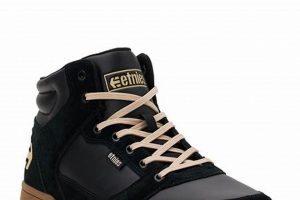
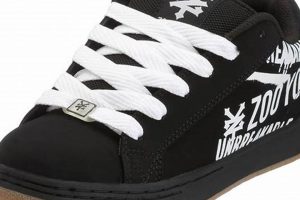
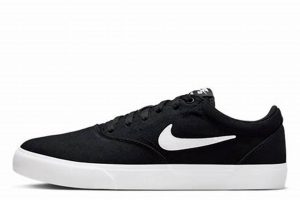
Footwear designed for skateboarding must withstand significant abrasion and impact forces. This specialized footwear prioritizes longevity and resistance to wear and tear, enabling skaters to perform tricks and navigate various surfaces without premature degradation of the shoe. Features like reinforced stitching, robust materials, and strategic padding contribute to the overall resilience of this category of footwear.
The demand for long-lasting skate footwear stems from the inherent stresses placed upon it during skateboarding. Reliable footwear not only saves skaters money in the long run by reducing the frequency of replacements, but also enhances performance and safety. Historically, modifications to standard athletic shoes were common amongst skaters, eventually leading to dedicated designs focused on increased structural integrity and improved protection.
The subsequent sections will examine the key components and materials contributing to the resilience of skateboarding footwear, analyze specific design features that enhance durability, and provide guidance on selecting appropriate footwear based on individual skating styles and typical usage environments.
Selecting Resilient Skate Footwear
Optimizing the lifespan of skate footwear requires careful attention to several key factors. A focus on construction, materials, and intended use will ensure maximum value and performance.
Tip 1: Prioritize Reinforced Stitching: Examine the stitching around high-stress areas such as the toe cap and ollie patch. Double or triple stitching indicates a higher level of durability and resistance to tearing.
Tip 2: Choose Vulcanized or Cupsole Construction: Vulcanized soles offer superior board feel and flexibility, while cupsole constructions provide greater impact protection and support. The selection depends on individual skating style and preferences.
Tip 3: Evaluate Material Composition: Leather, suede, and canvas are common materials. Leather and suede offer higher abrasion resistance, while canvas provides better breathability. Reinforced synthetics represent an alternative with balanced characteristics.
Tip 4: Inspect the Ollie Patch: The ollie patch, located on the lateral side of the shoe, is crucial for protecting against wear during ollies. Ensure it is made of a durable material such as reinforced suede or rubber.
Tip 5: Consider Midsole Material: A robust midsole provides cushioning and impact absorption. Polyurethane (PU) midsoles offer superior durability and rebound compared to ethylene-vinyl acetate (EVA) midsoles, although EVA is lighter.
Tip 6: Assess Outsole Tread Pattern: A deep, grippy tread pattern enhances board control and extends the outsole’s lifespan. Look for patterns specifically designed for skateboarding.
Tip 7: Account for Skating Style: Aggressive street skating demands footwear with higher abrasion resistance and impact protection, while park skating may prioritize flexibility and board feel.
Selecting skate footwear based on these criteria directly impacts its longevity and performance, minimizing the need for frequent replacements and enhancing the overall skating experience.
The subsequent sections will provide a detailed analysis of specific brands and models known for their resilience, offering practical recommendations for informed purchasing decisions.
1. Reinforced Stitching

Reinforced stitching serves as a critical element in the construction of skateboarding footwear intended for extended use. The activity subjects shoes to extreme stress, particularly at seams connecting different material panels. Standard stitching methods often prove inadequate under these conditions, leading to premature separation and a compromised structure. Reinforced stitching, therefore, represents a proactive design choice aimed at mitigating these failure points.
The application of reinforced stitching manifests in several ways. Double or triple stitching along high-stress zones, such as the toe cap, heel counter, and ollie area, distributes force across a greater number of thread lines, enhancing resistance to tearing. Furthermore, specialized stitching patterns, like bar tacking at critical junctures, further fortify these areas against repetitive strain. Converse CONS, for example, often employ reinforced stitching around the ollie patch, acknowledging the significant wear experienced in this specific region. The result is a quantifiable increase in the shoe’s lifespan and a reduction in the likelihood of structural failure during skateboarding.
Understanding the significance of reinforced stitching allows consumers to make more informed purchasing decisions. Recognizing visual cues such as multiple stitch lines and robust thread types provides a means of assessing the relative durability of different skate shoe models. Ultimately, the implementation of reinforced stitching directly contributes to the overall value proposition of skateboarding footwear, offering a longer-lasting and more reliable product capable of withstanding the demands of the sport.
2. Material Abrasion Resistance

The longevity of skateboarding footwear is intrinsically linked to the abrasion resistance of its constituent materials. Skateboarding subjects shoes to repeated friction against abrasive surfaces, most notably grip tape on the skateboard deck. Therefore, the capacity of the shoe’s materials to withstand this abrasion is a primary determinant of its overall durability.
- Suede and Leather Properties
Suede and leather are frequently employed in skateboarding footwear due to their inherent abrasion-resistant qualities. The dense fiber structure of these materials provides a robust barrier against surface wear. Full-grain leather, in particular, offers exceptional resistance to tearing and abrasion. While offering durability, leather and suede are more expensive and often require a break-in period to achieve optimal flexibility and board feel.
- Canvas and Synthetic Alternatives
Canvas, a more economical material, provides breathability and flexibility, but is inherently less abrasion-resistant than leather or suede. Synthetic materials, engineered to mimic the properties of natural fibers, can offer a compromise between cost, comfort, and abrasion resistance. The performance of synthetic materials varies widely depending on their specific composition and manufacturing process.
- Reinforcement Technologies
To enhance the abrasion resistance of weaker materials, manufacturers employ various reinforcement technologies. Rubber ollie patches, strategically placed in high-wear areas, provide an additional layer of protection against grip tape abrasion. Similarly, multiple layers of material or the incorporation of abrasion-resistant coatings can significantly extend the lifespan of skateboarding footwear.
- Impact of Construction Techniques
The manner in which materials are assembled also influences overall abrasion resistance. Tightly woven canvas, for example, will generally exhibit greater durability than loosely woven varieties. Reinforced stitching, particularly in high-stress areas, prevents seams from unraveling and exposing underlying materials to abrasion. The careful selection of appropriate construction techniques is paramount in maximizing the lifespan of skateboarding footwear, regardless of the specific materials utilized.
In conclusion, the selection of materials with high abrasion resistance, coupled with strategic reinforcement and robust construction methods, directly contributes to the creation of skateboarding footwear that can withstand the rigorous demands of the sport. This focus on material science is essential for delivering durable and reliable products to the skateboarding community.
3. Sole Construction Type

The method employed to attach the sole to the upper of skateboarding footwear significantly influences its durability and performance characteristics. Sole construction type dictates the shoe’s flexibility, impact absorption, and overall resistance to wear and tear, thereby playing a critical role in determining its suitability for skateboarding.
- Vulcanized Construction
Vulcanized construction involves bonding the sole to the upper using heat and pressure. This process creates a flexible and responsive sole, offering superior board feel. However, vulcanized soles generally exhibit lower impact absorption compared to other construction types. Due to the nature of the bond, delamination can occur over time, reducing the lifespan, especially under intense use.
- Cupsole Construction
Cupsole construction features a pre-molded sole unit that is stitched and/or glued to the upper. This construction method provides increased impact protection and support due to the thicker sole unit. Cupsole designs are often more durable than vulcanized soles, as the bonding area is larger and less prone to separation. The trade-off is reduced board feel and increased stiffness compared to vulcanized models. Examples include many skate shoes designed for vert or park skating where impact protection is paramount.
- Boardfeel vs. Durability Trade-off
The selection between vulcanized and cupsole construction necessitates a trade-off between board feel and durability. Vulcanized soles offer enhanced board feel, allowing for greater sensitivity and control. However, their lower impact absorption and susceptibility to delamination can limit their lifespan. Cupsole constructions provide superior impact protection and overall durability but at the expense of board feel. Skaters must consider their individual skating style and priorities when selecting a sole construction type.
Ultimately, the choice of sole construction type represents a critical decision in the pursuit of durable skateboarding footwear. Each method offers distinct advantages and disadvantages, influencing the shoe’s performance, longevity, and suitability for different skating styles. Understanding these nuances empowers skaters to make informed purchasing decisions based on their specific needs and preferences, leading to enhanced performance and reduced frequency of shoe replacement.
4. Impact Absorption Capacity

Impact absorption capacity is a critical attribute directly influencing the longevity and protective qualities of skateboarding footwear. Skateboarding inherently involves repetitive high-impact activities, such as landing jumps and performing tricks. Insufficient impact absorption leads to increased stress on the foot, ankle, and knee joints, potentially causing injuries. Furthermore, the constant force exerted during these activities accelerates the degradation of the shoe’s internal components, particularly the midsole, ultimately shortening its lifespan. The correlation between impact absorption capacity and the durability of skate shoes is thus a cause-and-effect relationship, where greater absorption directly contributes to increased shoe lifespan by mitigating material fatigue. A practical example is the difference between landing a trick in shoes with a thick polyurethane (PU) midsole versus a thin ethylene-vinyl acetate (EVA) midsole; the PU midsole will demonstrably absorb more impact, protecting the skater and preserving the midsole’s integrity for a longer period.
Advanced materials and design elements significantly enhance the impact absorption capacity of skateboarding footwear. Gel inserts, air pockets, and multi-density foam configurations strategically placed within the midsole provide targeted cushioning and shock dissipation. Construction techniques also play a role; for instance, a cupsole design generally offers superior impact absorption compared to a vulcanized sole due to its thicker, more structured midsole. Several brands incorporate proprietary technologies, such as Nike’s Zoom Air or Adidas’ Boost, into their skate shoe models, explicitly designed to maximize energy return and minimize impact forces. Consequently, a shoe engineered with these features will not only provide greater comfort and protection but also maintain its structural integrity for a longer duration, contributing significantly to its durability.
In summary, impact absorption capacity is not merely a comfort feature but a fundamental component contributing directly to the durability and protective function of skateboarding footwear. By mitigating stress on both the skater’s body and the shoe’s internal materials, adequate impact absorption extends the shoe’s usable lifespan and reduces the risk of injury. While material selection and construction techniques play vital roles, the overarching principle remains: a shoe with superior impact absorption will demonstrably last longer and provide better protection than one lacking this crucial characteristic. The challenges lie in balancing impact absorption with board feel and flexibility, requiring innovative material science and design solutions.
5. Ollie Patch Reinforcement

Ollie patch reinforcement directly influences the lifespan of skateboarding footwear. The ollie, a fundamental skateboarding maneuver, involves repeated abrasion between the lateral side of the shoe and the skateboard’s grip tape. Without adequate reinforcement in this area, the shoe’s upper material quickly deteriorates, leading to structural failure. Therefore, the presence and quality of the ollie patch serve as a primary indicator of a shoe’s potential for longevity in skateboarding applications. The size, placement, and material composition of the ollie patch are all factors that determine its effectiveness in preventing wear and tear. For example, an ollie patch constructed from multiple layers of suede, as seen on certain models from brands like Etnies, demonstrably increases resistance to abrasion compared to a single layer of canvas. The strategic integration of the ollie patch is thus not merely an aesthetic detail, but a functional design element integral to creating durable skateboarding footwear.
The effectiveness of ollie patch reinforcement is further enhanced through specific construction techniques. Reinforced stitching around the perimeter of the patch prevents the patch from detaching from the upper. Furthermore, the type of adhesive used to bond the patch to the shoe influences its resistance to peeling. Some manufacturers employ a combination of stitching and adhesive bonding to maximize patch security. Examination of popular skate shoe models reveals a variety of approaches to ollie patch design, each with varying degrees of effectiveness. Brands like Adidas and Nike incorporate molded rubber ollie patches into some of their designs, providing a virtually impenetrable barrier against abrasion. Conversely, other brands utilize smaller, less substantial patches, resulting in reduced protection and a shorter lifespan for the footwear. The practical application of this understanding allows consumers to make informed purchasing decisions, prioritizing models with robust ollie patch reinforcement.
In summary, ollie patch reinforcement stands as a critical component in the design and construction of durable skateboarding footwear. Its primary function is to protect the shoe’s upper from the abrasive forces generated during ollies, thereby extending the overall lifespan of the product. The effectiveness of the ollie patch depends on factors such as material composition, size, placement, and construction techniques. While varying design approaches exist, the underlying principle remains consistent: adequate ollie patch reinforcement is essential for creating footwear capable of withstanding the demands of skateboarding. The challenge lies in balancing ollie patch durability with other factors such as board feel and overall shoe weight.
Frequently Asked Questions
This section addresses common inquiries regarding the selection, maintenance, and performance of skateboarding footwear designed for extended use.
Question 1: What constitutes a “durable” skate shoe?
A durable skate shoe exhibits resistance to abrasion, tearing, and impact forces. Key characteristics include reinforced stitching, abrasion-resistant materials (e.g., suede, leather), robust sole construction (e.g., cupsole), and strategic reinforcement in high-wear areas (e.g., ollie patch).
Question 2: How does sole construction impact shoe lifespan?
Sole construction significantly influences a skate shoe’s durability. Cupsole construction generally offers greater impact protection and resistance to delamination compared to vulcanized construction, albeit at the expense of board feel.
Question 3: Which materials are most conducive to longevity in skate footwear?
Suede and leather offer superior abrasion resistance compared to canvas and synthetic alternatives. Full-grain leather provides the highest level of durability, while reinforced synthetic materials can offer a balance of durability and breathability.
Question 4: Why is the ollie patch crucial for durability?
The ollie patch protects the lateral side of the shoe from abrasion caused by the skateboard’s grip tape during ollies. A robust ollie patch, constructed from durable materials and securely attached, significantly extends the shoe’s lifespan.
Question 5: Can proper maintenance extend the life of skate shoes?
Yes. Regular cleaning to remove dirt and debris prevents premature wear. Avoiding prolonged exposure to moisture and extreme temperatures also contributes to increased longevity. Prompt repair of minor damage (e.g., loose stitching) can prevent further deterioration.
Question 6: Are more expensive skate shoes necessarily more durable?
Price is not always a reliable indicator of durability. While higher-priced models often feature premium materials and construction techniques, it is essential to assess specific features (e.g., stitching, materials, sole construction) rather than solely relying on price as a measure of durability.
In summary, durable skateboarding footwear is characterized by a combination of robust materials, reinforced construction, and strategic design elements. Proper maintenance further enhances the shoe’s lifespan, providing enhanced value and performance.
The next section will delve into specific brands and models known for their extended lifespan and resistance to wear and tear.
Durable Skate Shoes
The preceding analysis has underscored the multifaceted nature of skateboarding footwear engineered for longevity. Durability, in this context, is not merely a marketing claim, but rather a tangible outcome of deliberate design choices, material selection, and construction techniques. Reinforced stitching, abrasion-resistant materials, robust sole constructions, and strategically placed reinforcement, such as the ollie patch, are essential elements contributing to a shoe’s ability to withstand the rigors of skateboarding. The interplay of these factors ultimately determines the footwear’s lifespan and its capacity to protect the skater’s feet.
The pursuit of long-lasting skateboarding footwear is not simply a matter of cost savings, but rather a reflection of a commitment to performance, safety, and environmental responsibility. Selecting footwear designed for extended use reduces the frequency of replacements, minimizing waste and promoting a more sustainable approach to skateboarding. Furthermore, by investing in durable equipment, skaters can focus on their progression without the distraction of premature shoe failure. The continued development and refinement of skateboarding footwear technology will undoubtedly lead to further advancements in durability, providing skaters with increasingly reliable and long-lasting products.