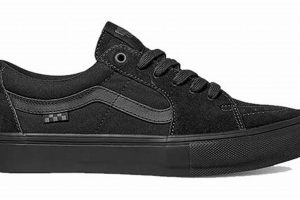
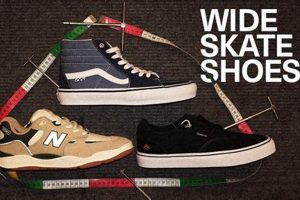
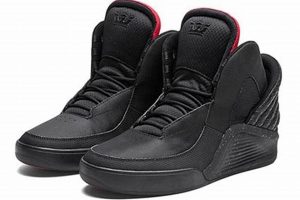
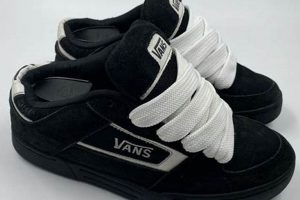
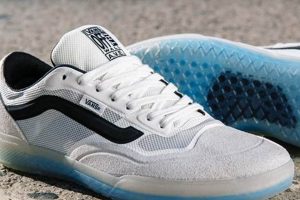
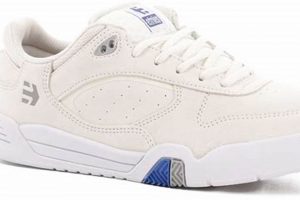
Footwear specifically engineered for skateboarding provides the necessary grip, durability, and support required for performing tricks and navigating skate parks or street environments. This specialized footwear often features reinforced stitching, cushioned insoles, and vulcanized rubber outsoles for enhanced board feel and impact absorption. These characteristics differentiate it from standard athletic shoes.
The design and construction of this type of footwear offer crucial advantages to skateboarders. Protection against abrasion from the skateboard deck, improved control due to the sole’s grip, and reduced fatigue from cushioning all contribute to enhanced performance and prolonged skateboarding sessions. Their evolution mirrors the progression of skateboarding itself, with innovations responding to the increasing demands of the sport.
The ensuing discussion will explore key aspects of selecting appropriate skateboarding footwear, including considerations for material choice, fit, and specific design features. A review of notable brands and technologies contributing to the advancement of performance and safety will also be presented.
Selection Guidance
The following guidelines offer insight into selecting footwear specifically designed for skateboarding, focusing on durability, performance, and user safety.
Tip 1: Assess Material Durability: Prioritize models constructed with robust materials such as suede or reinforced canvas. These materials withstand the abrasive forces encountered during skateboarding maneuvers, prolonging the lifespan of the footwear.
Tip 2: Evaluate Sole Construction: Vulcanized soles provide enhanced board feel and grip, while cupsole constructions offer increased impact protection. The choice depends on individual skateboarding style and preference for board feel versus cushioning.
Tip 3: Inspect Stitching Quality: Reinforced stitching, particularly in high-wear areas such as the ollie patch and toe cap, enhances structural integrity. Double or triple stitching minimizes the risk of premature separation of the upper from the sole.
Tip 4: Consider Ankle Support: High-top designs offer increased ankle support, potentially reducing the risk of injury, particularly for individuals new to skateboarding or those attempting more complex tricks.
Tip 5: Verify Fit Accuracy: Ensure a snug but comfortable fit. Excessively loose footwear diminishes board feel and control, while overly tight footwear can cause discomfort and impede circulation.
Tip 6: Examine Insole Cushioning: Insoles with sufficient cushioning absorb impact forces generated during landings, reducing stress on joints and muscles. Look for insoles with gel or foam padding for enhanced comfort.
Tip 7: Research Brand Reputation: Established brands with a history of producing skateboarding footwear often utilize proprietary technologies and materials, contributing to improved performance and durability.
Adherence to these recommendations can significantly enhance the skateboarding experience, minimizing the risk of injury and maximizing performance potential.
The subsequent sections will delve into specific product reviews and comparative analyses of various skateboarding footwear options available on the market.
1. Durability

Durability is a critical attribute of skateboarding footwear due to the intense abrasion and impact forces experienced during skateboarding. The demanding nature of the sport subjects the footwear to repeated contact with abrasive surfaces such as concrete, asphalt, and the skateboard deck itself. Premature wear and tear compromise performance and necessitate frequent replacements, increasing costs and potentially leading to injury. For instance, the ollie, a fundamental skateboarding maneuver, involves repeatedly scraping the side of the shoe against the grip tape, creating significant stress on the material. Footwear lacking adequate durability will quickly degrade in this area, rendering them unusable.
Materials such as suede, leather, and reinforced canvas are commonly employed in the construction of skateboarding footwear to enhance resistance to abrasion. Moreover, design features like double or triple stitching in high-stress zones, such as the toe cap and heel counter, provide added reinforcement. The use of rubber overlays and strategically placed reinforcements further mitigates the effects of wear and tear. Consider the example of professional skateboarders who often subject their footwear to extreme conditions; their choice of footwear reflects a strong emphasis on durability, as evidenced by their preference for models incorporating robust materials and reinforced construction techniques.
In summary, durability is inextricably linked to the functionality and longevity of skateboarding footwear. Its absence directly translates to reduced performance, increased costs, and heightened risk of injury. Recognizing the importance of durable materials and construction methods allows skateboarders to make informed decisions, ultimately contributing to a safer and more enjoyable skateboarding experience. The ongoing development of abrasion-resistant materials and innovative construction techniques continues to drive advancements in the durability of skateboarding footwear.
2. Board Feel

Board feel, in the context of skateboarding footwear, refers to the tactile sensation and sensitivity transmitted from the skateboard deck to the skater’s feet. It is a critical component directly influencing control, precision, and overall performance. Footwear designed with enhanced board feel allows the skater to perceive subtle nuances in the board’s movement, enabling quicker reactions and more accurate execution of tricks. For example, a skater attempting a technical maneuver like a kickflip relies heavily on board feel to gauge the board’s rotation and landing position. Insufficient board feel hinders this process, increasing the likelihood of missed tricks and potential falls.
The construction of the sole plays a pivotal role in determining board feel. Thinner soles, often made from vulcanized rubber, maximize sensory input by minimizing the barrier between the skater’s foot and the board. Conversely, thicker soles, while providing greater impact protection, reduce sensitivity and diminish board feel. The flexibility of the sole material is also a factor; a more flexible sole conforms to the contours of the board, enhancing the feeling of connection. Consider the experience of a skater transitioning from bulky, cushioned footwear to a pair of shoes with a thin, flexible sole; the increased board feel often results in improved control and a greater sense of confidence.
Understanding the significance of board feel allows skateboarders to make informed choices when selecting footwear. Balancing board feel with other essential attributes, such as durability and impact protection, is crucial. Compromising excessively on board feel for the sake of cushioning may hinder performance, particularly for experienced skaters prioritizing technical maneuvers. Ultimately, the ideal balance depends on individual preferences, skateboarding style, and the specific demands of the terrain. The pursuit of optimal board feel continues to drive innovation in skateboarding footwear design, with manufacturers constantly experimenting with new materials and construction techniques.
3. Ankle Support
Ankle support within skateboarding footwear directly influences rider safety and performance. The repetitive, high-impact nature of skateboarding places considerable stress on the ankle joint. Insufficient ankle support can lead to sprains, strains, and other injuries, potentially hindering a skater’s progress and overall well-being. High-top designs, in particular, offer enhanced stability by limiting the range of motion, reducing the likelihood of excessive inversion or eversion. The increased surface area around the ankle provides greater support during landings and minimizes the risk of acute injuries, especially when attempting more complex or aerial maneuvers. For example, a skater landing awkwardly after a failed trick may be more susceptible to an ankle injury if wearing low-cut footwear with minimal support, compared to wearing high-top designs providing a secure fit and restricting excessive movement.
The degree of ankle support required often depends on individual skating style, experience level, and the type of terrain encountered. Skaters who frequently perform vert or transition skating may benefit significantly from the added stability offered by higher-cut models. Similarly, individuals with a history of ankle injuries may find that the increased support provided by these designs helps to prevent re-injury. However, some skaters prioritize freedom of movement over stability, opting for lower-cut footwear to enhance board feel and flexibility. The selection process should therefore consider a skater’s personal preferences, physical condition, and specific skateboarding activities. The trade-off between stability and flexibility is a crucial factor in determining the appropriate level of ankle support. Manufacturers often incorporate features such as padded collars and reinforced heel counters to further enhance ankle support without significantly restricting movement.
In conclusion, ankle support represents a critical component of skateboarding footwear, influencing both safety and performance. The choice between high-top and low-top designs involves carefully weighing the need for stability against the desire for freedom of movement. While higher-cut models can reduce the risk of injury, particularly for beginners or those with pre-existing conditions, lower-cut options may provide increased board feel and flexibility for experienced skaters. Ultimately, the decision should be based on individual needs and preferences, taking into account the specific demands of the skateboarding environment. Continuous advancements in footwear design are aimed at optimizing ankle support while minimizing any negative impact on board feel and overall performance.
4. Impact Absorption

The capacity of skateboarding footwear to mitigate the force of impacts directly influences skater safety and long-term joint health. Skateboarding involves repetitive landings and high-impact maneuvers that exert considerable stress on the feet, ankles, knees, and hips. Insufficient impact absorption can lead to chronic injuries, such as stress fractures, cartilage damage, and premature joint degeneration. The incorporation of effective impact absorption technologies within skateboarding footwear is therefore paramount to reducing the risk of injury and prolonging a skater’s career. For instance, landing a jump from an elevated surface generates significant force, which, if not adequately absorbed by the shoe, is transmitted directly to the skeletal system.
Materials such as polyurethane foam, gel inserts, and air cushioning systems are commonly employed to enhance impact absorption in skateboarding footwear. These materials compress upon impact, dissipating energy and reducing the force transmitted to the foot. For example, midsoles constructed with dual-density foam offer varying levels of support and cushioning, providing a balance between impact absorption and board feel. The strategic placement of cushioning elements in high-impact areas, such as the heel and forefoot, further enhances protection. The selection of appropriate impact absorption technologies depends on factors such as skateboarding style, weight, and personal preference. Skaters who frequently engage in vert or transition skating may require footwear with enhanced cushioning to mitigate the impact of repeated landings, while skaters focused on street skating may prioritize board feel over maximum impact absorption.
In summary, impact absorption is a critical consideration in the design and selection of skateboarding footwear. Effective impact absorption technologies minimize the risk of injury, promote long-term joint health, and enhance overall performance. While the pursuit of maximum impact absorption must be balanced with the need for board feel and flexibility, prioritizing this attribute is essential for skaters of all skill levels. The ongoing development of advanced cushioning materials and innovative designs continues to drive improvements in the impact absorption capabilities of skateboarding footwear, contributing to a safer and more enjoyable skateboarding experience.
5. Grip
Grip, in the context of skateboarding footwear, represents the frictional force generated between the shoe’s outsole and the skateboard deck. This attribute is essential for maintaining control, executing tricks, and ensuring rider safety. Footwear lacking sufficient grip compromises a skater’s ability to manipulate the board effectively, increasing the likelihood of missed maneuvers and potential falls. The materials, tread patterns, and construction techniques employed in the design of the outsole directly influence the level of grip provided.
- Rubber Compound Composition
The chemical composition of the rubber compound used in the outsole dictates its frictional properties. Softer, tackier rubber compounds generally offer superior grip compared to harder, more durable compounds. However, softer compounds tend to wear down more quickly. The selection of the appropriate rubber compound represents a trade-off between grip and longevity, requiring careful consideration based on skateboarding style and terrain. For instance, a skater who frequently performs power slides may prioritize a harder compound for increased durability, while a skater focused on technical street skating may prefer a softer compound for maximum grip.
- Tread Pattern Design
The tread pattern etched into the outsole enhances grip by increasing the surface area in contact with the skateboard deck and providing channels for water displacement. Herringbone, waffle, and geometric patterns are commonly employed, each offering distinct advantages in terms of grip and durability. Deeper tread patterns generally provide better grip on rough or uneven surfaces, while shallower patterns offer enhanced board feel and responsiveness. The design and arrangement of the tread pattern directly influence the distribution of pressure across the outsole, impacting the overall grip performance.
- Vulcanization Process
The vulcanization process, which involves heating rubber in the presence of sulfur, significantly impacts the grip characteristics of the outsole. Vulcanization creates cross-links between rubber molecules, increasing its strength, elasticity, and resistance to wear. The degree of vulcanization can be adjusted to optimize the grip properties of the outsole. Insufficient vulcanization may result in a soft, gummy outsole with poor durability, while excessive vulcanization can lead to a hard, brittle outsole with reduced grip. The precise control of the vulcanization process is crucial for achieving the desired balance between grip, durability, and flexibility.
- Outsole Contact Area
The total surface area of the outsole that makes contact with the skateboard deck directly influences the level of grip. A larger contact area generally provides greater grip, distributing the skater’s weight more evenly across the deck. However, a larger contact area can also reduce board feel and responsiveness. The shape and profile of the outsole are designed to maximize contact area while minimizing interference with other aspects of performance. For example, some skateboarding footwear designs feature a flat, wide outsole for increased grip, while others incorporate a more contoured outsole to enhance board feel and flexibility.
The facets of grip, encompassing rubber compound, tread pattern, vulcanization, and contact area, critically influence skateboarding footwear performance. These design elements must be carefully optimized to deliver the necessary traction for skaters, enabling them to confidently maneuver their boards and perform stunts while minimizing the risk of slips and falls. Improvements in these areas lead to greater skater control, safety, and overall progression in skateboarding.
Frequently Asked Questions
The following section addresses common inquiries regarding footwear specifically designed for skateboarding, clarifying misconceptions and providing detailed information for informed decision-making.
Question 1: Are standard athletic shoes suitable for skateboarding?
No. Standard athletic shoes typically lack the durability, grip, and support necessary to withstand the rigors of skateboarding. Their construction is not designed for the abrasive forces and impact experienced during skateboarding maneuvers, leading to premature wear and increased risk of injury.
Question 2: How frequently should skateboard footwear be replaced?
Replacement frequency depends on the intensity and frequency of skateboarding activity, as well as the quality of the footwear. Signs of wear include sole separation, fabric tears, and diminished grip. Footwear exhibiting these signs should be replaced to maintain performance and safety.
Question 3: Is there a difference between vulcanized and cupsole construction?
Yes. Vulcanized soles are bonded to the upper using heat and pressure, resulting in a flexible and grippy sole. Cupsole construction involves stitching or gluing the upper to a pre-molded sole, offering greater impact protection but potentially reduced board feel.
Question 4: How does material choice affect skateboard footwear performance?
Material choice significantly impacts durability, breathability, and board feel. Suede and reinforced canvas are durable options, while leather offers increased water resistance. Mesh panels enhance breathability, and thinner materials improve board feel.
Question 5: What features contribute to ankle support in skateboard footwear?
High-top designs, padded collars, and reinforced heel counters enhance ankle support by restricting excessive movement and providing stability. These features are particularly beneficial for individuals prone to ankle injuries or those performing demanding maneuvers.
Question 6: How important is tread pattern on the outsole?
The tread pattern directly influences grip and traction on the skateboard deck. Deeper, more aggressive patterns provide enhanced grip, while shallower patterns offer increased board feel and responsiveness. The optimal tread pattern depends on individual skateboarding style and terrain.
In summary, understanding the nuances of construction, materials, and design features is essential for selecting appropriate skateboarding footwear. Prioritizing durability, grip, support, and impact absorption is crucial for maximizing performance and minimizing the risk of injury.
The subsequent section will delve into specific product reviews and comparative analyses of various skateboarding footwear options available on the market.
Conclusion
This discussion has explored the multifaceted characteristics of footwear designed for skateboarding. The importance of durability, board feel, ankle support, impact absorption, and grip has been established, emphasizing the functional requirements of the activity. Material selection, construction techniques, and design considerations all contribute to the overall performance and longevity of the footwear.
The selection of appropriate footwear is a critical element in the pursuit of skateboarding and for protection and performance. Understanding these elements will improve safety and enable skaters to achieve peak results. Continued research and development in materials and design will further enhance future generation products.