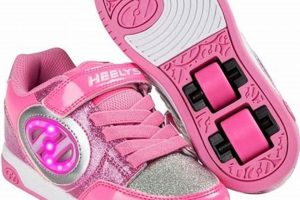
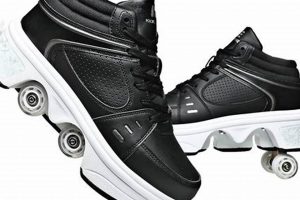
Footwear incorporating a retractable wheel in the heel allows for both walking and a form of skating. This design enables users to transition between these activities by shifting their weight and engaging or disengaging the wheel mechanism. An example includes athletic shoes modified with a recessed cavity to accommodate a single, removable wheel.
The integration of skating functionality into everyday footwear offers a novel approach to personal mobility and recreation. This design gained popularity for its perceived convenience and appeal to younger demographics. Historically, the concept addresses the desire for versatile footwear suitable for both pedestrian and gliding movement, potentially reducing the need to carry separate skates.
The following sections will delve into the mechanics of this type of footwear, explore its safety considerations, and examine its impact on various user groups and the broader recreational landscape.
Operating Footwear with Integrated Wheels
This section provides essential guidance on the responsible and effective utilization of wheeled footwear, designed for both walking and rolling movement.
Tip 1: Prioritize Protective Equipment. Helmets, wrist guards, and knee pads are strongly advised to mitigate potential injuries during use. A controlled environment, free of obstacles, is recommended when learning.
Tip 2: Master Fundamental Balance. Before attempting advanced maneuvers, establish a firm understanding of weight distribution and body positioning. Practice maintaining balance on a flat, smooth surface.
Tip 3: Utilize Appropriate Surfaces. Wheeled footwear performs optimally on smooth, paved surfaces. Avoid uneven terrain, gravel, or areas with heavy pedestrian traffic to ensure safety and control.
Tip 4: Practice Controlled Braking. Familiarize oneself with the braking mechanism, typically involving tilting the foot and applying pressure. Practice stopping smoothly and gradually to avoid sudden falls.
Tip 5: Adhere to Local Regulations. Be aware of and comply with any local ordinances or regulations regarding the use of wheeled footwear in public spaces. Respect pedestrian right-of-way and avoid obstructing walkways.
Tip 6: Regular Maintenance is Crucial. Regularly inspect wheels, bearings, and locking mechanisms for wear and tear. Clean debris from the wheel area and replace worn parts promptly to ensure optimal performance and safety.
Tip 7: Start Slowly and Progress Gradually. Avoid attempting complex tricks or high-speed maneuvers until proficiency in basic skills is achieved. Incrementally increase the level of difficulty as comfort and control improve.
Adhering to these guidelines promotes safer and more enjoyable use of wheeled footwear. Consistent practice and responsible behavior are paramount for minimizing risk.
The subsequent sections will cover advanced techniques and address potential maintenance requirements.
1. Retractable Wheel Mechanism
The core functionality of athletic shoes equipped with wheels resides in its retractable wheel mechanism. This mechanism enables the transformation of ordinary footwear into a mobile platform. A wheel, typically made of durable polyurethane, is housed within a recessed cavity located in the heel of the shoe. The mechanism permits the user to engage or disengage the wheel, thus alternating between walking and rolling gaits. Without this mechanism, the product would not function as intended, thereby eliminating its unique selling proposition. A malfunctioning or poorly designed mechanism can directly compromise the safety and usability of the footwear.
The design and implementation of the wheel retraction system dictate the ease of use and overall durability. A robust and reliable system ensures smooth transitions and minimizes the risk of accidental wheel deployment or failure. Example: a high-quality system incorporates a secure locking mechanism and utilizes durable materials resistant to wear and tear. Conversely, a substandard system may exhibit sticking, difficulty in deployment/retraction, or premature failure of components, rendering the footwear impractical or even dangerous.
Therefore, the retractable wheel mechanism represents a fundamental component for athletic shoes with integrated wheels. Its effective design, reliable operation, and durability are paramount to the product’s success and the safety of its users. Understanding this relationship highlights the necessity for manufacturers to prioritize quality and engineering rigor in the development of this specific aspect of the overall footwear design.
2. Balance and Stability

The integration of a wheel into the heel of athletic footwear fundamentally alters the wearer’s center of gravity and base of support. Consequently, balance and stability become paramount considerations for safe and effective use.
- Altered Center of Gravity
The introduction of a wheel elevates the heel, shifting the center of gravity forward. This necessitates a compensatory adjustment in posture and gait to maintain equilibrium. Failure to adapt can result in instability and an increased risk of falls. An example includes the tendency to lean backwards while stationary, requiring conscious effort to maintain an upright stance. This shift is a primary concern when learning to use the footwear.
- Reduced Base of Support
The single wheel provides a significantly smaller contact area compared to a traditional flat sole, diminishing the base of support. This reduction in surface area compromises stability, particularly during lateral movements or on uneven terrain. For instance, navigating a slight incline or making a sudden turn demands precise balance control. The diminished base introduces an increased potential for instability and injury if balance isn’t effectively managed.
- Proprioceptive Adaptation
Successful use requires the development of enhanced proprioception the body’s awareness of its position in space. Users must learn to sense and respond to subtle shifts in balance to maintain control. This involves strengthening relevant muscle groups and refining neuromuscular coordination. The process of learning to use the footwear cultivates an awareness of body positioning that extends beyond typical ambulation.
- Surface Dependence
Balance and stability are significantly affected by the surface on which the footwear is used. Smooth, flat surfaces provide optimal conditions, while uneven, slippery, or inclined surfaces pose a greater challenge. Traversing a cracked pavement necessitates a higher degree of balance control than gliding on a polished floor. Understanding surface dependence is crucial for safe operation in varied environments.
These facets illustrate the intricate relationship between balance and the design of athletic shoes incorporating wheels. The altered center of gravity, reduced base of support, and the need for proprioceptive adaptation, coupled with surface dependence, highlight the necessity for careful consideration and responsible use of such footwear to minimize the risk of falls and injuries.
3. Surface Compatibility

Surface compatibility is a critical determinant of the performance, safety, and overall usability of wheeled athletic footwear. The interaction between the wheel material and the surface texture directly influences traction, speed, and maneuverability. Understanding this relationship is paramount for users to operate the footwear effectively and avoid potential hazards.
- Smooth, Hard Surfaces
Ideal performance is achieved on smooth, hard surfaces such as polished concrete, asphalt, or tile. These surfaces provide minimal resistance, allowing for optimal rolling speed and efficient gliding. Examples include indoor skating rinks, smooth sidewalks, and designated bike paths. The lack of surface irregularities minimizes vibrations and enhances control.
- Rough or Textured Surfaces
Rough or textured surfaces, such as unpaved roads, gravel, or heavily textured concrete, significantly impede rolling performance. These surfaces introduce friction and vibration, reducing speed and increasing the effort required to propel oneself. Moreover, they elevate the risk of instability and loss of control. An example includes the difficulty of using wheeled footwear on a brick walkway, where the uneven surface disrupts smooth rolling.
- Inclined Surfaces
The angle of inclination profoundly impacts both forward motion and braking capability. Uphill slopes demand increased effort to maintain momentum, while downhill slopes necessitate greater braking control to prevent uncontrolled acceleration. The effectiveness of the braking mechanism is often compromised on steep inclines. For example, attempting to stop on a sharply angled hill can result in a loss of traction and potential loss of control.
- Wet or Slippery Surfaces
Wet or slippery surfaces, such as rain-slicked pavement or polished floors, drastically reduce traction and increase the likelihood of slippage. The wheel material loses its grip, diminishing both propulsion and braking effectiveness. Instances include using the footwear indoors after rain has been tracked in, potentially leading to an uncontrolled slide. These conditions demand extreme caution and often render the footwear unsafe for use.
In summary, surface compatibility represents a key factor influencing the operation of wheeled athletic footwear. The interplay between the surface characteristics and the wheel material dictates the ease of use, safety, and overall performance. Awareness of these considerations enables users to select appropriate environments and adapt their techniques accordingly, thereby minimizing the risk of accidents and maximizing enjoyment.
4. Braking Techniques
Effective braking techniques are indispensable for the safe and controlled operation of wheeled athletic footwear. Mastering these techniques allows users to manage speed, avoid obstacles, and prevent accidents. The unique design of this footwear necessitates specific braking methods distinct from conventional skating or walking.
- Heel Drop Method
The heel drop method involves lowering the heel of the shoe to engage the sole with the ground, creating friction and decelerating forward momentum. This technique requires precise timing and controlled muscle engagement. For example, executing a heel drop too abruptly can result in a loss of balance, while insufficient pressure may not provide adequate braking force. Consistent practice is essential to develop proficiency with this maneuver. This method is the foundational approach for stopping.
- Drag Stop Technique
The drag stop technique involves using one foot as a braking mechanism by dragging the sole along the ground. This method is typically employed for gradual deceleration or when greater control is needed at lower speeds. The user must maintain balance on the non-braking foot while modulating the pressure applied by the dragging foot. Using the side of the shoes sole is preferable to preserve the sole and prevent tripping. An over-reliance on this method can accelerate shoe wear.
- Turning and Carving
Strategic turning and carving can also serve as a braking mechanism by redirecting momentum and reducing forward speed. This technique requires a higher degree of skill and coordination, as it involves shifting weight and angling the body to create controlled turns. For example, executing a series of S-turns can effectively dissipate energy and slow down the user. This technique is better suited for skilled individuals due to its technicality and risk of falling.
- Emergency Stop Maneuvers
In emergency situations, a combination of techniques may be required to rapidly decelerate or avoid obstacles. This could involve a sudden heel drop coupled with a controlled slide or a quick turn to divert direction. The ability to react swiftly and decisively is crucial for minimizing the risk of collisions. Users should practice these maneuvers in a controlled environment to develop the necessary reflexes. This type of stopping is meant for emergency situations only.
In essence, the implementation of appropriate braking techniques is vital for safe navigation on wheeled athletic footwear. Proficiency in these methods enables users to manage speed and maintain control, thereby mitigating the potential for accidents and injuries. The effectiveness of each technique depends on factors such as surface conditions, speed, and user skill level.
5. Regulatory Compliance

Adherence to regulatory standards is a critical consideration for the manufacture, distribution, and use of wheeled athletic footwear. These regulations, established by various governing bodies, aim to ensure user safety, product quality, and responsible market practices. Non-compliance can result in legal repercussions, product recalls, and damage to brand reputation.
- Safety Standards for Wheeled Products
Many jurisdictions have established safety standards specifically addressing wheeled recreational products. These standards may encompass requirements for braking performance, wheel durability, and structural integrity. Compliance often involves rigorous testing procedures and certification processes. An example includes adherence to ASTM F2723, a standard for wheeled sports, which sets benchmarks for specific safety parameters. Failure to meet these standards can lead to product bans or mandated safety recalls.
- Age Restrictions and Usage Guidelines
Certain regions impose age restrictions on the use of wheeled footwear, reflecting concerns about the developmental readiness of younger children to safely operate such products. Usage guidelines may also be stipulated, such as restrictions on use in specific public spaces or requirements for protective gear. For example, a local ordinance might prohibit the use of wheeled footwear on sidewalks in designated pedestrian zones. Ignoring these restrictions can result in fines or other penalties.
- Product Labeling and Warnings
Regulations often mandate specific labeling requirements, including clear warnings about potential hazards associated with the use of wheeled footwear. These warnings must be prominently displayed on the product and its packaging. The content of these warnings typically addresses risks such as falls, collisions, and the importance of using protective equipment. Failure to provide adequate warnings can expose manufacturers and distributors to liability claims in the event of user injury.
- Liability and Insurance Considerations
The use of wheeled athletic footwear raises potential liability concerns for both manufacturers and users. Manufacturers can be held liable for product defects or inadequate safety warnings, while users may be responsible for injuries caused to themselves or others through negligent operation. Insurance policies may have specific exclusions or limitations related to wheeled recreational activities. Understanding these liability and insurance implications is essential for both producers and consumers to mitigate potential financial risks.
These facets underscore the importance of regulatory compliance in the context of wheeled athletic footwear. By adhering to established safety standards, usage guidelines, and labeling requirements, manufacturers and users can minimize risks and promote responsible use of these products. Ignoring these regulations can have significant legal, financial, and safety consequences.
Frequently Asked Questions
The following addresses common inquiries regarding footwear equipped with integrated, retractable wheels, offering objective responses based on current knowledge and best practices.
Question 1: What age is deemed appropriate for using wheeled athletic footwear?
While no universal age restriction exists, developmental readiness plays a crucial role. Children should possess sufficient balance, coordination, and cognitive understanding to operate the footwear safely. Parental guidance and supervision are strongly advised for younger users.
Question 2: Are wheeled athletic footwear permitted in all public spaces?
Permissibility varies based on local regulations. Certain municipalities restrict usage on sidewalks, in pedestrian zones, or within specific establishments. Users are responsible for verifying and complying with local ordinances to avoid penalties.
Question 3: What protective gear is recommended when using wheeled athletic footwear?
Helmets are considered essential to mitigate head injuries. Wrist guards and knee pads are also strongly advised to protect against common fall-related injuries. The use of elbow pads is also recommended to mitigate injury.
Question 4: How does one properly maintain wheeled athletic footwear?
Regular maintenance includes cleaning debris from the wheel and wheel housing, inspecting the wheel for wear and tear, and ensuring the wheel locking mechanism functions correctly. Lubricating the wheel bearings periodically can enhance performance and longevity.
Question 5: What surfaces are suitable for using wheeled athletic footwear?
Smooth, hard, and level surfaces such as polished concrete or asphalt are optimal. Rough, uneven, or slippery surfaces should be avoided due to the increased risk of falls and loss of control.
Question 6: What are the potential risks associated with wheeled athletic footwear?
The primary risks include falls, collisions with objects or pedestrians, and injuries resulting from loss of control. These risks can be mitigated through proper training, the use of protective gear, and adherence to safety guidelines.
In summary, responsible use of wheeled athletic footwear requires careful consideration of age appropriateness, adherence to local regulations, the use of protective gear, and consistent maintenance practices. Awareness of potential risks is paramount for user safety.
The subsequent section will examine the historical evolution and social impact of wheeled athletic footwear.
Conclusion
This exploration of shoes with skates heelys has illuminated the multifaceted aspects of this unique footwear. The analysis has covered the mechanical operation of the retractable wheel, the critical importance of balance and surface compatibility, the necessity of mastering braking techniques, and the imperative of regulatory compliance. These elements collectively contribute to the safe and effective use of this product.
Responsible utilization of shoes with skates heelys demands a comprehensive understanding of its capabilities and limitations. Continued research and development, coupled with informed user practices, are essential to maximizing the potential benefits while minimizing inherent risks. The onus lies on manufacturers, regulatory bodies, and users to prioritize safety and promote responsible innovation in this evolving product category.