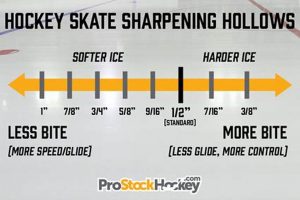
The curvature ground into the bottom of an ice skate blade, forming two distinct edges, significantly influences a skater’s performance. This measurement, typically expressed in inches, dictates the depth of the hollow between the edges. A smaller value indicates a deeper hollow, resulting in sharper edges that bite into the ice more aggressively, providing increased grip and maneuverability. Conversely, a larger value creates a shallower hollow, offering a smoother glide and less resistance. For instance, a hockey player might favor a deeper hollow for quick turns and stops, while a figure skater might prefer a shallower hollow for graceful gliding and edge control.
The selection of this curvature is paramount to optimizing a skater’s experience. It affects speed, agility, and the overall feeling on the ice. Historically, skaters relied on intuition and experience to determine the ideal configuration. Today, modern sharpening techniques and a better understanding of blade dynamics allow for more precise customization. A well-chosen setting enhances control, reduces fatigue, and allows skaters to execute maneuvers with greater confidence. The configuration is not static; it can be adjusted to suit individual skating styles, ice conditions, and the specific demands of different disciplines.
Understanding the principles behind this curvature is fundamental for skaters, coaches, and equipment technicians alike. The subsequent sections will delve deeper into factors influencing its selection, methods for achieving optimal results, and strategies for maintaining blade integrity, ensuring peak performance on the ice.
Optimizing Ice Skate Performance Through Blade Curvature Management
Effective management of the blade’s curvature is crucial for maximizing skating performance. Consistent and informed practices will preserve blade integrity and enhance on-ice capabilities.
Tip 1: Prioritize Regular Sharpening. Consistent maintenance of the blade’s curvature ensures optimal edge quality. Sharpening frequency should be dictated by ice time and the severity of blade wear. Neglecting regular sharpening leads to diminished edge control and increased skating effort.
Tip 2: Understand the Impact of Blade Curvature on Performance. A deeper curvature provides increased grip, facilitating rapid turns and stops. A shallower curvature offers smoother gliding characteristics, advantageous for maintaining speed and flow. Experimentation with different settings, under professional guidance, can identify the optimal configuration for individual skating styles.
Tip 3: Utilize Experienced Sharpening Professionals. Employing a knowledgeable sharpening technician is essential. An expert can accurately assess blade condition, recommend appropriate settings, and execute the sharpening process with precision. Inexperienced sharpening can lead to improper blade geometry and compromised performance.
Tip 4: Maintain a Detailed Sharpening Log. Recording sharpening dates, curvature settings, and observations regarding on-ice performance facilitates informed decision-making. Tracking these parameters enables skaters to identify trends, optimize settings, and anticipate future sharpening needs.
Tip 5: Protect Blades with Appropriate Guards. Utilizing hard guards when off the ice and soft soakers when storing skates prevents blade damage from contact with hard surfaces and corrosion from moisture. Consistent blade protection significantly extends blade life and preserves edge quality.
Tip 6: Consider Ice Hardness. The hardness of the ice can influence the optimal curvature. Harder ice might benefit from a slightly shallower curvature, while softer ice might require a deeper curvature for better grip. Adjustments may be necessary based on prevailing ice conditions.
Tip 7: Inspect Blades Regularly for Damage. Routinely examine blades for nicks, burrs, or other imperfections that can compromise performance. Addressing these issues promptly prevents further damage and maintains optimal edge quality.
Implementing these strategies contributes significantly to consistent performance, prolonged blade lifespan, and enhanced skating experience. A proactive approach to blade maintenance is a fundamental aspect of optimizing on-ice capabilities.
The subsequent section will explore advanced techniques for assessing blade condition and customizing curvature settings to achieve peak performance.
1. Edge Bite

Edge bite, the degree to which a skate blade’s edge penetrates and grips the ice surface, is intrinsically linked to the blade’s curvature. A smaller radius creates a deeper hollow, resulting in sharper, more pronounced edges. This configuration allows the blade to “bite” into the ice with greater force, providing enhanced grip and control. For instance, a hockey player executing a sharp turn relies on significant edge bite to maintain balance and direction. Without sufficient bite, the skate would slip, compromising the maneuver. The effectiveness of edge bite is therefore a direct consequence of the selected curvature and the resulting edge profile.
The relationship is not solely about depth of the hollow. The quality of the sharpening process also plays a critical role. Even with a theoretically optimal radius, a poorly sharpened blade with rounded or uneven edges will exhibit diminished edge bite. This manifests as reduced responsiveness and a feeling of instability on the ice. Consider figure skaters performing intricate footwork; consistent and precise edge bite is essential for executing clean turns and maintaining control throughout complex sequences. Inadequate bite would lead to missed steps and a loss of artistic expression.
Therefore, optimizing edge bite is a balancing act. While a deeper hollow enhances grip, it also increases friction and reduces glide efficiency. The ideal selection depends on the skater’s skill level, skating style, and the specific demands of their discipline. Understanding this interplay is essential for selecting the appropriate curvature and maintaining blade sharpness, ensuring both control and performance on the ice. This understanding guides skaters and technicians to optimize blade configurations to meet the unique requirements of each skating activity.
2. Glide Efficiency
Glide efficiency, the measure of how effortlessly a skater moves across the ice with minimal resistance, is significantly impacted by the configuration of an ice skate blade. A well-optimized curvature can maximize glide, allowing for smoother, faster skating with reduced energy expenditure. Improper configurations, conversely, can impede glide, leading to increased fatigue and compromised performance.
- Hollow Depth and Friction
The depth of the hollow ground into the blade, determined by the grinding radius, directly influences the amount of friction generated between the blade and the ice. A deeper hollow, achieved with a smaller radius, creates sharper edges that dig into the ice more aggressively, increasing friction and slowing the skater. Conversely, a shallower hollow, resulting from a larger radius, reduces the sharpness of the edges and minimizes friction, allowing the skater to glide with greater ease. Consider a speed skater seeking maximum velocity; a shallower hollow would be favored to minimize drag and maximize glide efficiency.
- Edge Angle and Contact Area
The grinding radius also affects the angle at which the blade’s edges contact the ice. A shallower hollow distributes the skater’s weight over a larger contact area, reducing pressure and minimizing ice deformation. This results in less friction and improved glide. A deeper hollow concentrates the weight on a smaller area, increasing pressure and creating more friction. Imagine a figure skater transitioning from an edge jump to a glide; a shallower hollow will allow for a smoother, more controlled transition with minimal loss of momentum.
- Water Film and Capillary Action
The curvature of the blade influences the formation and behavior of the water film that develops between the blade and the ice. A shallower hollow promotes a more uniform water film distribution, reducing capillary action and minimizing drag. A deeper hollow can disrupt the water film, creating localized pressure points and increasing friction. Think of a hockey player making a long stride; a blade configuration that supports a consistent water film ensures a smooth, efficient glide, maximizing the power of each stride.
- Blade Finish and Surface Texture
While the grinding radius primarily dictates the hollow depth, the final finish of the blade surface also contributes to glide efficiency. A smooth, polished surface minimizes friction and enhances glide. Conversely, a rough or uneven surface increases friction and impedes glide. The choice of a specific surface finish in conjunction with the grinding configuration is critical. Therefore, skaters that require a higher glide performance should give their blade a polish and then test it out on the rink.
These factors highlight the intricate relationship between blade configuration and glide efficiency. Selecting the appropriate curvature requires a careful consideration of skating style, ice conditions, and individual preferences. Optimizing blade curvature for glide efficiency contributes significantly to improved skating performance, reduced fatigue, and enhanced overall enjoyment of the skating experience. The subsequent content will explore the influence of turning agility on the blade configuration.
3. Turning Agility
Turning agility, the capacity to execute rapid and precise changes in direction, is fundamentally governed by the blade’s curvature. The radius of the hollow ground into the skate blade dictates the sharpness of the edges, directly influencing a skater’s ability to grip the ice during turns. A smaller radius, creating a deeper hollow, provides a more aggressive edge that bites into the ice with greater force. This enhanced grip allows for tighter turns and quicker directional changes. Hockey players, for example, rely on this configuration to maneuver swiftly around opponents and maintain control during fast-paced gameplay. The practical significance of understanding this relationship lies in the ability to fine-tune blade configurations to match specific skating styles and performance objectives.
Conversely, a larger radius, resulting in a shallower hollow, offers less aggressive edges and a smoother glide. This configuration is less conducive to rapid turns, but provides greater stability and reduced friction. Figure skaters may opt for a slightly shallower hollow to facilitate smooth transitions between edges and maintain control during complex routines. However, the trade-off is a reduction in turning agility. The selection of the appropriate radius is therefore a critical decision that must balance the need for edge grip with the desire for glide efficiency and stability. Skaters must be mindful of the interplay between the curvature and the quality of the ice surface; softer ice may necessitate a deeper hollow to maintain adequate grip, while harder ice may allow for a shallower setting without compromising agility.
In summary, turning agility is inextricably linked to the radius. Optimizing blade configuration requires a nuanced understanding of the interplay between edge grip, glide efficiency, ice conditions, and individual skating style. While a smaller radius enhances turning agility, it also increases friction and reduces glide. The ideal configuration represents a compromise that maximizes performance based on the skater’s specific needs and objectives. Skilled technicians and experienced skaters can adjust the configuration to achieve optimal balance, improving the overall skating experience and performance capabilities.
4. Skater Weight

Skater weight exerts a considerable influence on the selection of the appropriate radius. The force exerted upon the ice surface is directly proportional to the skater’s mass. Consequently, heavier skaters require a different configuration compared to lighter skaters to achieve optimal performance and control.
- Pressure Distribution
A heavier skater concentrates more pressure onto a smaller area of the ice in contact with the blade. This increased pressure can cause the edges to dig deeper into the ice, potentially leading to excessive grip and reduced glide efficiency if the radius is not appropriately adjusted. For instance, a 200-pound skater using the same blade configuration as a 120-pound skater will experience a significantly different interaction with the ice, potentially resulting in sluggish performance and increased fatigue. The implication is that heavier skaters may benefit from a shallower radius to distribute the pressure more evenly and maintain a balance between grip and glide.
- Edge Engagement
The ease with which the blade edges engage the ice is also affected by the skater’s weight. A heavier skater will naturally engage the edges more readily, requiring a shallower radius to prevent over-engagement and maintain smooth transitions between edges. Conversely, a lighter skater may need a deeper radius to achieve sufficient edge engagement and maintain control during turns and maneuvers. Consider a figure skater attempting a complex jump; a lighter skater may require a more aggressive edge to generate sufficient lift, while a heavier skater may need a less aggressive edge to prevent over-rotation and maintain balance upon landing.
- Ice Condition Sensitivity
Skater weight also influences the sensitivity to ice conditions. A heavier skater is more likely to be affected by variations in ice hardness and surface quality. Softer ice may require a shallower radius to prevent the edges from sinking too deeply, while harder ice may allow for a slightly deeper radius to enhance grip. A lighter skater, however, may be less affected by these variations and can maintain consistent performance across a wider range of ice conditions. This suggests that heavier skaters may need to adjust their radius more frequently to adapt to changing ice conditions.
- Blade Flex and Load
The load applied to the blade influences its flex, which indirectly impacts the effective radius. A heavier skater generates greater blade flex, subtly altering the contact point and pressure distribution on the ice. This increased flex necessitates a careful consideration of blade material and overall skate construction in conjunction with the configuration. The configuration selection must account for the potential for blade deformation under load, ensuring consistent edge engagement and minimizing unwanted slippage.
In conclusion, skater weight is a critical factor influencing the optimization of the radius. The ideal configuration must account for the interplay between pressure distribution, edge engagement, ice condition sensitivity, and blade flex to ensure peak performance, control, and comfort. The selection should be considered an integral part of the equipment fitting process.
5. Ice Condition

The characteristics of the ice surface are fundamentally linked to the optimal configuration. Ice temperature, hardness, and surface texture directly influence the degree of grip attainable with a given blade curvature. Softer ice, typically found at warmer temperatures, allows the blade to penetrate more deeply. This necessitates a shallower radius to prevent excessive edge engagement and maintain glide efficiency. Conversely, harder ice, prevalent in colder environments, offers less penetration, requiring a deeper radius to achieve sufficient grip for turning and stopping. The texture of the ice, ranging from smooth to granular, further modulates blade-ice interaction, influencing the overall skating experience and performance.
Consider a hockey game played on freshly resurfaced ice. The pristine, smooth surface may initially require a slightly deeper hollow to provide the necessary bite for quick starts and stops. As the game progresses and the ice becomes more worn, developing ruts and snow buildup, a shallower radius may become more advantageous to prevent the edges from catching and impeding glide. Similarly, a figure skater training outdoors on natural ice may encounter varying ice conditions throughout the day. Early in the morning, when the ice is frozen solid, a deeper hollow may be ideal for precise edge work. As the sun warms the ice, causing it to soften, the skater may need to adjust to a shallower radius to maintain control and prevent excessive edge drag. This adaptability is crucial for consistent performance across diverse environments.
In summary, ice condition is a critical determinant in optimizing the radius. A thorough understanding of the interplay between ice temperature, hardness, surface texture, and blade curvature enables skaters and technicians to make informed decisions, enhancing performance, minimizing fatigue, and ensuring safety. While other factors, such as skater weight and skating style, also contribute to the selection process, ice condition remains a primary consideration that must be carefully evaluated to achieve the best possible skating experience. Neglecting ice condition considerations can compromise blade configuration.
6. Blade Steel
The type of steel used in ice skate blades significantly influences the selection and maintenance of the radius. Different steel alloys possess varying degrees of hardness, edge retention, and resistance to corrosion. These properties directly affect how a blade responds to sharpening and the frequency with which sharpening is required. For example, blades made from softer steel alloys may require more frequent sharpening to maintain the desired curvature and edge sharpness, while harder steel alloys can hold an edge longer but may be more prone to chipping if not sharpened correctly. The composition of the steel, including the presence of elements such as carbon, chromium, and molybdenum, determines its overall durability and performance characteristics, which are critical considerations when determining the most suitable radius for a skater’s needs.
Furthermore, the manufacturing process employed in creating the blade influences its internal structure and integrity. Blades that are properly heat-treated and tempered exhibit a uniform hardness throughout, ensuring consistent performance and responsiveness during skating. Conversely, blades with inconsistent hardness may develop uneven wear patterns, leading to a compromised edge profile and reduced control. The skill and experience of the sharpening technician become paramount when working with different steel types. A technician must adapt their sharpening techniques to account for the specific properties of the steel, using appropriate grinding wheels and applying precise pressure to achieve the desired curvature without damaging the blade. Failure to do so can result in premature wear, reduced performance, or even blade failure. Stainless steel and carbon steel are examples of blades that will require differing methods of sharpening
In summary, the characteristics of the blade steel are integral to the overall management and selection of the optimal configuration. Understanding the interplay between steel properties, manufacturing processes, and sharpening techniques is essential for maximizing blade performance, prolonging blade lifespan, and ensuring a safe and enjoyable skating experience. The steel utilized is a major factor for consistent and controlled blade management. Without a proper blade, the sharpener and skater will experience problems with wear and edge retention.
7. Sharpening Consistency
Maintaining a consistent radius during ice skate sharpening is paramount for predictable performance and sustained blade integrity. Variations in the applied curvature, however subtle, can significantly alter the skater’s experience, impacting edge control, glide efficiency, and overall maneuverability. Therefore, adherence to a standardized sharpening process is not merely a matter of preference, but a fundamental requirement for optimizing skating performance and ensuring safety.
- Uniform Hollow Depth
Achieving a uniform hollow depth across the entire length of the blade is crucial. Inconsistent pressure during sharpening, or variations in the grinding wheel’s contact, can result in uneven edges. This manifests as unpredictable grip, with the skater experiencing a “catchy” or unstable feeling on the ice. For instance, if the heel of the blade has a deeper hollow than the toe, the skater may find it difficult to maintain a consistent edge during backward skating.
- Precise Radius Measurement
Accurate measurement of the radius after each sharpening is essential for verifying consistency. Relying solely on visual inspection or subjective feel can lead to cumulative errors over time. The use of radius gauges or digital profiling tools allows for objective assessment and ensures that the intended curvature is precisely achieved. Consistent measurement prevents gradual deviations from the skater’s preferred setting, maintaining predictable on-ice behavior.
- Consistent Sharpening Technique
Employing a standardized sharpening technique minimizes the risk of introducing inconsistencies. This involves maintaining a consistent angle of attack, applying uniform pressure, and adhering to a defined number of passes across the grinding wheel. Deviations from this technique, even minor ones, can alter the blade’s geometry and affect its performance characteristics. A consistent technique also minimizes heat build-up, preventing the blade from losing its temper.
- Equipment Calibration and Maintenance
Regular calibration and maintenance of sharpening equipment are critical for ensuring consistent results. Worn grinding wheels, misaligned fixtures, or malfunctioning gauges can all contribute to inconsistencies in the sharpening process. A well-maintained sharpening machine, operated by a skilled technician, provides the foundation for achieving consistent and repeatable results.
The facets detailed above underscore the importance of sharpening consistency. These factors are fundamental for achieving optimal performance, prolonging blade lifespan, and ensuring a safe and enjoyable skating experience. Inconsistent sharpness is an undesirable state.
Frequently Asked Questions
The following addresses common inquiries regarding the optimal configuration and maintenance of ice skate blades.
Question 1: How does the radius influence a skater’s ability to perform turns?
The radius dictates the sharpness of the edges. A smaller radius creates sharper edges that grip the ice more aggressively, facilitating tighter turns. A larger radius offers less grip, but smoother glide.
Question 2: What radius is generally recommended for hockey players?
Hockey players often favor a smaller radius to enable quick turns and stops. The exact measurement depends on individual preferences, weight, and ice conditions; consulting a professional technician is advised.
Question 3: How often should ice skates be sharpened?
Sharpening frequency depends on ice time and blade wear. Regular sharpening preserves edge quality and prevents performance degradation; inspection for nicks or dullness is recommended.
Question 4: Does skater weight impact the optimal radius?
Yes. Heavier skaters exert more force on the ice, potentially requiring a shallower radius to prevent over-engagement. Lighter skaters may benefit from a deeper radius for enhanced grip. Optimal performance relies on balancing weight, radius, and ice conditions.
Question 5: How does ice hardness influence the radius selection?
Softer ice allows for deeper blade penetration, potentially necessitating a shallower radius. Harder ice requires a deeper radius for adequate grip. Adaptations may be needed depending on environmental conditions.
Question 6: Can an improperly sharpened blade damage the skate?
Yes. Inexperienced sharpening can lead to improper blade geometry, excessive material removal, or heat damage, compromising the blade’s integrity and potentially shortening its lifespan.
Selecting the correct radius and maintaining consistent sharpness are essential for optimal performance and safety. Consulting a qualified sharpening technician is highly recommended.
The succeeding section will delve into advanced methodologies for curvature optimization.
Concluding Remarks on Blade Configuration
This exploration has underscored the critical role of the configuration, emphasizing its profound impact on skating performance. A meticulously selected radius, tailored to the skater’s individual needs and the prevailing ice conditions, is essential for achieving optimal edge control, glide efficiency, and maneuverability. Furthermore, maintaining consistent sharpness through regular, skilled sharpening is imperative for preserving blade integrity and ensuring predictable on-ice behavior. The interplay between blade steel, skater weight, and ice characteristics necessitates a nuanced understanding of blade mechanics to achieve optimal results.
Therefore, the pursuit of peak skating performance requires a commitment to informed blade management. This includes seeking guidance from experienced sharpening technicians, diligently monitoring blade wear, and adapting sharpening practices to accommodate changing environmental factors. By prioritizing these practices, skaters can unlock their full potential, maximizing both their enjoyment and their success on the ice. Neglecting the detailed consideration of blade configuration is a compromise of performance.