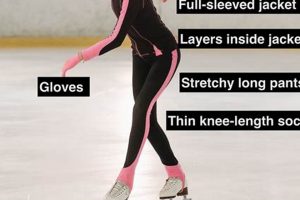
The process of moving in reverse on ice using skates requires a distinct set of skills compared to forward motion. It involves employing specific edge control, posture, and rhythmic movements to propel oneself backwards across the ice surface. Examples include executing controlled backward crossovers to navigate turns or maintaining a stable backward glide for defensive positioning in sports.
Proficiency in reverse skating enhances overall skating ability, providing increased agility and spatial awareness on the ice. This skill is crucial in various disciplines, including hockey, figure skating, and recreational skating, allowing for greater maneuverability and strategic advantage. Historically, the development of reverse skating techniques has significantly contributed to the evolution of these ice-based activities.
Understanding the fundamentals is essential for safe and efficient execution. Subsequent sections will detail the foundational techniques, including proper stance, edge engagement, and methods for generating momentum, providing a comprehensive guide to developing competence in this skill.
Tips for Reverse Ice Skating Proficiency
The following guidance aims to enhance the development of effective and safe backward movement techniques on ice. These recommendations address key areas requiring attention during the learning process.
Tip 1: Maintain a Balanced Stance: A low center of gravity is crucial. Knees should be bent, with weight distributed evenly between both skates. This posture provides stability and control.
Tip 2: Engage Inside Edges: Reverse motion relies heavily on the inside edges of the skates. Experiment with shifting weight slightly to the inside of each skate to feel the edge engage and propel backward movement.
Tip 3: Practice Controlled C-Cuts: The “C-cut” motion, creating a semi-circular push with each skate, is fundamental. Focus on generating smooth, controlled arcs to maintain momentum and direction.
Tip 4: Coordinate Arm Movement: Arms should move in opposition to the legs. This counter-balancing action aids in maintaining equilibrium and promotes a more fluid stride.
Tip 5: Focus Visual Attention: Scan the surrounding area to maintain awareness of obstacles and other skaters. Proper visual attention is essential for safety and spatial orientation.
Tip 6: Gradual Progression: Begin with short, controlled backward glides before attempting more complex maneuvers. Incremental progress is key to developing confidence and technique.
Tip 7: Seek Expert Guidance: Consider instruction from a qualified skating coach. Professional feedback can accelerate skill development and address individual challenges effectively.
Adhering to these recommendations will facilitate the acquisition of proficient backward ice skating skills, improving overall skating ability and enhancing safety. Consistent practice and focused attention are paramount to achieving desired results.
These tips provide a solid foundation for skill development. The following sections will address more advanced techniques and strategies.
1. Balance

Maintaining equilibrium is paramount when executing reverse movements on ice. The ability to distribute weight effectively and adjust to changing forces directly influences stability and control while skating backwards.
- Center of Gravity and Posture
A low center of gravity, achieved through bent knees and a slightly forward lean, enhances stability. This posture allows for quicker adjustments to shifts in momentum, reducing the likelihood of falls. For example, a figure skater maintaining a low center of gravity during a backward spin ensures a stable axis of rotation.
- Weight Distribution and Edge Control
Even distribution of weight between both skates is essential for controlled gliding. Subtle shifts in weight allow for engagement of the inside edges, enabling directional changes and propulsion. Uneven weight distribution can lead to instability and difficulty in maintaining a straight line. In hockey, a defenseman adjusting weight distribution allows for swift transitions and agile backwards movements.
- Core Engagement and Stability
Active engagement of core muscles provides additional stability and control. A strong core helps maintain posture and resist rotational forces that can disrupt balance. For example, a skater with a weak core may struggle to maintain a stable position during backward crossovers.
- Visual Focus and Spatial Orientation
Maintaining visual focus on the intended direction and scanning the surrounding environment contributes to balance and spatial awareness. Awareness of obstacles and other skaters allows for anticipatory adjustments to maintain equilibrium. A skater who only looks down loses spatial awareness and compromises balance.
Effective balance is not a static state but a dynamic process of constant adjustment. Integrating these facets of balance into the reverse skating technique allows for greater control, efficiency, and confidence on the ice. Proper technique and safety considerations all depend on the skater maintaining their balance while learning this new method.
2. Edge Control
Effective reverse movement on ice is fundamentally dependent upon precise edge control. This skill encompasses the ability to manipulate the angle and pressure of the skate blades to generate propulsion, maintain balance, and execute turns in a backward direction. Without proper mastery of the edges, controlled reverse skating is unattainable.
- Inside Edge Engagement for Propulsion
Propulsion in reverse skating is primarily achieved by engaging the inside edges of the skates. A “C-cut” motion, wherein the skater pushes outward and backward with the inside edge, generates the necessary force to move in reverse. The angle and force applied to the edge directly impact the speed and efficiency of the backward glide. For instance, a hockey player uses quick inside edge engagement for rapid defensive retreats.
- Outside Edge Stabilization
While inside edges provide propulsion, the outside edges play a crucial role in stabilization and maintaining balance. Subtle adjustments to the outside edge prevent unwanted lateral movement and ensure a controlled trajectory. For instance, a figure skater uses the outside edge to maintain a straight line during a backward glide, preventing unwanted deviations.
- Edge Transitions and Backward Crossovers
Advanced reverse skating maneuvers, such as backward crossovers, require seamless transitions between inside and outside edges. The skater must shift weight and pressure to the appropriate edge to execute a controlled turn or change of direction. In hockey, quick edge transitions allow players to maintain speed and agility while moving backward.
- Edge Sharpening and Maintenance
The sharpness of the skate blades directly impacts edge control. Dull blades hinder the ability to effectively engage the edges, compromising balance and control. Regular sharpening is essential for maintaining optimal edge performance and ensuring safe and efficient reverse skating. Skaters in all disciplines, from recreational to professional, prioritize blade maintenance for this reason.
The interplay between inside and outside edges, the ability to transition between them smoothly, and the maintenance of blade sharpness are all critical for successful reverse skating. Developing proficiency in edge control is essential for unlocking advanced techniques and enhancing overall skating ability in reverse.
3. C-Cuts
The “C-cut” motion is a fundamental technique directly related to backward movement on ice. Its execution is crucial for generating momentum and maintaining control while moving in reverse, serving as a primary method for propulsion in this skill.
- Mechanics of the C-Cut
The C-cut involves using the inside edge of the skate to push outward and backward in a semi-circular motion, resembling the letter “C”. This action creates a reactive force that propels the skater backwards. Consistent execution of controlled C-cuts provides a continuous source of momentum. For example, speed skaters use elongated C-cuts to maintain speed while navigating turns.
- Edge Engagement and Pressure Application
The effectiveness of a C-cut hinges on proper edge engagement and controlled pressure application. The skater must apply pressure to the inside edge while maintaining balance and coordination. Insufficient edge engagement results in slippage and loss of momentum. In hockey, players utilize quick, short C-cuts to maintain defensive positioning and agility.
- Coordination and Rhythm
Successful backward skating via C-cuts requires coordinated movement between the legs and arms. Arms are typically swung in opposition to the legs to aid in balance and rhythm. A consistent, rhythmic execution of C-cuts contributes to a smoother, more efficient backward glide. Figure skaters coordinate arm movements with C-cuts to enhance artistry and stability during backward sequences.
- Progression and Skill Development
Mastery of the C-cut is a progressive process. Beginners often start with stationary C-cuts to develop edge awareness and balance. As proficiency increases, skaters can integrate C-cuts into more complex maneuvers, such as backward crossovers and turns. A structured progression of drills focused on C-cuts builds a solid foundation for advanced backward skating techniques.
The C-cut serves as a foundational element in acquiring competence in moving backwards on ice. Understanding the mechanics, practicing proper edge engagement, coordinating body movements, and following a progressive training approach are crucial for developing proficiency in this essential skill. Backward movement is dependent on how well the skater understand the C-cut and implement that in a more smooth movement.
4. Spatial Awareness

The act of reverse skating on ice demands a heightened degree of spatial awareness. Movement in a forward direction typically affords a broader field of vision and intuitive anticipation of obstacles. In contrast, reverse motion inherently limits visual perception and necessitates a reliance on peripheral vision, kinesthetic sense, and predictive judgment. Deficient spatial awareness while skating backwards significantly increases the risk of collisions, falls, and inefficient maneuvering. For instance, a hockey player without adequate spatial awareness may skate into teammates or lose track of opponents while retreating defensively, compromising their performance and team strategy.
Spatial awareness while skating backwards involves several key components: proprioception, peripheral vision, and predictive modeling. Proprioception, the sense of one’s body position in space, allows skaters to maintain balance and control even without direct visual input. Peripheral vision provides critical information about the surrounding environment, detecting approaching obstacles or changes in terrain. Predictive modeling, based on experience and anticipation, enables skaters to project the paths of other moving objects and adjust their course accordingly. A figure skater demonstrating spatial awareness can execute complex backward turns and jumps without colliding with rink boundaries or other skaters, showcasing a seamless integration of these components.
Developing robust spatial awareness is therefore integral to safe and effective reverse skating. Training drills designed to improve peripheral vision, proprioception, and predictive skills are essential. These may include practicing backward skating while navigating obstacles, responding to auditory cues indicating changes in direction, and engaging in simulated game situations that require rapid decision-making. The acquisition of refined spatial awareness not only enhances skating proficiency but also fosters a deeper understanding of movement dynamics on ice, leading to improved overall performance and a reduced risk of injury.
5. Arm Coordination

Effective arm coordination is integrally linked to the ability to perform reverse skating maneuvers on ice. Arm movements are not merely ancillary but rather serve as a critical counterbalance, influencing balance, momentum, and the overall efficiency of backward strides. The coordinated actions of the arms directly counteract the forces generated by the legs during the “C-cut” motion, thereby stabilizing the body and preventing unwanted rotations. Without proper arm coordination, the skater may experience a loss of balance, resulting in inefficient strides and a heightened risk of falls. For instance, in speed skating, the arms swing rhythmically in opposition to the legs, maximizing the force generated with each stride and maintaining a streamlined posture for reduced air resistance.
Furthermore, precise arm movements facilitate smooth transitions and directional changes while skating backwards. During backward crossovers, for example, the arms swing in the direction of the turn, assisting in weight transfer and maintaining equilibrium. Controlled arm movements are particularly critical for executing complex maneuvers, such as backward spins and jumps in figure skating. In these cases, the arms act as a dynamic counterbalance, enabling the skater to maintain a stable axis of rotation and control their trajectory. The effective use of arm movements transforms a potentially precarious situation into one of elegance and precision. Improper arm coordination can be a limiting factor, preventing the skater from executing the moves correctly.
In summary, arm coordination is not an optional element but a fundamental component of proficient reverse ice skating. It directly influences balance, momentum, and the capacity to execute advanced techniques. By consciously integrating coordinated arm movements into the backward skating stride, skaters can improve their stability, efficiency, and overall performance, making it a crucial skill to master and understand for any aspiring or experienced skater.
6. Practice
Consistent application of fundamental techniques through deliberate repetition is paramount to achieving proficiency in reverse skating. The acquisition of this skill necessitates dedicated training, as the biomechanics differ significantly from forward motion. Without regular practice, progress remains limited, and the development of essential muscle memory is impeded.
- Repetitive Drills and Muscle Memory
The execution of repetitive drills, such as C-cuts and backward crossovers, cultivates muscle memory. These drills reinforce proper form, enabling skaters to execute movements with greater fluidity and precision. Regular execution transforms conscious effort into unconscious competence. A skater practicing C-cuts consistently will develop muscle memory for this form.
- Progressive Skill Development
Practice facilitates the gradual progression from basic to advanced techniques. Initially, skaters may focus on maintaining balance and executing simple glides. As proficiency increases, they can incorporate more complex maneuvers, such as turns and jumps. The skater will be able to develop more skills as his backward motion becomes more complex.
- Error Correction and Refinement
Regular training provides opportunities for identifying and correcting technical errors. Through consistent self-assessment or guidance from a coach, skaters can refine their technique and eliminate inefficiencies. A skater might identify that they are leaning too far forward or not engaging their edges effectively.
- Adaptation to Diverse Ice Conditions
Consistent practice allows skaters to adapt to varying ice conditions. Different ice surfaces may require adjustments in edge control and pressure application. Experience gained through practice enhances the skater’s ability to perform effectively in diverse environments. For example, skaters may encounter soft or hard ice conditions, each requiring adaptation to maintain stability and control.
The integration of structured practice regimens is indispensable for developing and maintaining competence in reverse skating. It facilitates the acquisition of muscle memory, enables progressive skill development, promotes error correction, and enhances adaptability to diverse ice conditions. Those engaging in all disciplines benefit from mastering such techniques.
7. Safety
The integration of safety protocols is inextricably linked to the process of reverse ice skating. Uncontrolled backward movement presents an elevated risk of collisions and falls due to limited visibility and reduced reaction time compared to forward skating. Consequently, adherence to safety guidelines is not merely an ancillary consideration but rather a foundational element for acquiring and maintaining proficiency in this skill. Real-world examples frequently illustrate the potentially severe consequences of neglecting safety measures, ranging from minor abrasions to significant injuries resulting from unanticipated impacts with other skaters or rink boundaries.
Effective safety practices in reverse ice skating encompass several key components. These include wearing appropriate protective gear, such as helmets and padding; maintaining awareness of the surrounding environment through constant scanning; and regulating speed to allow for timely reactions to unforeseen obstacles. Furthermore, adopting controlled backward skating techniques, such as the proper execution of C-cuts and crossovers, reduces the likelihood of losing balance or colliding with others. Practical application of these measures can be observed in organized skating programs, where instructors emphasize the importance of protective gear and spatial awareness as integral parts of the learning process. A lack of safety measures can lead to severe injuries for those involved.
In summary, the successful execution of reverse ice skating techniques hinges upon the prioritization of safety. Protective gear, spatial awareness, and controlled movements constitute essential components of a responsible approach. The failure to integrate these elements elevates the risk of accidents and injuries, underscoring the critical relationship between safety and proficiency in this specialized skating discipline. The absence of a focus on safety can seriously impact not just skill advancement but also the overall enjoyment and well-being of participants.
Frequently Asked Questions
The following section addresses common queries and misconceptions regarding the techniques and safety considerations associated with backward movement on ice using skates.
Question 1: What protective gear is considered essential for learning reverse skating?
A properly fitted helmet is paramount to mitigating the risk of head injuries. Additionally, wrist guards and knee pads are advisable, particularly during the initial stages of learning, to protect against falls.
Question 2: How can balance be improved when skating backwards?
A low center of gravity, achieved by bending the knees and maintaining a slightly forward lean, is crucial. Consistent engagement of core muscles and even distribution of weight between both skates also contribute to enhanced stability.
Question 3: What is the significance of the “C-cut” motion?
The C-cut is the fundamental propulsion technique for reverse skating. Executing controlled, semi-circular pushes with the inside edges of the skates generates the necessary force for backward movement.
Question 4: How does spatial awareness contribute to safe reverse skating?
Maintaining awareness of the surrounding environment is essential for avoiding collisions with other skaters or rink boundaries. This involves scanning the area, utilizing peripheral vision, and anticipating potential hazards.
Question 5: How often should skates be sharpened for optimal edge control?
The frequency of sharpening depends on usage and ice conditions. As a general guideline, skates should be sharpened when edges become dull, hindering the ability to effectively grip the ice.
Question 6: What is the appropriate progression for learning reverse skating?
Begin with short, controlled backward glides to develop balance and edge awareness. Progress to C-cuts and backward crossovers as proficiency increases, gradually incorporating more complex maneuvers.
Mastering reverse skating requires a combination of skill, dedication, and vigilance. By adhering to these guidelines and prioritizing safety, individuals can enhance their overall skating ability and enjoy the benefits of this essential technique.
The following sections will delve deeper into advanced techniques and strategies for reverse skating proficiency.
Conclusion
This exploration of techniques on moving in reverse on ice has underscored the multifaceted nature of the skill, encompassing balance, edge control, spatial awareness, and diligent practice. The ability to execute controlled backward movements is not merely an enhancement to skating ability but a fundamental component of comprehensive ice skating competence, impacting performance across various disciplines.
Continued dedication to refining backward skating skills offers the potential for enhanced agility, maneuverability, and overall mastery of the ice surface. By consistently applying the principles outlined herein, individuals can significantly elevate their skating prowess and expand the possibilities within their chosen discipline. This commitment fosters a deeper understanding of ice dynamics and contributes to a more rewarding and accomplished skating experience.