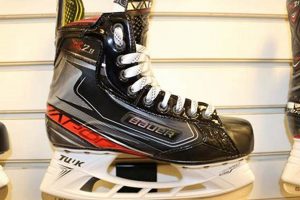
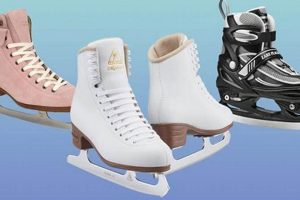
Footwear designed for gliding across ice surfaces, typically constructed with a supportive boot and a blade affixed to the sole. These implements allow individuals to engage in activities such as recreational skating, figure skating, and ice hockey. The specific design and materials vary depending on the intended purpose and skill level of the user.
Properly fitted and maintained skating equipment provides stability, control, and protection, enhancing the user’s experience and minimizing the risk of injury. Throughout history, variations of this equipment have evolved, from rudimentary bone skates to the sophisticated, high-performance models used in contemporary sports. These advancements have played a critical role in the development of winter sports and recreational activities.
The subsequent sections will delve into the key aspects of choosing appropriate equipment, including considerations for boot design, blade types, sizing, and maintenance practices. Factors influencing optimal performance and longevity will also be discussed, providing a comprehensive understanding for users of all levels.
Essential Considerations for Selecting Appropriate Equipment
This section outlines crucial aspects for selecting ice skating equipment, ensuring both performance and safety on the ice.
Tip 1: Prioritize Proper Fit: The boot should fit snugly but comfortably, allowing for minimal movement within the skate. Ill-fitting skates can lead to discomfort, blisters, and reduced control.
Tip 2: Select the Correct Blade Type: Different blades are designed for specific disciplines. Hockey skates have shorter, more curved blades for maneuverability, while figure skates feature longer, straighter blades with toe picks for jumps and spins.
Tip 3: Consider Boot Stiffness: Stiffer boots provide greater ankle support and are generally recommended for advanced skaters. Beginner skaters may benefit from softer, more flexible boots that allow for greater range of motion.
Tip 4: Assess Ankle Support: Adequate ankle support is essential for stability and injury prevention. Ensure the boot provides sufficient support to prevent excessive pronation or supination.
Tip 5: Evaluate Blade Material: Stainless steel blades offer superior edge retention and corrosion resistance compared to carbon steel blades. Regular sharpening is necessary to maintain optimal performance.
Tip 6: Mind the Lacing Technique: Proper lacing is crucial for achieving a secure and comfortable fit. Tighten laces firmly at the ankle and instep, allowing for some flexibility at the toe.
Tip 7: Seek Professional Advice: Consulting with a qualified skate fitter is highly recommended, especially for first-time buyers. A professional can assess foot shape and skill level to recommend the most appropriate equipment.
By adhering to these guidelines, individuals can optimize their skating experience and minimize the risk of injury, enhancing both enjoyment and performance.
The subsequent section will summarize key considerations and offer guidance for ongoing maintenance to ensure the longevity of the equipment.
1. Blade Material

The selection of blade material is a critical factor influencing the performance and longevity of ice skates. The material directly impacts the blade’s ability to hold an edge, resist corrosion, and withstand the stresses associated with skating maneuvers. Stainless steel and carbon steel are the two primary materials used in blade construction. Stainless steel offers superior resistance to rust and corrosion, making it a durable choice for skaters of all levels. This characteristic translates to lower maintenance requirements and a prolonged lifespan, especially for those who skate frequently or in environments where moisture is prevalent. Conversely, carbon steel blades, while offering a potentially sharper initial edge, are more susceptible to rust and require meticulous care and frequent sharpening. Improper maintenance of carbon steel can lead to rapid degradation of the blade’s edge, impacting the skater’s control and performance. Consider, for example, the difference in performance between a seasoned hockey player using skates with high-grade stainless steel blades, who can execute quick turns and stops with precision, and a beginner using carbon steel blades that have not been properly maintained, who may struggle to maintain balance and control.
The specific grade and treatment of the steel also play a significant role. Higher-end stainless steel blades often undergo heat treatments and tempering processes to enhance their hardness and durability. These processes optimize the steel’s microstructure, increasing its resistance to wear and tear. Furthermore, the blade’s surface finish can impact its glide across the ice. A smoother, more polished surface reduces friction, allowing for greater speed and efficiency. For instance, figure skating blades, often crafted from high-quality stainless steel, are meticulously polished to minimize friction during jumps and spins. Similarly, speed skates utilize blades with specialized coatings designed to enhance glide and reduce energy expenditure. Blade material impacts edge sharpness and the resulting impact on mens ice skates’ overall performance.
In summary, blade material selection represents a crucial decision that balances performance, durability, and maintenance requirements. Stainless steel offers a robust and low-maintenance option, suitable for a wide range of skaters. Carbon steel, while potentially offering a sharper initial edge, demands meticulous care to prevent corrosion and maintain performance. The choice ultimately depends on the skater’s skill level, skating frequency, and willingness to invest in proper maintenance. Ignoring the interplay between blade material and skating performance can lead to suboptimal experiences and potentially compromise safety.
2. Boot Stiffness

Boot stiffness in ice skates directly influences support, responsiveness, and overall performance. The degree of rigidity significantly impacts energy transfer and ankle stability, factors essential for both beginner and advanced skaters. Choosing the correct boot stiffness is paramount for optimizing comfort, control, and minimizing the risk of injury.
- Ankle Support and Injury Prevention
Stiffer boots provide enhanced ankle support, crucial for preventing injuries such as sprains and fractures, particularly during high-impact activities like ice hockey or figure skating. The rigid structure restricts excessive ankle movement, maintaining proper alignment and stability. Beginners may find overly stiff boots restrictive, hindering their ability to develop fundamental skating techniques, while advanced skaters rely on the enhanced support for complex maneuvers.
- Energy Transfer and Responsiveness
Stiffer boots facilitate efficient energy transfer from the skater’s leg to the blade, enhancing responsiveness and power. The reduced flex in the boot minimizes energy loss, allowing for quicker acceleration and more precise control. This is especially vital in sports requiring rapid changes in direction and speed. Softer boots, conversely, offer greater flexibility, potentially improving comfort but sacrificing power and control at higher speeds.
- Skill Level and Boot Stiffness Correlation
A direct correlation exists between skating skill level and appropriate boot stiffness. Beginner skaters typically benefit from boots with moderate stiffness, providing a balance of support and flexibility to aid in skill development. Intermediate and advanced skaters generally require stiffer boots to maximize performance and control during more demanding maneuvers. Choosing a boot that is either too stiff or too flexible for the skater’s skill level can hinder progress and increase the risk of injury.
- Material Composition and Rigidity
The materials used in boot construction directly influence its overall stiffness. High-quality materials, such as carbon fiber or reinforced polymers, contribute to greater rigidity and support. The layering and construction techniques also play a crucial role. Manufacturers employ various methods to strategically reinforce specific areas of the boot, optimizing stiffness while maintaining a comfortable fit. Inferior materials or construction can compromise the boot’s stiffness, leading to reduced support and performance.
In conclusion, boot stiffness is a fundamental consideration in skate selection, intricately linked to ankle support, energy transfer, skill level, and material composition. The correct level of stiffness maximizes performance, minimizes injury risk, and enhances the overall skating experience. Skaters must carefully evaluate their individual needs and skill level to choose the most appropriate boot stiffness for their specific discipline and skating goals. Ignoring this crucial aspect can lead to suboptimal performance and potential injuries.
3. Ankle Support
Ankle support represents a critical design element in equipment, directly influencing stability, control, and injury prevention. The structure of skating equipment extends upward from the sole, encompassing the ankle joint. This design aims to limit excessive lateral movement and provide a stable platform for force transmission from the skater’s body to the ice surface. Without adequate support, the risk of ankle sprains and other related injuries significantly increases. Consider, for example, a hockey player executing a sharp turn; the ankle support within the skating equipment prevents the joint from rolling inward or outward, maintaining balance and enabling precise maneuvering. Similarly, a figure skater performing a jump relies on the rigid structure to stabilize the ankle upon landing, reducing the likelihood of injury.
The effectiveness of ankle support is contingent upon several factors, including boot stiffness, lacing systems, and the overall fit of the equipment. Stiffer boot materials and strategically designed lacing patterns enhance stability by restricting ankle motion. Proper fit ensures that the equipment conforms closely to the skater’s foot, maximizing the support provided by the boot structure. Inadequate fit, even with stiff materials, can compromise stability and increase the risk of injury. The design considerations for ankle support also vary based on the intended application. Hockey equipment often prioritizes range of motion and forward flex, while still providing robust lateral support. Figure skating equipment, conversely, typically emphasizes maximum stiffness and stability to facilitate complex jumps and landings. These differing design philosophies reflect the specific demands of each discipline.
In summary, ankle support is an indispensable component of effective ice skating equipment. Its presence mitigates the risk of ankle injuries, enhances stability and control, and enables skaters to perform maneuvers with confidence. The effectiveness of ankle support depends upon the synergistic interplay of boot stiffness, lacing systems, and proper fit. Understanding the relationship between these factors and their impact on ankle stability is crucial for selecting equipment that meets the specific needs and demands of the intended skating activity. Therefore, prioritizing adequate ankle support is a fundamental consideration for individuals engaging in ice skating, regardless of their skill level or discipline.
4. Proper Fit
Proper fit is a foundational element determining the efficacy and safety of ice skates. A correctly fitted skate interfaces seamlessly with the foot, translating intended movements directly to the blade. Conversely, ill-fitting skates impede performance and elevate the risk of injury. Consider the consequences of a skate that is too large: the foot shifts within the boot, reducing control during turns and potentially leading to blisters from friction. A skate that is too small restricts circulation, causing discomfort and numbness, ultimately compromising the skater’s ability to maintain balance and execute maneuvers effectively. The ideal fit is snug, allowing for minimal heel lift and sufficient toe room without pinching.
The significance of proper fit extends beyond mere comfort. It directly impacts energy transfer and responsiveness on the ice. A secure fit ensures that the skater’s power is efficiently transmitted to the blade, enabling quicker acceleration and more precise control. Imagine a hockey player attempting a quick stop; a skate that fits poorly will delay the response time, potentially resulting in a missed play or a collision. Furthermore, improper fit can exacerbate existing foot problems, such as bunions or plantar fasciitis. In such cases, custom fitting or modifications may be necessary to accommodate the individual’s specific needs and prevent further discomfort. The fitting process should involve a thorough assessment of foot length, width, and arch height, ensuring that the selected skate conforms to the unique contours of the individual’s foot.
In conclusion, proper fit is not merely a desirable attribute but a prerequisite for safe and effective skating. It enhances performance by optimizing energy transfer and responsiveness while minimizing the risk of injury. Selecting skates that conform precisely to the individual’s foot dimensions is paramount, requiring careful assessment and, when necessary, professional assistance. Ignoring the importance of proper fit can lead to a compromised skating experience and an increased susceptibility to foot-related problems, underscoring its pivotal role in the overall functionality and safety of ice skates.
5. Blade Type
The performance characteristics of ice skates are heavily influenced by blade type. For the average consumer, blade design dictates the suitability of for various ice-related activities. The cause-and-effect relationship between blade features (e.g., curvature, length, and presence of toe picks) and a skater’s ability to execute specific maneuvers is direct and significant. An ice hockey blade, characterized by its shorter length and pronounced rocker (curvature), promotes agility and rapid turning. This contrasts sharply with figure skating blades, where a longer, straighter blade and prominent toe picks facilitate stability for jumps and spins. The blade is not merely an attachment to the boot; it functions as a critical interface between the skater and the ice, directly affecting speed, control, and maneuverability. For instance, a recreational skater using skates equipped with hockey blades will find it easier to navigate crowded ice rinks compared to someone using figure skates, due to the superior maneuverability of hockey blades. Thus, understanding blade type becomes a key factor.
The importance of selecting the correct blade type becomes even more pronounced at advanced skill levels. Competitive hockey players rely on blades optimized for acceleration and sharp turns, enabling them to gain a competitive edge. Figure skaters require blades that provide precise control during complex routines, allowing them to execute jumps and spins with accuracy. The consequences of using an inappropriate blade type can range from diminished performance to increased risk of injury. A hockey player attempting to use figure skates in a game, for example, would experience significant difficulty with skating efficiently and reacting effectively to on-ice action. Similarly, a figure skater attempting a complex jump with hockey skates would encounter stability issues, greatly increasing the likelihood of a fall. This demonstrates the critical role of the blade in ensuring both safety and maximizing the potential of the skater.
Ultimately, the blade type must match the intended use. The various blade configurations are designed with particular activities in mind. Ignoring this basic need can lead to diminished control or increased risk of injury. Choosing the appropriate ice skate blade is key, from beginners to experienced users, whether for figure skating, ice hockey, or simply recreational skating. Therefore, careful consideration of blade design is paramount when selecting appropriate footwear, thereby enhancing performance and mitigating potential hazards on the ice.
6. Lacing System
The lacing system on ice skates is a critical component affecting performance, comfort, and safety. It directly influences the fit and support provided by the skate boot, thereby impacting the skater’s control and stability on the ice. A well-designed and properly utilized lacing system secures the foot within the boot, minimizing movement and maximizing energy transfer. Conversely, an inadequate or improperly adjusted lacing system can lead to discomfort, reduced control, and an increased risk of injury. For instance, a hockey player relying on quick turns and rapid acceleration requires a lacing system that maintains a snug fit around the ankle, preventing slippage and ensuring precise responsiveness. Similarly, a figure skater performing intricate jumps and spins needs a lacing system that provides firm ankle support, minimizing the risk of instability and injury upon landing.
The effectiveness of a lacing system depends on several factors, including the number of eyelets, the spacing between them, and the type of laces used. More eyelets generally allow for a more customized fit, enabling the skater to adjust the tightness in different areas of the foot. Eyelet spacing influences the distribution of pressure across the instep, affecting comfort and circulation. The laces themselves can be made from various materials, each with its own properties in terms of elasticity, durability, and grip. Waxed laces, for example, provide increased friction and prevent slippage, while synthetic laces may offer greater elasticity and comfort. The manner in which the laces are tied is also significant. Different lacing techniques can be employed to achieve varying degrees of support and flexibility in different areas of the foot and ankle. Skaters may tighten the laces more firmly around the ankle for enhanced stability or loosen them slightly at the toes for increased comfort.
In summary, the lacing system is an integral part of the ice skate, playing a vital role in fit, support, and performance. Its design and adjustment directly impact the skater’s control, stability, and safety on the ice. Proper attention to the lacing system ensures a secure and comfortable fit, maximizing energy transfer and minimizing the risk of injury. Therefore, understanding the principles of lacing and experimenting with different techniques is essential for skaters of all levels, contributing significantly to a positive and successful skating experience.
7. Maintenance
Sustaining the functional integrity of equipment is paramount for performance optimization and prolonged lifespan. Diligence in upkeep directly influences safety, efficiency, and the overall economic value derived from the investment in footwear.
- Blade Sharpening
Regular blade sharpening is crucial for maintaining proper edge alignment, which directly affects the skater’s ability to grip the ice. Dull blades compromise control and increase the risk of falls. The frequency of sharpening depends on usage intensity and ice conditions; however, professional sharpening is recommended to ensure proper blade geometry and prevent damage.
- Rust Prevention
Moisture exposure can lead to rust formation on the blades, degrading their performance and structural integrity. Following each use, blades should be thoroughly dried with a clean cloth and stored in breathable blade covers to prevent moisture accumulation. The application of a rust-inhibiting compound can further protect against corrosion.
- Boot Care and Conditioning
The boot component requires periodic cleaning to remove dirt and debris, which can accelerate wear and tear. Leather or synthetic materials should be conditioned to maintain their flexibility and prevent cracking. Proper boot support and shape can be preserved by utilizing boot trees when the equipment is not in use.
- Lace Management and Inspection
Laces should be routinely inspected for signs of fraying or damage, as compromised laces can lead to inadequate boot support and potential injury. Laces should be replaced as needed to ensure a secure and reliable fit. Proper lacing techniques can also prolong the life of the laces and optimize boot support.
Adhering to these maintenance protocols ensures that footwear remains a reliable and safe component for various ice-related activities. Neglecting maintenance reduces equipment longevity and increases the potential for performance degradation and injury, highlighting the critical link between proactive care and sustained functionality.
Frequently Asked Questions about Ice Skating Footwear
This section addresses common inquiries regarding selection, maintenance, and proper utilization of ice skating footwear.
Question 1: What are the primary differences between hockey and figure skating blades?
Hockey blades are typically shorter and more curved, facilitating quick turns and maneuverability. Figure skating blades are longer and straighter, featuring toe picks that aid in jumps and spins.
Question 2: How often should the blades be sharpened?
Sharpening frequency depends on usage and ice conditions. Blades should be sharpened when they lose their edge, indicated by a lack of grip and difficulty controlling movement on the ice. Consult a professional for optimal sharpening techniques.
Question 3: What constitutes a proper fit for ice skating footwear?
A proper fit entails a snug but comfortable feel, allowing for minimal heel lift and adequate toe room without pinching. The foot should be securely held within the boot to maximize control and prevent slippage.
Question 4: What factors contribute to boot stiffness and why is it important?
Boot stiffness is influenced by material composition and construction techniques. Stiffer boots provide enhanced ankle support and energy transfer, beneficial for advanced maneuvers. Softer boots offer greater flexibility but may compromise stability.
Question 5: How should the user care for the blades to prevent rust?
Following each use, blades should be thoroughly dried with a clean cloth and stored in breathable blade covers. The application of a rust-inhibiting compound can further protect against corrosion.
Question 6: What are the common signs that ice skating equipment needs to be replaced?
Signs indicating replacement include excessive wear and tear on the boot, compromised blade integrity (e.g., deep gouges or persistent dullness), and a loss of structural support compromising fit and stability.
In summary, informed selection, diligent maintenance, and meticulous attention to fit are essential for maximizing the performance and longevity of ice skating equipment.
The subsequent section will provide resources for further exploration and guidance on ice skating techniques.
Mens Ice Skates
This exploration of the topic has underscored the critical interplay between design, maintenance, and performance. Considerations such as blade material, boot stiffness, ankle support, proper fit, blade type, and lacing systems collectively determine the efficacy and safety of these implements. Regular maintenance, including blade sharpening and rust prevention, is essential for prolonging the lifespan and ensuring the continued functionality of the equipment.
The information presented herein serves as a foundation for informed decision-making. The selection and maintenance of appropriate equipment are paramount not only for optimizing performance but also for mitigating the risk of injury. Continued adherence to these principles will contribute to the safe and enjoyable pursuit of ice-related activities.