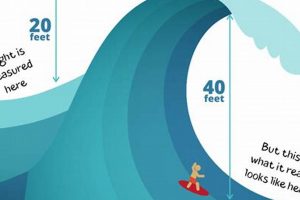
Information regarding wave conditions, tide levels, and wind patterns at a specific coastal location is crucial for water sports enthusiasts. This data allows individuals to assess the safety and suitability of the environment for activities such as surfing. Factors detailed in these reports include wave height, wave period, wind direction and speed, and water temperature.
Accessibility to accurate and timely coastal condition updates provides significant advantages. It enables informed decision-making, promoting safety and optimizing recreational experiences. Historically, accessing such information required direct observation or relying on local knowledge. Technological advancements have streamlined the process, making real-time data readily available through various digital platforms.
The subsequent sections will delve into specific aspects of interpreting and utilizing coastal condition forecasts, focusing on resources for obtaining current observations, understanding the influence of environmental factors, and employing the information for safe and enjoyable ocean-based activities.
Guidance on Utilizing Localized Coastal Condition Forecasts
This section provides guidance on effectively interpreting and applying localized coastal condition forecasts for the benefit of ocean users. Proper understanding and application can lead to enhanced safety and enjoyment of water activities.
Tip 1: Consult Multiple Sources: Do not rely solely on a single forecast. Compare information from various reputable sources, such as official meteorological services, buoy data, and specialized forecasting websites, to obtain a comprehensive understanding of the projected conditions.
Tip 2: Understand Wave Height and Period: Wave height indicates the vertical distance between the crest and trough, while wave period measures the time between successive crests. Longer wave periods typically indicate more powerful waves, even if the wave height appears moderate.
Tip 3: Analyze Wind Direction and Speed: Onshore winds can create choppy conditions and may negatively impact wave quality. Offshore winds can groom waves, resulting in a smoother surface but may also increase the risk of being carried further out to sea.
Tip 4: Check Tide Information: Low tides can expose hazards such as reefs or sandbars, while high tides can alter wave breaking patterns and current strength. Refer to tide charts to understand the timing and magnitude of tidal fluctuations.
Tip 5: Assess Water Temperature: Lower water temperatures can increase the risk of hypothermia. Proper thermal protection, such as a wetsuit, is essential when water temperatures are low.
Tip 6: Be Aware of Local Hazards: Research potential hazards specific to the location, such as rip currents, submerged objects, and marine life. Heed any posted warnings or advisories.
Tip 7: Continuously Monitor Conditions: Coastal conditions can change rapidly. Regularly reassess the situation and be prepared to adjust plans or exit the water if conditions deteriorate.
Adhering to these guidelines promotes informed decision-making, mitigating potential risks associated with ocean activities and maximizing positive experiences.
The following section will address resources available for obtaining current localized coastal condition information.
1. Wave Height

Wave height is a primary component within a coastal condition assessment and critically informs decisions related to ocean activities at Satellite Beach, Florida. Accurate wave height information directly impacts safety and the potential for successful surfing experiences. The following outlines key facets related to wave height as reported in the context of Satellite Beach, Florida.
- Measurement and Reporting Standards
Wave height is typically reported as either significant wave height or swell height. Significant wave height represents the average height of the highest one-third of waves. Swell height refers to the height of waves generated by distant weather systems. Discrepancies in reported measurements may arise from variations in measurement techniques or reporting standards, influencing the perceived wave conditions.
- Influence of Local Topography
The bathymetry and coastal configuration of Satellite Beach, Florida, exert a significant influence on wave height. Submerged reefs, sandbars, and the angle of the coastline can refract and diffract waves, leading to localized variations in wave height. Understanding these topographical effects allows for a more nuanced interpretation of wave height forecasts.
- Impact on Surfing Suitability
Wave height directly dictates the suitability of Satellite Beach, Florida, for surfing. Small wave heights may be ideal for beginners, while larger wave heights cater to more experienced surfers. The optimal wave height depends on individual skill level and preferences. Excessive wave height can present hazardous conditions, necessitating caution or avoidance of the water.
- Correlation with Weather Patterns
Wave height is closely linked to prevailing weather patterns and offshore storm systems. Distant storms generate swell that propagates towards Satellite Beach, Florida, resulting in increased wave heights. Monitoring weather forecasts and understanding the trajectory of storm systems allows for anticipation of changes in wave height.
These facets of wave height, in conjunction with other environmental factors, provide a comprehensive understanding of coastal conditions at Satellite Beach, Florida. By considering the measurement standards, local topography, surfing suitability, and correlation with weather patterns, individuals can make informed decisions regarding their participation in ocean activities.
2. Wave Period
Wave period, a critical component of coastal condition assessments, describes the time interval between successive wave crests passing a fixed point. Its significance for surf conditions at Satellite Beach, Florida, lies in its relationship to wave power and surfability, influencing both the type of waves produced and the overall experience for surfers and other water users.
- Definition and Measurement
Wave period is typically measured in seconds and is an indicator of the energy contained within a wave. Longer wave periods generally correspond to greater distances traveled by the swell and indicate waves carrying more energy. At Satellite Beach, Florida, wave period is usually measured by buoys strategically positioned offshore, transmitting data used in formulating surf reports.
- Influence on Wave Shape and Breaking Characteristics
Wave period substantially affects how a wave breaks. Longer-period swells tend to produce more organized and powerful surf, often resulting in cleaner breaking waves ideal for surfing. Shorter-period waves typically generate choppy conditions with less distinct wave faces. The surf reports specific to Satellite Beach, Florida, use wave period data to predict the type of waves expected at different locations along the shore.
- Relevance to Surfing Skill Level
The appropriate wave period for surfing is often correlated with experience. Longer-period swells can create challenging conditions for novice surfers, requiring advanced paddling skills and wave judgment. Shorter-period, less powerful waves are generally more suitable for beginners. Surf reports for Satellite Beach, Florida, frequently provide guidance on the suitability of current conditions for different skill levels based on prevailing wave period measurements.
- Relationship to Swell Origin and Distance
The wave period observed at Satellite Beach, Florida, often provides clues regarding the origin and distance traveled by the swell. Swells generated by distant storms tend to exhibit longer wave periods upon arrival, indicative of the swell having traveled across expansive ocean stretches. Locally generated wind waves typically have shorter periods. Analyzing the wave period helps surfers understand the nature and longevity of the swell currently impacting the coastline.
Consideration of wave period in conjunction with wave height and wind conditions offers a more comprehensive understanding of the surf environment at Satellite Beach, Florida. By assessing these variables, ocean users can better anticipate conditions, optimize their experience, and prioritize safety when engaging in water activities.
3. Wind Direction

Wind direction is a critical element within a coastal condition assessment because it directly affects wave quality and surf conditions at locations such as Satellite Beach, Florida. Its influence stems from the interaction between wind and water surfaces, generating or modifying wave characteristics. Onshore winds, blowing from the ocean towards the shore, can disrupt wave formation, creating choppy or unstable conditions that are generally unfavorable for surfing. Offshore winds, blowing from the land towards the ocean, tend to groom waves, producing smoother faces and more defined breaks. The intensity and direction of winds are thus essential parameters in determining the suitability of a location for water-based activities. A surf reports precision is linked to wind direction accuracy, which allows a surfer to identify locations that have offshore winds on a specific day. For example, a surf report indicating strong onshore winds at Satellite Beach proper might prompt surfers to seek sheltered spots further north or south that experience more favorable conditions.
The practical impact of wind direction is evident in the variability of surf quality at Satellite Beach, Florida. During periods of consistent offshore winds, waves exhibit a cleaner, more rideable shape, increasing the appeal to surfers of all skill levels. Conversely, when onshore winds dominate, wave conditions deteriorate rapidly, leading to a decrease in surfability. Local surf shops and experienced surfers rely heavily on accurate wind direction data to advise customers and plan their sessions accordingly. Furthermore, understanding the relationship between wind direction and wave conditions allows lifeguards and coastal authorities to anticipate potential hazards, such as increased rip current formation due to strong onshore winds, and issue appropriate warnings to the public.
In summary, the role of wind direction within a coastal condition assessment extends beyond a mere meteorological measurement. It serves as a crucial indicator of wave quality, influencing surfability and overall safety. Accurately interpreting wind direction data in relation to Satellite Beach’s specific coastal geography enables informed decision-making for surfers, lifeguards, and other ocean users, ultimately contributing to a more secure and enjoyable coastal experience.
4. Tide Levels

Tide levels are a fundamental component of a comprehensive coastal condition assessment, significantly influencing wave behavior and surf characteristics at locations such as Satellite Beach, Florida. Fluctuations in water depth due to tidal cycles alter wave breaking patterns, impacting wave height, shape, and overall surfability. High tides often submerge sandbars and reefs, modifying the way waves break and potentially creating softer, less defined surf. Low tides can expose these features, causing waves to break abruptly and powerfully, sometimes resulting in hollower, more challenging conditions. The tidal range, or the difference between high and low tide, is thus a critical parameter for surfers and other ocean users to consider when assessing the suitability of Satellite Beach, Florida, for water activities. A surf report that neglects to account for tide levels provides an incomplete and potentially misleading picture of the current surfing environment.
Real-world examples highlight the practical significance of understanding tide levels in conjunction with surf reports. During a rising tide, waves may progressively break further up the beach, shifting the optimal surfing zone and altering the characteristics of existing breaks. Conversely, a falling tide can lead to the formation of new breaks or the disappearance of others as previously submerged features become exposed. For instance, a particular reef break at Satellite Beach, Florida, might only become surfable during a mid-tide stage, offering optimal wave shape and size. Lifeguards also rely on tide level information to anticipate changes in rip current patterns, which tend to be strongest during tidal transitions. By monitoring tidal fluctuations and their impact on wave dynamics, experienced surfers and lifeguards can make informed decisions about where and when to enter the water, maximizing safety and enjoyment.
In summary, tide levels exert a powerful influence on surf conditions at Satellite Beach, Florida, directly affecting wave breaking patterns and overall surfability. Accurate tidal data is an indispensable element of any reliable coastal condition assessment, enabling surfers, lifeguards, and other ocean users to make informed decisions based on a complete understanding of the surfing environment. Neglecting the role of tide levels can lead to misinterpretations of surf reports and potentially dangerous situations, underscoring the importance of integrating tidal information into any assessment of coastal conditions.
5. Water Temperature

Water temperature is a critical component of a comprehensive surf report, including those focused on Satellite Beach, Florida. This parameter directly influences surfer comfort, performance, and safety, determining the type of thermal protection required for prolonged exposure. A low water temperature can rapidly lead to hypothermia, impairing muscle function and cognitive abilities. Conversely, excessively warm water can contribute to fatigue and dehydration. Therefore, accurate water temperature data, as part of a surf report, enables informed decisions regarding the necessity of wetsuits, rash guards, or other protective gear. The omission of water temperature from a surf report represents a significant oversight, potentially endangering individuals who underestimate the effects of cold or warm water immersion.
The practical significance of water temperature data is evident in the seasonal variations observed at Satellite Beach, Florida. During the winter months, water temperatures can drop significantly, necessitating the use of full wetsuits to maintain core body temperature. Conversely, during the summer, water temperatures rise, often rendering wetsuits unnecessary and allowing for surfing in boardshorts or swimsuits. Surf shops in the area routinely monitor water temperature trends and advise customers on appropriate gear choices. Lifeguards utilize water temperature information to assess the risk of hypothermia or heat exhaustion among swimmers and surfers, tailoring their responses accordingly. Furthermore, water temperature can influence marine life activity, potentially affecting the presence of jellyfish or other organisms that pose a threat to ocean users.
In summary, water temperature is an indispensable element of a complete surf report for Satellite Beach, Florida. Its inclusion allows for informed decision-making regarding thermal protection, enhancing surfer safety and comfort. Discrepancies between reported and actual water temperatures can have significant consequences, highlighting the importance of reliable and up-to-date data. While other factors such as wave height and wind direction are undoubtedly important, the absence of water temperature information renders a surf report incomplete and potentially hazardous.
6. Rip Currents

Rip currents represent a significant hazard to individuals engaging in water activities at Satellite Beach, Florida. These strong, localized currents flow away from the shore, posing a risk to swimmers and surfers who may inadvertently become caught in their flow. A comprehensive coastal condition assessment, such as a surf report, must incorporate information regarding the likelihood of rip current formation. Several factors contribute to the development of rip currents, including wave height, wave period, tidal stage, and the presence of submerged sandbars or channels. Increased wave activity, particularly following a storm, can amplify the strength and frequency of rip currents. A detailed surf report will often include observations or forecasts related to these factors, enabling informed decision-making by beachgoers.
The integration of rip current information into a surf report for Satellite Beach, Florida, has practical applications for enhancing safety. Lifeguards utilize these reports to assess potential hazards and strategically position themselves along the beach. Surfers can use rip current information to identify channels for paddling out to the surf zone, while also avoiding areas where strong rip currents may pull them away from the breaking waves. Beachgoers should familiarize themselves with the signs of rip currents, such as discolored water, a break in the wave pattern, or a line of foam or debris moving seaward. If caught in a rip current, individuals should swim parallel to the shore until they are out of the current’s flow, then swim towards the beach.
In conclusion, the presence and potential strength of rip currents are inextricably linked to the usefulness and completeness of a surf report for Satellite Beach, Florida. Accurate and timely information regarding the factors that contribute to rip current formation allows for proactive risk assessment and mitigation, enhancing the safety and enjoyment of water activities. Overlooking this critical element can have severe consequences, underscoring the importance of integrating rip current forecasts into any coastal condition assessment.
Frequently Asked Questions
This section addresses common inquiries regarding the interpretation and utilization of coastal condition information, particularly in the context of Satellite Beach, Florida. Understanding these answers is crucial for safe and informed participation in ocean activities.
Question 1: What specific data points constitute a comprehensive coastal condition assessment?
A thorough assessment incorporates wave height, wave period, wind direction and speed, tide levels, water temperature, and an evaluation of potential hazards such as rip currents and marine life. Absence of any element compromises the assessment’s reliability.
Question 2: How frequently are localized coastal condition reports updated?
Update frequency varies depending on the source. Official meteorological services often provide updates multiple times daily, while specialized surf forecasting websites may offer more granular, real-time data. Check the source’s update schedule.
Question 3: What are the limitations of relying solely on automated coastal condition forecasts?
Automated forecasts rely on mathematical models and may not fully account for localized effects such as bathymetry or changing weather patterns. Verification with visual observation is recommended.
Question 4: How does wave period influence surfing conditions, as opposed to wave height?
Wave period is an indicator of wave energy. Longer wave periods generally equate to more powerful waves, even at moderate wave heights. Wave height indicates size but not necessarily power. Shorter period waves often means wind swell which is often choppy.
Question 5: What are the typical water temperature variations observed at Satellite Beach, Florida, throughout the year?
Water temperatures range from averages in the 60s Fahrenheit during winter months to the 80s Fahrenheit during summer months. Review current temperature data for specific needs.
Question 6: Where can individuals access reliable, real-time coastal condition information for Satellite Beach, Florida?
Reputable sources include the National Weather Service, specialized surf forecasting websites that utilize buoy data, and local marine weather reports. Cross-reference data from multiple sources.
The preceding answers are intended to provide clarification on interpreting coastal condition data. Continued vigilance and awareness are crucial for safety.
The subsequent section will explore advanced techniques for wave forecasting and prediction.
“Surf Report Satellite Beach FL”
This exploration of “surf report satellite beach fl” has detailed essential components such as wave height, wave period, wind direction, tide levels, water temperature, and the potential for rip currents. Proper interpretation of these factors is vital for informed decision-making prior to engaging in ocean activities. The use of multiple reputable sources for acquiring real-time data enhances the reliability of the assessment.
Continual monitoring and understanding of localized coastal conditions remain paramount. While technological advancements provide valuable tools for forecasting, direct observation and awareness of environmental dynamics are indispensable for ensuring safety and responsible ocean stewardship in the waters off Satellite Beach, Florida.