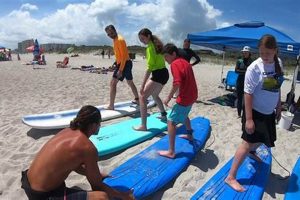
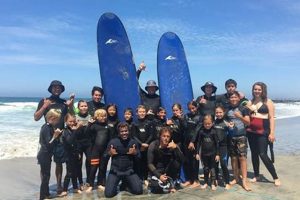
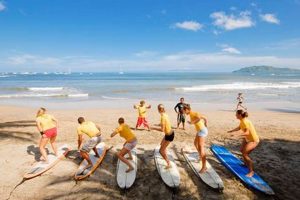
Instruction in wave riding, specifically tailored for the coastal environment of Pacific Beach, involves a structured approach to learning the skills necessary to safely and effectively engage in the sport of surfing. Such instruction often includes foundational knowledge of ocean safety, wave dynamics, board handling, and paddling techniques, alongside practical in-water coaching.
Participation in structured surf education offers multiple advantages, ranging from accelerated skill acquisition and enhanced safety awareness to a greater appreciation for the marine environment. Historically, formalized surf instruction represents a development from informal, peer-based learning, contributing to a more accessible and standardized introduction to the sport.
The following discussion will explore the various aspects of acquiring proficiency in surfing within this specific locale, encompassing the types of instruction available, the environmental factors impacting the learning experience, and the resources accessible to prospective surfers.
Essential Guidance for Surf Education at Pacific Beach
The following recommendations aim to optimize the learning experience for individuals undertaking surf instruction in the Pacific Beach area. Adherence to these guidelines can improve safety, accelerate skill development, and enhance overall enjoyment.
Tip 1: Prioritize Qualified Instruction: Select instructors certified by recognized organizations. Verification of credentials ensures a baseline level of competence and adherence to safety protocols.
Tip 2: Assess Physical Condition: Surfing demands a degree of physical fitness. Engage in preparatory exercises that build core strength, upper body endurance, and leg power to enhance performance and reduce the risk of injury.
Tip 3: Understand Ocean Conditions: Familiarize oneself with tide patterns, swell forecasts, and potential hazards such as rip currents. Monitoring conditions before and during sessions is critical for safe surfing.
Tip 4: Master Fundamental Skills: Focus on mastering basic paddling, pop-up technique, and wave selection before attempting advanced maneuvers. A solid foundation accelerates progression.
Tip 5: Utilize Appropriate Equipment: Employ a surfboard suitable for skill level and wave conditions. Larger boards offer increased stability for beginners, while advanced surfers may opt for smaller, more maneuverable designs.
Tip 6: Practice Surf Etiquette: Adhere to established rules of conduct in the lineup. Respect the right-of-way, avoid dropping in on other surfers, and maintain a safe distance from fellow riders.
Tip 7: Hydrate Adequately: Maintain sufficient hydration levels before, during, and after surf sessions. Dehydration can impair performance and increase susceptibility to heat-related illnesses.
Implementing these recommendations facilitates a safer, more effective, and ultimately more rewarding introduction to the sport of surfing at Pacific Beach. Emphasis on proper training, awareness, and respect for the ocean environment is paramount.
The subsequent sections will delve deeper into specific considerations for maximizing success and enjoyment when learning to surf within this unique coastal setting.
1. Safety Protocols and Surf Education at Pacific Beach

Adherence to established safety protocols constitutes an indispensable component of surf education at Pacific Beach. The inherent risks associated with wave riding, including collisions with other surfers, injuries from the surfboard itself, and potential hazards presented by the ocean environment, necessitate a structured approach to risk mitigation. Failure to implement and rigorously enforce safety protocols during instruction can lead to serious injuries or even fatalities. A documented instance of a student sustaining a severe head injury due to a board collision underscores the critical importance of maintaining adequate spacing between learners and providing comprehensive instruction on fall techniques.
The specific safety protocols employed during surf instruction typically encompass a range of measures, including pre-session briefings on ocean conditions and potential hazards, mandatory use of leashes to prevent board separation, instruction on recognizing and avoiding rip currents, and procedures for responding to emergencies. Furthermore, qualified instructors maintain constant vigilance and provide immediate assistance to students experiencing difficulty in the water. The efficacy of these protocols is demonstrated by the significantly lower incidence of serious injuries among students participating in lessons with certified instructors compared to those learning independently.
In summation, the integration of comprehensive safety protocols into surf education at Pacific Beach is not merely a recommended practice but a fundamental requirement for ensuring the well-being of participants. Prioritizing safety through meticulous planning, thorough instruction, and constant supervision minimizes the potential for adverse events and fosters a more positive and sustainable introduction to the sport of surfing. The ongoing refinement and enforcement of these protocols remain paramount to the continued safety and success of surf instruction within this coastal environment.
2. Instructor Qualifications
The proficiency and safety of surf instruction at Pacific Beach are inextricably linked to the qualifications and expertise of the instructors providing the lessons. The selection of appropriately credentialed instructors represents a critical factor in ensuring a positive and secure learning environment for aspiring surfers.
- Certification and Accreditation
Reputable surf schools at Pacific Beach typically require instructors to hold certifications from recognized surf organizations. These certifications, such as those offered by the International Surfing Association (ISA) or equivalent bodies, validate the instructor’s competence in areas like water safety, rescue techniques, and surf instruction methodology. Holding such credentials assures students that their instructor has met established standards of proficiency and is qualified to deliver safe and effective lessons.
- First Aid and CPR Training
Beyond surf-specific certifications, instructors should possess current certifications in first aid and cardiopulmonary resuscitation (CPR). These qualifications are essential for responding effectively to medical emergencies that may arise during surf lessons, ranging from minor cuts and bruises to more serious incidents like near-drowning. An instructor’s ability to administer immediate medical assistance can be crucial in mitigating the consequences of an accident.
- Local Knowledge and Experience
While formal certifications provide a baseline level of competence, practical experience and local knowledge are equally valuable attributes. Instructors familiar with the specific wave patterns, tidal variations, and potential hazards unique to Pacific Beach can provide students with insights that enhance their understanding of the surf environment and improve their safety awareness. A deep understanding of local conditions enables instructors to tailor their lessons to suit the prevailing environment and minimize risks.
- Communication and Teaching Skills
Effective communication skills are paramount for instructors seeking to convey complex concepts and techniques in a clear and understandable manner. Instructors must be able to adapt their teaching style to accommodate different learning styles and address the individual needs of each student. Patience, empathy, and the ability to provide constructive feedback are all essential qualities for fostering a positive and productive learning environment. The capacity to communicate effectively ensures that students comprehend the principles of surfing and develop the necessary skills to progress safely and confidently.
The convergence of these qualificationscertification, medical training, local knowledge, and communication skillscontributes significantly to the overall quality and safety of surf instruction at Pacific Beach. Prioritizing instructors with these attributes empowers learners to acquire surf skills effectively while mitigating inherent risks associated with the sport. The investment in qualified instruction translates directly into a more rewarding and sustainable surfing experience.
3. Optimal conditions

Optimal conditions are a fundamental determinant of the efficacy and safety of wave-riding instruction within the Pacific Beach environment. Wave height, swell direction, tide levels, and wind patterns exert a direct influence on the learning experience, dictating the suitability of a particular time and location for novice surfers. For example, excessively large waves or strong offshore winds can create hazardous conditions, rendering instruction impractical and potentially dangerous. Conversely, small, gently breaking waves characteristic of certain tide levels are conducive to skill acquisition and confidence building.
The selection of appropriate conditions also minimizes the risk of injury, allowing instructors to focus on technique and safety protocols without the added pressure of managing challenging surf. A real-world example illustrates this point: A surf school scheduling lessons during a period of elevated surf experienced a higher incidence of minor injuries among its students, prompting a revision of their scheduling practices to prioritize sessions during periods of calmer conditions. Furthermore, understanding the influence of these conditions enables instructors to tailor their teaching approach, providing specific guidance on wave selection, paddling strategy, and board control relative to the prevailing environment.
In conclusion, recognizing and leveraging optimal conditions is not merely a matter of convenience but a critical component of effective wave-riding education at Pacific Beach. By carefully assessing wave characteristics, tidal influences, and wind patterns, instructors can create a safer, more productive, and ultimately more rewarding learning experience for their students. Ignoring these factors can increase the risk of injury and hinder skill development, underscoring the practical significance of this understanding within the context of surf instruction.
4. Equipment selection
The selection of appropriate equipment constitutes a crucial element within the framework of surfing lessons at Pacific Beach. The interaction between the student, the instructor, and the ocean is mediated through the surfboard, and its suitability directly impacts learning progression and safety. Using a board of adequate size and stability, tailored to the student’s skill level and physical attributes, facilitates easier paddling, improved balance, and a greater likelihood of successfully catching waves. Conversely, employing equipment that is too advanced or ill-suited can hinder progress, increase frustration, and elevate the risk of accidents. For instance, a beginner attempting to learn on a shortboard designed for experienced surfers will likely struggle to maintain stability and control, leading to a negative and potentially unsafe learning experience.
Surf schools operating at Pacific Beach often maintain a diverse inventory of surfboards to accommodate varying skill levels and body types. Instructors typically assess each student’s capabilities and make recommendations regarding board selection, factoring in parameters such as board length, width, thickness, and fin configuration. Soft-top surfboards, characterized by their foam construction, are frequently utilized for initial instruction due to their increased buoyancy and reduced potential for injury upon impact. As students progress, they may transition to harder epoxy or fiberglass boards, enabling them to execute more advanced maneuvers. Proper wetsuit selection, based on water temperature, is also essential for maintaining comfort and preventing hypothermia, a risk that can significantly detract from the learning experience.
In summary, judicious equipment selection represents a critical component of effective surfing lessons at Pacific Beach. The thoughtful matching of equipment to individual needs and skill levels promotes accelerated learning, enhances safety, and fosters a more positive and rewarding introduction to the sport. A deliberate approach to equipment considerations reflects a commitment to providing high-quality instruction and maximizing the potential for student success.
5. Skill progression

Within the context of surf education at Pacific Beach, skill progression represents a structured advancement through defined stages of competence, moving from fundamental techniques to more complex maneuvers. The effectiveness of instructional programs is directly reflected in the demonstrable progress of learners, as they transition from novice to proficient wave riders.
- Foundational Skills Acquisition
The initial phase of skill progression centers on mastering essential techniques, including paddling proficiency, pop-up execution, and basic wave awareness. This stage typically involves instruction on flat water or gentle waves, emphasizing proper body positioning, balance, and board control. Successful acquisition of these foundational skills provides the necessary building blocks for subsequent progression.
- Wave Selection and Riding Techniques
As learners gain confidence and competence, instruction shifts to identifying and selecting appropriate waves. This involves understanding wave dynamics, recognizing breaking patterns, and positioning oneself effectively to catch and ride waves. Advanced techniques, such as trimming, turning, and navigating different sections of the wave, are introduced to enhance maneuverability and control.
- Maneuver Development and Refinement
Upon mastering basic wave riding skills, the focus shifts to developing and refining more advanced maneuvers, including cutbacks, bottom turns, and floaters. This stage requires a deeper understanding of wave mechanics, board control, and body positioning. Instructors provide guidance on technique refinement, video analysis, and progressive skill-building exercises to facilitate maneuver development.
- Independent Surfing Proficiency
The ultimate goal of skill progression is to achieve independent surfing proficiency, enabling learners to confidently and safely navigate a variety of wave conditions without direct supervision. This involves developing a comprehensive understanding of ocean safety, surf etiquette, and self-assessment skills. Successful completion of this stage signifies the transition from novice to competent and self-sufficient surfer.
These facets of skill progression are directly linked to the quality and effectiveness of surfing lessons at Pacific Beach. Instructional programs that prioritize a structured and progressive approach to skill development are more likely to produce proficient and confident surfers. Conversely, programs lacking a clear progression pathway may result in slower progress, increased frustration, and a higher risk of injury.
6. Ocean awareness
Ocean awareness constitutes an indispensable component of responsible surfing education at Pacific Beach. A lack of understanding regarding ocean dynamics, marine life, and environmental hazards presents a direct threat to the safety and well-being of individuals participating in wave-riding activities. Instruction that neglects to integrate comprehensive ocean awareness training fails to adequately prepare students for the realities of the marine environment, increasing the likelihood of accidents and potentially undermining conservation efforts. A real-world example highlights the significance of ocean awareness: Several novice surfers, unaware of the local rip current patterns, were swept out to sea and required rescue by lifeguards, demonstrating the potentially severe consequences of inadequate training.
The integration of ocean awareness into surfing lessons encompasses several critical aspects. Students must acquire a working knowledge of tide cycles, wave formation, and the identification of hazardous currents. They should also receive instruction on recognizing and avoiding marine life, such as jellyfish or potentially dangerous fish species. Furthermore, responsible surf education includes fostering an appreciation for the marine ecosystem and promoting environmentally conscious behavior, such as minimizing plastic pollution and respecting wildlife habitats. The practical application of this knowledge translates to safer surfing practices, reduced environmental impact, and a greater understanding of the interconnectedness of the marine environment.
In summary, ocean awareness is not merely an ancillary element of surfing lessons at Pacific Beach, but rather a foundational principle that underpins responsible and sustainable participation in the sport. The challenge lies in effectively conveying this information to students in a manner that is both engaging and impactful, ensuring that they develop not only the skills necessary to ride waves but also the knowledge and respect required to interact safely and responsibly with the ocean environment. By prioritizing ocean awareness, surf schools can contribute to the long-term health of the marine ecosystem and promote a culture of stewardship among future generations of surfers.
Frequently Asked Questions
This section addresses common inquiries regarding surf instruction in the Pacific Beach area. Information is presented to clarify expectations and provide practical guidance.
Question 1: What is the typical duration of a surf lesson at Pacific Beach?
The standard duration of a surf lesson at Pacific Beach typically ranges from 90 minutes to two hours. This timeframe generally allows for adequate instruction on basic techniques and supervised practice in the water.
Question 2: What are the age restrictions for participating in surf lessons?
Age restrictions vary among surf schools; however, most programs accept participants from approximately six years of age and older. Individuals under the age of 18 often require parental consent.
Question 3: Is prior swimming experience necessary to take surf lessons?
While not always mandatory, prior swimming experience is highly recommended for individuals undertaking surf lessons. Basic swimming proficiency enhances safety and comfort in the water.
Question 4: What equipment is typically provided during surf lessons?
Surf schools generally provide all necessary equipment, including surfboards, wetsuits, and leashes. Participants are typically responsible for providing their own swimwear and sunscreen.
Question 5: What happens if ocean conditions are unfavorable on the day of a scheduled lesson?
In the event of unfavorable ocean conditions, such as excessively large waves or dangerous currents, surf schools typically offer rescheduling options or refunds. Safety is prioritized over adherence to pre-arranged schedules.
Question 6: What are the cancellation policies for surf lessons?
Cancellation policies vary among surf schools. It is imperative to review and understand the cancellation policy prior to booking a lesson. Advance notice is generally required to avoid cancellation fees.
This FAQ aims to provide clarity on several common points of inquiry regarding surf lessons in Pacific Beach. Prospective participants are encouraged to seek further clarification from individual surf schools as needed.
The following section will address considerations related to selecting a surf school or instructor.
Conclusion
The preceding discussion has outlined the multifaceted considerations inherent in obtaining wave-riding instruction tailored to the Pacific Beach environment. Essential aspects encompass instructor qualifications, safety protocols, equipment selection, optimal conditions, skill progression, and ocean awareness. A deficiency in any of these areas can compromise the effectiveness of the learning experience and potentially elevate risks for participants. The confluence of these factors determines the quality and safety profile of surf instruction within this coastal location.
Prospective students should approach the selection of surf instruction with due diligence, prioritizing programs that emphasize safety, responsible environmental stewardship, and comprehensive skill development. A well-informed approach will contribute to a more rewarding and sustainable engagement with the sport of surfing, while simultaneously promoting respect for the unique coastal ecosystem of Pacific Beach. The pursuit of wave-riding proficiency should be balanced with a commitment to responsible ocean practices.