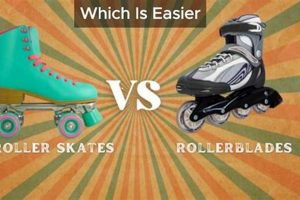
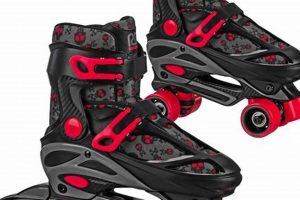
A comparison of wheeled footwear reveals two primary types: inline skates and quad skates. Inline skates feature wheels arranged in a single line, generally offering greater speed and maneuverability. Quad skates, conversely, distribute wheels in two pairs, providing enhanced stability and balance. A person choosing between these options might consider their intended use, skill level, and preferred style.
The selection between the two is influenced by factors such as desired application and individual physical attributes. Inline designs are often favored for fitness, racing, and aggressive skating due to their speed and responsiveness. Quad designs are commonly preferred for recreational skating, roller derby, and artistic skating because of their stability and ease of use. Historically, quad designs predate inline designs, having been developed earlier in the evolution of wheeled skates.
The subsequent discussion will delve into a detailed examination of the distinct features, advantages, and disadvantages associated with each type, further assisting in informed decision-making.
Guidance on Selecting Wheeled Footwear
When choosing between inline and quad designs, careful consideration of individual needs and skating goals is crucial. The following tips provide a framework for making an informed decision.
Tip 1: Assess Intended Use. Determine the primary activity. If fitness, speed, or aggressive maneuvers are the goals, inline skates may be more appropriate. For recreational skating, stability, or roller derby, quad skates could be a better fit.
Tip 2: Evaluate Skill Level. Beginners often find quad skates easier to learn on due to their enhanced stability. Experienced skaters may prefer the increased agility and speed offered by inline skates.
Tip 3: Consider Ankle Support. Inline skates typically offer more rigid ankle support, which can be beneficial for high-impact activities. Quad skates generally provide greater freedom of movement in the ankle.
Tip 4: Examine Wheel Configuration. Inline wheels are arranged in a straight line, contributing to speed and maneuverability. Quad wheels are positioned in pairs, enhancing stability and balance.
Tip 5: Review Braking Systems. Inline designs usually incorporate a heel brake, while quad designs often utilize a toe stop. Each system requires a different technique and may be more suitable for certain skating styles.
Tip 6: Understand Maintenance Requirements. Both types require regular maintenance, including cleaning and lubricating bearings, checking wheel alignment, and replacing worn parts. The specific requirements may vary depending on the design and materials used.
Tip 7: Prioritize Comfort and Fit. Proper fit is essential for both safety and performance. Ensure the skates are snug but not too tight, and that they provide adequate support and cushioning.
Selecting between the two types involves a careful evaluation of intended use, skill level, and personal preferences. By considering these factors, an informed decision can be made.
The subsequent sections will provide a detailed comparison of performance characteristics, maintenance requirements, and suitable applications for each skate type.
1. Wheel arrangement

Wheel arrangement is a foundational characteristic differentiating inline and quad designs. The configuration directly influences balance, maneuverability, and the intended use of the skates. Inline designs position wheels along a single line beneath the boot. This arrangement minimizes contact with the skating surface, resulting in less friction and a greater capacity for speed. The elongated wheelbase also facilitates efficient forward propulsion and sharper turns, making inline designs suited to activities such as speed skating and aggressive skating. Conversely, quad designs distribute wheels in two pairs, one at the front and one at the rear of the boot. This broader base provides inherent stability, reducing the likelihood of tipping or losing balance.
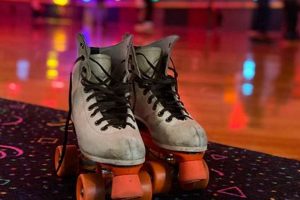
The inherent stability of the quad wheel arrangement makes it a preferred choice for beginners, recreational skaters, and those participating in roller derby. For instance, in roller derby, the ability to quickly change direction and maintain balance while enduring physical contact is paramount. Quad skates facilitate these actions due to their stable platform. The distribution of weight across four points also contributes to improved control during slower speeds and intricate maneuvers. Inline designs, while offering enhanced speed and agility, demand a higher degree of skill and balance control to effectively manage.
Therefore, the selection of the appropriate wheel arrangement depends on the specific skating application and the skill level of the user. Inline designs prioritize speed and maneuverability at the expense of stability, while quad designs prioritize stability and control at the expense of speed. Understanding this trade-off is crucial for making an informed decision. The arrangement dictates the skate’s performance profile, influencing its suitability for various skating disciplines and user demographics.
2. Ankle support
Ankle support constitutes a critical element in distinguishing inline and quad designs, directly affecting stability, control, and injury prevention. The structural design of the boot significantly influences the degree of ankle support provided, which in turn impacts the skater’s ability to execute maneuvers and maintain balance. Inline designs typically feature a high-cut, rigid boot that extends well above the ankle joint, offering substantial lateral and medial support. This design minimizes ankle flexion and extension, reducing the risk of sprains and strains, particularly during high-impact activities or aggressive skating. Conversely, quad designs often incorporate a lower-cut boot, allowing for greater ankle mobility.
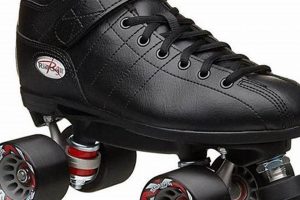
The correlation between ankle support and skate type is evident in various applications. For instance, speed skaters and hockey players, who rely on rapid acceleration and precise movements, frequently utilize inline designs with robust ankle support. The stiff boot ensures efficient power transfer from the leg to the skate, while also preventing excessive ankle pronation or supination, which could compromise performance. Roller derby participants, on the other hand, often favor quad designs with more flexible ankle support. The increased range of motion allows for quicker footwork and more agile maneuvering within the pack. A notable example is the Riedell roller skates, commonly used in roller derby, provide a balance of support and flexibility that allows players to quickly react. Understanding this connection facilitates informed equipment selection based on the skater’s intended use and skill level.
In summary, the degree of ankle support offered by a wheeled skate profoundly impacts its suitability for various activities and skating styles. Inline designs generally prioritize ankle stability and protection, while quad designs prioritize ankle mobility and agility. Choosing the appropriate level of support based on individual needs and skating goals is essential for optimizing performance and minimizing the risk of injury. Failure to consider ankle support can lead to discomfort, decreased control, and an increased susceptibility to ankle-related injuries.
3. Maneuverability
Maneuverability, the ease and precision with which a wheeled skate can change direction and navigate obstacles, constitutes a key differentiating factor between inline and quad designs. The fundamental design differences of each skate type inherently influence its maneuverability characteristics. Inline skates, with their single line of wheels, offer a smaller turning radius and greater responsiveness to directional changes. This allows for sharper turns and more intricate maneuvers, beneficial in applications such as slalom skating and aggressive skating. Quad skates, with their wider wheel base, sacrifice some of this agility for enhanced stability. The turning radius is typically larger, requiring a different technique to execute sharp turns.
The effect of maneuverability on skating style is significant. An aggressive skater using inline skates can execute complex tricks and jumps with greater precision, owing to the skate’s responsiveness. Conversely, a roller derby player using quad skates may prioritize stability and the ability to quickly pivot and block opponents. An example of this trade-off is evident in roller hockey, where the fast-paced nature of the game and the need for quick stops and starts often favor inline skates, while artistic skating, which emphasizes intricate footwork and balance, benefits from the stability of quad skates. Thus, maneuverability dictates the suitability of each skate type for specific skating disciplines.
Understanding the relationship between maneuverability and skate design is critical for selecting the appropriate equipment. The choice depends on the intended use, skill level, and desired performance characteristics. Inline designs prioritize agility, while quad designs prioritize stability. This choice influences both the skater’s experience and their ability to perform specific maneuvers. Failure to appreciate this connection can lead to suboptimal performance or an increased risk of injury. The consideration of maneuverability, alongside other factors such as ankle support and wheel arrangement, leads to a more informed decision.
4. Braking system
The braking system constitutes a fundamental safety component that differentiates inline and quad designs. Each type employs a distinct mechanism that demands specific techniques for effective deceleration. Inline designs commonly utilize a heel brake, a rubber or composite pad positioned at the rear of one or both boots. Activation requires extending the braking leg forward while lowering the heel, applying pressure to the ground. Conversely, quad designs typically incorporate a toe stop, a rubber or composite block located at the front of each boot. Deceleration involves tilting the skate forward, applying pressure to the toe stop to the skating surface. The choice of braking system directly impacts stopping distance, control, and overall safety, influencing the suitability of each skate type for different skating styles and environments.
The selection of a braking system is intertwined with the intended application and the skater’s skill level. For example, inline designs, often favored for speed skating and aggressive skating, benefit from the heel brake’s ability to provide controlled deceleration at higher speeds. The heel brake allows skaters to maintain balance and directional control while reducing speed, crucial for navigating obstacles or preventing collisions. Quad designs, commonly used in roller derby and recreational skating, rely on the toe stop for quick stops and agile maneuvering. The toe stop enables skaters to execute abrupt stops and pivot quickly, essential for navigating tight spaces or reacting to sudden changes in direction. Failure to properly understand the technique required for each braking system can lead to accidents and injuries. For instance, attempting to use a heel brake on quad skates would prove ineffective and potentially hazardous. The implementation of safety training focused on proper braking techniques is, therefore, vital.
In summary, the braking system is a crucial factor to consider when selecting between inline and quad designs. The choice hinges on individual skating style, intended use, and proficiency in utilizing the specific braking mechanism. While heel brakes on inline skates offer controlled deceleration at high speeds, toe stops on quad skates facilitate quick stops and agile maneuvering. The proper understanding and application of the selected braking system directly impact safety and overall skating performance. A well-informed decision, based on a thorough evaluation of braking system characteristics, is paramount.
5. Typical applications
The selection between inline and quad designs is fundamentally determined by intended use. This principle dictates that optimal performance and safety rely on aligning skate characteristics with the specific demands of the skating activity. Consequently, diverse applications necessitate the selection of one design over the other, reflecting a direct cause-and-effect relationship. The inherent design features of each skate type render them suitable for distinct purposes, emphasizing the significance of ‘Typical applications’ as a critical component in differentiating them. For example, the enhanced speed and agility of inline designs make them preferable for competitive speed skating and fitness training, while the stability of quad designs lends itself to artistic skating and roller derby, where balance and maneuverability are paramount.
Practical application examples highlight the necessity of this understanding. Consider the sport of roller hockey, which, due to its fast-paced nature and demands for rapid acceleration and deceleration, predominantly utilizes inline designs. The aggressive skating style enabled by inline skates provides a competitive edge. Contrast this with artistic skating, where the intricate footwork and balance requirements find greater support in the stability of quad designs. Similarly, in a warehouse environment, where employees may utilize skates for efficient order fulfillment, the stability and ease of use offered by quad designs can minimize accidents and enhance productivity. These instances illustrate the practical significance of recognizing the relationship between skate type and application.
In summary, the connection between skate design and application constitutes a crucial determinant in selecting appropriate equipment. The distinct characteristics of inline and quad designs render them suitable for disparate activities. Awareness of these distinctions allows individuals and organizations to make informed decisions, maximizing performance, ensuring safety, and optimizing the utility of wheeled skates. Failing to consider application-specific requirements can lead to suboptimal outcomes, highlighting the importance of aligning skate choice with the intended use. The broader theme emphasizes that a nuanced understanding of wheeled skate design directly informs practical implementation.
Frequently Asked Questions
The following addresses common inquiries regarding the selection and application of wheeled footwear, aiming to provide clarity and informed decision-making.
Question 1: What are the primary performance differences between inline and quad designs?
Inline skates generally offer enhanced speed, maneuverability, and agility due to their single line of wheels. Quad skates prioritize stability, control, and balance due to their broader wheel base. These differences dictate suitability for various skating disciplines.
Question 2: Which type of wheeled skate is recommended for beginners?
Quad skates are typically recommended for beginners due to their greater stability and ease of balancing. This allows new skaters to develop foundational skills with reduced risk of falls.
Question 3: Do braking systems differ between inline and quad designs, and how does this affect safety?
Yes, inline designs generally employ a heel brake, while quad designs typically use a toe stop. Each system requires specific techniques for effective deceleration, and the proper understanding and application of the selected braking system is crucial for safety.
Question 4: Are inline skates better suited for outdoor use compared to quad skates?
Inline skates are often favored for outdoor use on smooth surfaces due to their speed and efficiency. However, the larger wheels and wider wheel base of some quad designs can provide greater stability on uneven terrain.
Question 5: What are the primary applications for which inline and quad skates are specifically designed?
Inline skates are frequently used for fitness skating, speed skating, and aggressive skating. Quad skates find common applications in artistic skating, roller derby, and recreational skating.
Question 6: How does ankle support differ between inline and quad designs, and what impact does this have?
Inline skates generally offer more rigid ankle support, beneficial for high-impact activities. Quad skates typically provide greater ankle mobility, suitable for activities requiring agile footwork. The correct level of support enhances control and minimizes injury risk.
The selection of appropriate wheeled footwear demands careful consideration of individual needs, skill level, and intended use. Prioritizing these factors ensures a safe and enjoyable skating experience.
The subsequent section will explore advanced techniques and maintenance procedures for both inline and quad designs.
Conclusion
The preceding analysis has delineated the fundamental differences between inline and quad wheeled skates. Considerations involving wheel arrangement, ankle support, maneuverability, braking systems, and typical applications reveal distinct performance characteristics inherent to each design. Selection of the appropriate skate requires a thorough evaluation of intended use, skill level, and specific performance requirements.
Ultimately, informed decision-making regarding the selection of “rollerblades vs roller skates” is paramount for ensuring safety, optimizing performance, and maximizing the utility of wheeled footwear across a spectrum of applications. Continued adherence to safety guidelines and proper maintenance practices are crucial for long-term enjoyment and injury prevention. Further research and development in wheeled skate technology may introduce future design enhancements.